



 Sustainability Scoop
The Back-to-School Wardrobe Audit: A Smarter Checklist That Starts With What Your Kids Already Have
Before you spend a dollar on back-to-school clothes, do this first.
But here’s the thing most families discover only after they’ve already spent the money: the closet was more full than they realized. The drawer had six t-shirts. The bin under the bed had a perfectly good raincoat. And now there’s a new pile of clothes sitting on top of the old pile, and the whole system is just a little more overwhelming than it was before.
According to a 2026 consumer survey by PwC, US parents are projected to spend an average of $278 per household on back-to-school clothing and shoes this year alone — part of an overall back-to-school budget that’s approaching nearly $1,000 per family. A significant portion of that spending goes toward things kids don’t need, won’t wear, or already own in a slightly different form. And still, most parents report finishing the shop feeling like something is still missing.
The smarter move — the one that actually solves the problem — doesn’t start at a store. It starts at the closet. This blog is your complete guide to doing a back-to-school wardrobe audit: a clear, repeatable system that tells you exactly what your child already has, what no longer fits, what genuinely needs replacing, and what to shop for preloved first. Prelove You exists precisely for this seasonal moment — the one where everything shifts at once — and this is the playbook they wish every family had before the season began.
There’s a reason back-to-school shopping is one of the most stressful retail events of the year for parents — and it’s not the price tags. It’s the sheer cognitive load of trying to assess an entire wardrobe’s worth of items for a child who may have grown two sizes since you last paid attention, for a season that hasn’t started yet, while also managing every other thing that a new school year demands.
Children outgrow clothing faster than any other category of household spending. This is especially true around school age, when growth spurts arrive in unpredictable waves and clothing gets worn with an intensity that adults don’t inflict on their own wardrobes. A pair of trousers that fit perfectly in May might be awkward by August. A hoodie that was roomy in spring might suddenly be too short in the torso. The pace of change is relentless, and parents are constantly playing catch-up without a reliable system to help them do it.
Compounding this is the invisible labor involved. Figuring out what fits, what’s been stained, what needs replacing, what size comes next, what the school dress code actually requires — this is mental load work, and it falls disproportionately on one parent, almost always the mother. It’s the kind of thinking that happens in the background of every other task: at 11pm when you’re scrolling, in the parking lot before school pickup, while making dinner and suddenly realizing your kid hasn’t worn that hoodie since February. It is invisible, constant, and exhausting.
And so the reflex to just buy new makes complete sense. It feels like a solution. It feels decisive and efficient — like you’ve handled the problem rather than sat with the discomfort of not knowing. But buying new without auditing first is the single most reliable way to end up with duplicate purchases, overstuffed drawers, and a child who still doesn’t have what they actually need for school.
Deloitte’s 2025 back-to-school survey found something telling: clothing remains the highest-growth spending category for back-to-school families, with parents projecting a 6% increase in clothing spend compared to the previous year — the only category trending upward. And yet most parents still finish the season feeling like something wasn’t quite right. Like the pile of new purchases didn’t quite solve the problem they were trying to solve. Like they spent money they didn’t mean to spend, on things that didn’t land quite the way they hoped.
This isn’t a spending problem. It’s a system problem. More specifically, it’s the absence of a system that starts before the shopping — one that tells you what you have, what you need, and what you can let go. The household clothing cycle keeps breaking precisely because families keep skipping this step, year after year, and the chaos accumulates.
The good news is that the fix is simpler than it sounds. It starts with opening the closet before opening your wallet.
If there is one habit shift that separates families who feel in control of their children’s wardrobes from families who feel perpetually behind, it is this: audit before you shop. Every single time.
The audit is not extra work. It is the move that eliminates unnecessary work for every season that follows. When you know exactly what you have, you cannot accidentally buy a duplicate. You cannot waste money on something that wasn’t needed. You cannot walk away from a shopping trip feeling like you missed something — because you already know what’s missing, specifically, before you start.
Most families skip straight to the store. They walk the aisles with a vague mental inventory — I think he has enough t-shirts, but I’m not sure about trousers, and definitely needs new shoes — and end up making purchasing decisions based on uncertainty rather than knowledge. The result is predictable: overspending on some things, missing others entirely, and returning home to a closet that is simultaneously overfull and incomplete.
The audit changes the equation. It reveals exactly three things that matter: what your child currently has that still fits and is in wearable condition, what has been outgrown, and — most usefully — the actual gaps. The specific pieces that are genuinely missing from the wardrobe. Not a general sense that “she probably needs some new things,” but a concrete list: one pair of trousers in good condition, zero long-sleeved shirts in her current size, no fall-weight jacket. That list transforms back-to-school shopping from a reactive, overwhelming experience into something intentional and satisfying.
There’s also an emotional dimension to the audit that shouldn’t be overlooked. Pulling everything out and going through it piece by piece is a moment of acknowledgment. These are the clothes your child actually lived in this past year. The t-shirt from the school trip. The leggings worn so often they became the default. The jacket that made it into every photograph. Taking a few minutes to see them — really see them — before deciding their fate is a different experience than shoving them into a bin bag and not looking too closely.
Timing matters too. The ideal window for a back-to-school wardrobe audit is three to four weeks before school starts. That gives you enough time to identify gaps, shop for them thoughtfully — preloved first — and have everything ready before the first day. For most families in 2026, that window is right now. If you’re reading this in late July, you are exactly on time. This is how smarter children’s wardrobes get built — not by shopping better, but by starting earlier and starting smarter.
“The audit is not extra work. It’s the move that eliminates unnecessary work for every season that follows.”
For eco-conscious families, there’s an additional reason the audit-first approach matters: it is one of the most effective ways to make back-to-school shopping more sustainable. When you know exactly what’s needed, you buy less of what isn’t — and every item that doesn’t get purchased unnecessarily is a small but real reduction in the environmental cost of clothing your child.
This is the back-to-school wardrobe checklist you came for. Follow it in order. Don’t skip steps. It takes most families about 45 minutes for one child, and it will save you hours of confusion, duplicate shopping, and post-purchase regret.
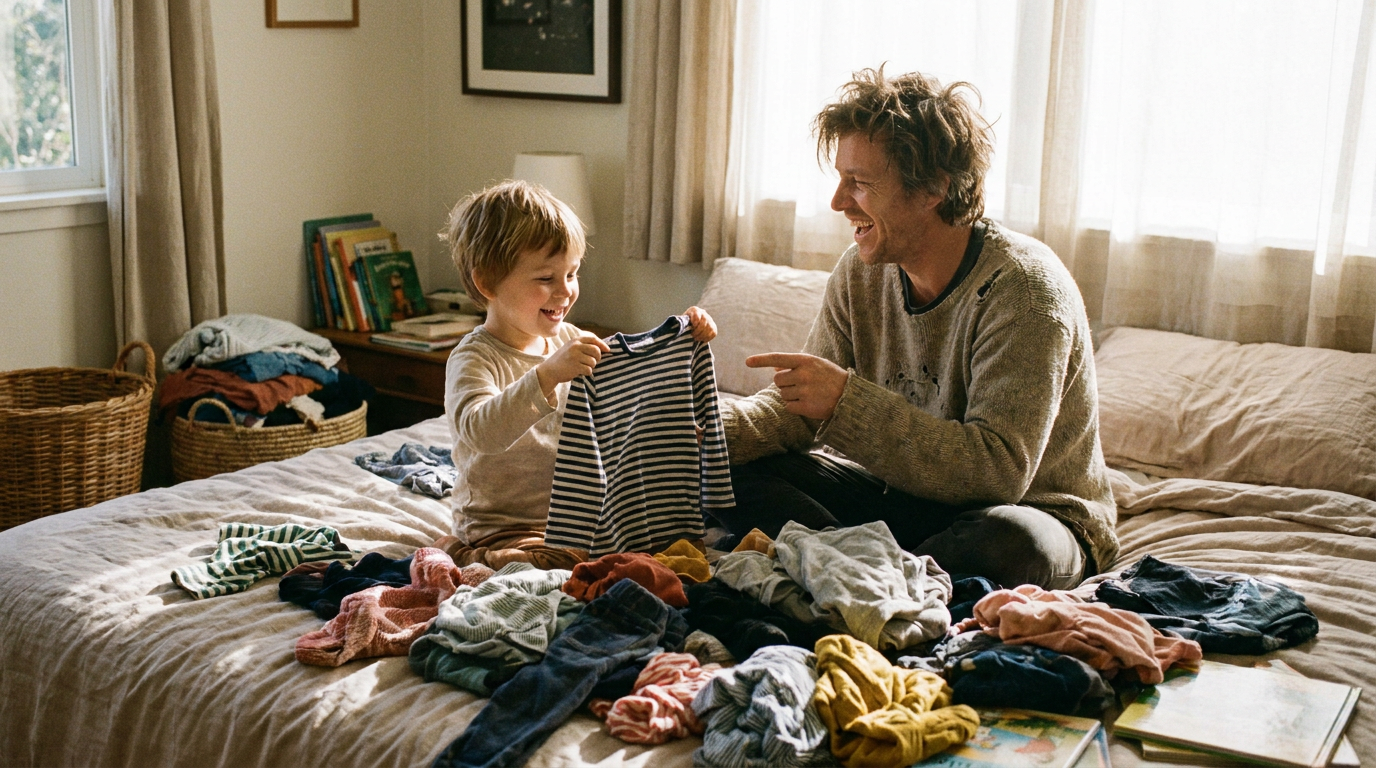
Do not audit in the drawer. Do not assess from the doorway of the closet. Pull everything out — every item from the closet rail, every folded piece from the dresser, every item from under the bed, from the mudroom hooks, from the seasonal bins, from the gym bag in the corner that hasn’t been opened since June. If it’s clothing your child might wear to school, it needs to be on the bed or the floor where you can actually see it.
This step feels chaotic, and it is meant to. The controlled chaos of everything being visible at once is precisely the point. Most parents dramatically underestimate how much their child owns simply because it’s distributed across too many locations to hold a complete mental picture. Pulling it all out creates that picture for the first time. You will almost certainly be surprised by what you find — both the abundance and the gaps.
Before you assess condition, assess fit. For every item you’re uncertain about, have your child try it on. This is non-negotiable. Parents consistently misjudge fit from a visual inspection alone, especially with children who have had a recent growth spurt. The rule of thumb is simple:
When in doubt, trust the body over the child’s opinion. A child who loves a particular item will almost always say it still fits. Check for yourself.
Once you’ve confirmed an item still fits, assess its condition honestly. Ask yourself one question: Would I send my child to school in this tomorrow? If the answer is yes, it makes the keep pile. If the answer is anything less than yes, it doesn’t.
Look specifically for:
Be honest and be unsentimental. A stained t-shirt that “might come out” has probably already proven it won’t. A pair of leggings with a worn-through knee is not a school legging. It is a park legging, or it is a piece that needs to be moved on. Clarity here saves confusion later.
Once everything is pulled out and individual items have been assessed for fit and condition, sort what remains into categories and count. Here is your complete category checklist for a school-age wardrobe audit:
Tops
Bottoms
Outerwear
Footwear
Uniforms (if applicable)
Activewear and PE Kit
Accessories
For each category, write down two numbers: how many items you currently have in the keep pile, and how many of those are in genuinely good condition. The second number is your functional wardrobe count — and it is almost always lower than the first.
As a loose baseline (not a rigid rule): most school-age children function well with 5–7 tops, 3–5 bottoms, one reliable everyday shoe, one smarter or occasion shoe, one lightweight jacket, and one heavier coat. PE kit is typically separate and needs its own count. Uniforms follow whatever the school specifies.
The gap between what you have and what you need is your real back-to-school shopping list. And it is almost certainly shorter, and more specific, than whatever you would have bought if you’d walked straight into a store.
Once the audit becomes an annual habit, it connects naturally to a full seasonal wardrobe system — one that keeps the household clothing cycle from ever breaking down again. But first, the audit results need to be sorted.
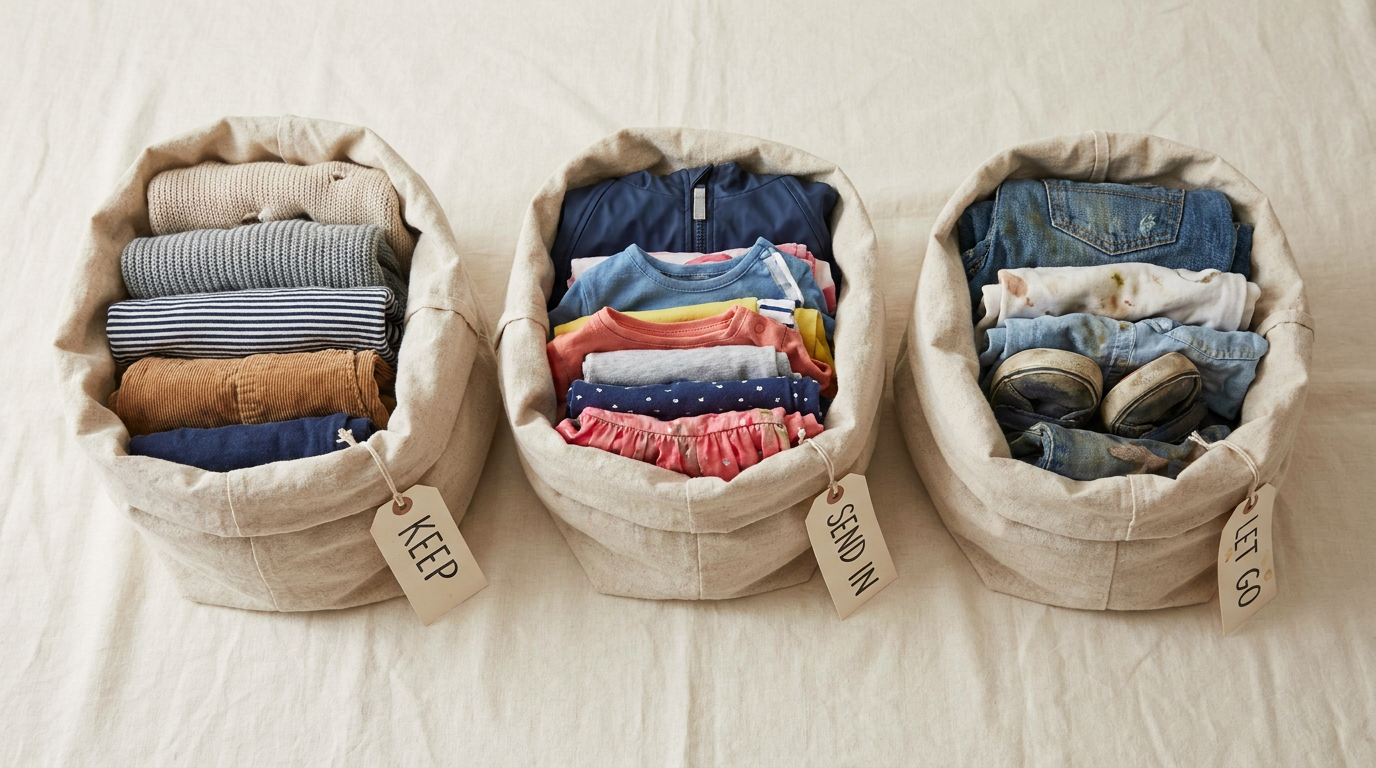
The audit is done. Everything is on the bed. Now comes the part that most parents find either oddly satisfying or quietly emotional — sometimes both. The sort. Every item in front of you belongs in one of three places, and once you know which place is which, the decision becomes simple.
This pile is straightforward. An item belongs here if it fits, is in genuinely wearable condition, and has a clear, specific role in your child’s fall wardrobe. Not a vague “maybe,” not a “probably fine for at home” — a confident yes. These pieces go back into the closet, organized by category, ready for the school year to begin. There should be no guilt about this pile and no second-guessing. These are the items doing exactly what clothing is meant to do.
This is the pile that most parents have always needed a destination for, and never quite had one. These are the items that have been outgrown — items that still have real life in them, that are in good condition, that another child would genuinely wear and love — but that simply don’t belong in this closet anymore.
In the old model, these pieces went into a bag in the basement, or a box in the trunk, or a donation pile that never quite made it to the charity shop. They sat in a kind of limbo: too good to throw away, not quite dealt with enough to be gone. They accumulated guilt and took up space.
Prelove You’s send-in system changes that entirely. Members send in their outgrown pieces, earn credits, and use those credits to shop for what comes next — the very items they just identified as missing in the audit. It is a closed loop. The pieces that leave your closet fund the pieces that enter it. The value stays in the system rather than disappearing into a donation bin and never being accounted for again.
Here is the piece of this system that most parents don’t expect, and that removes the final remaining reason to avoid sorting.
The stained ones. The worn-through ones. The ones with the fraying cuffs and the faded knees that you’ve been holding onto because you genuinely don’t know what to do with them and you can’t bring yourself to put them in the bin. These also go to Prelove You — in the same bag as the second pile.
PLY accepts end-of-life pieces and routes them responsibly through textile recycling partners, ensuring nothing ends up in landfill. Parents don’t need to sort them separately, or research recycling programs, or make one more decision about whether something is “good enough” to donate. They don’t need to feel guilty about the worn-out things. They just go in the bag. PLY handles the rest.
This matters emotionally as much as logistically. It removes the last blocker. There is no longer any reason to let the outgrown pieces sit — because everything has somewhere to go, and none of it needs to disappear into a bin.
For parents who find the letting-go part genuinely difficult — the ones who still have the tiny first-day-of-school outfit folded at the back of a drawer — this one is for you. The feelings are real. The system respects them. You can acknowledge what those pieces meant and still let them move on.
“The pieces you’re holding onto? The ones with the grass stains and the frayed cuffs? They don’t have to go in the trash. They just have to go somewhere better. Send them in. We’ll handle the rest.”
— Prelove You
If you’re new to how the send-in and credit system works from end to end, How PLY Works has everything you need before you get started.
With the closet sorted and the piles clear, you now have something that most parents have never had before a back-to-school shop: a precise, honest, category-specific list of what’s actually missing. That changes everything about what comes next.
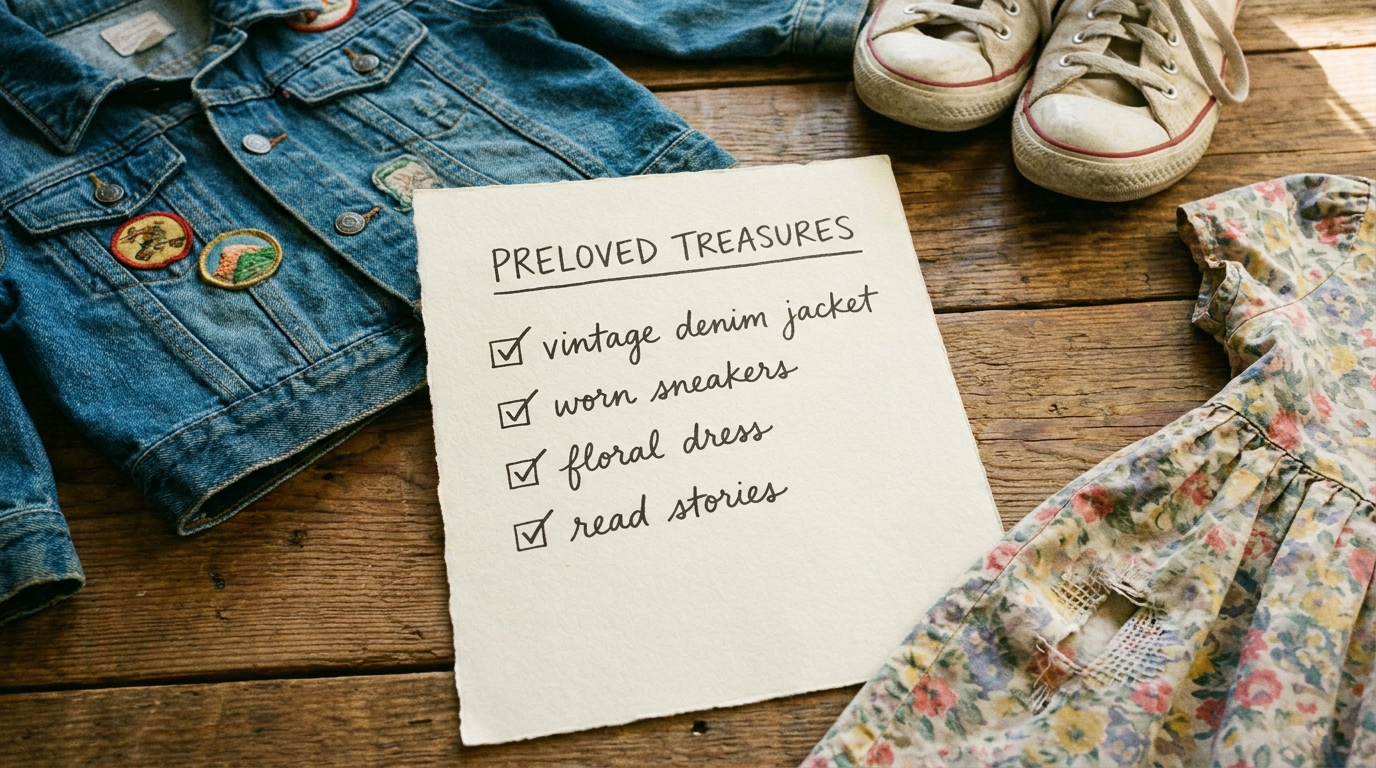
Here is where the back-to-school wardrobe checklist pays off in the most tangible way. After a proper audit and sort, most families discover something surprising: they need fewer new items than they thought. Fewer, but more specific. Not “some new things for school” — but rather: one waterproof jacket in size 8, two long-sleeve tops, a pair of school shoes, and PE trainers. That specificity is everything.
Generic back-to-school shopping lists — the kind that circulate every August and tell you to buy “5 bottoms, 7 tops, 2 pairs of shoes” — are not wrong, exactly. They’re just not yours. They don’t account for the three pairs of perfectly good leggings your daughter already has, or the two long-sleeve tops hiding in the seasonal bin you almost forgot to check, or the fact that your son’s school has a uniform so half the list is irrelevant. Your audit results are your list. Everything else is noise.
There are patterns in what families consistently discover they’re missing after a proper audit. If you’re not sure what to look for in your own tally, these are the categories where gaps most reliably appear:
Before buying anything new, shop preloved. This is not a compromise — it is the smarter first move. The quality is genuinely there. The price is better. The environmental cost is lower. And for the categories that matter most at back-to-school time, Prelove You carries new arrivals in kids’ sizes across every category you’ll need.
When building your preloved shopping priority list, lead with the items that hold their quality longest and benefit most from being bought second-hand:
If you’ve been operating with a “new outfit first, preloved as fallback” mentality, it might be worth reconsidering that order. There are compelling reasons to rethink the ‘new outfit’ default entirely — and the quality available through PLY makes preloved the obvious first stop, not the last resort. For more on how PLY already carries the specific pieces families need each season, The Summer Capsule is a useful companion read.
Once the shopping list is built and the preloved shop is done, there is one more dimension to the back-to-school audit that most guides overlook entirely — and it might be the most important one.
Most back-to-school clothing conversations happen about children, not with them. Parents assess, decide, purchase, and present — and kids receive. It’s efficient. But it misses something important.
Children who participate in sorting through their own clothing develop a different relationship with what they own. They begin to understand that things have value — not just price-tag value, but use-value, lifecycle-value. They learn, in a quiet and practical way, that things don’t just appear and disappear. They come from somewhere. They go somewhere. And what you choose to keep, what you choose to let go, and what you choose to bring in next — those choices matter.
The audit is a natural, low-pressure moment to ask your child the questions that reveal more than you’d expect: What did you love wearing this year? What felt good? What did you reach for again and again — and why? What did you never wear? Children are surprisingly insightful about this. A six-year-old who knows exactly which top she wore on the day she lost her first tooth is already developing a relationship with clothing that goes beyond passivity. A nine-year-old who can name the three things he wore every single week and explain why — that’s self-awareness about style, comfort, and identity forming in real time.
The PLY credit system turns this awareness into something tangible and empowering. When a child’s outgrown pieces are sent in, they earn credits that can be used to shop for what comes next. That is real, concrete agency. It is not an allowance. It is not charity. It is a value loop they can see and understand: the jacket I outgrew has value, that value becomes credits, those credits let me choose what comes next. It closes the loop in a way that builds genuine comprehension of how resources move through the world.
For parents wondering about the right age and approach to bring kids into wardrobe decisions, this age-by-age guide is a thoughtful starting point. And for families who want to go deeper on how the credit system specifically shapes a child’s sense of ownership and agency, this piece on why letting kids “earn” their new clothes changes everything is worth a read.
“When your kid understands that the jacket they outgrew helped them choose what comes next — that’s not just a clothing system. That’s a lesson in how things move through the world, and what their choices are worth.”
— Prelove You
Involving your children doesn’t complicate the audit. It deepens it. And it turns a seasonal household chore into a moment of connection, clarity, and real learning — one that pays dividends far beyond the school wardrobe.
With the audit complete, the piles sorted, the kids involved, and the shopping list built, there is one final step that separates families who do this once from families who make it work every single year.
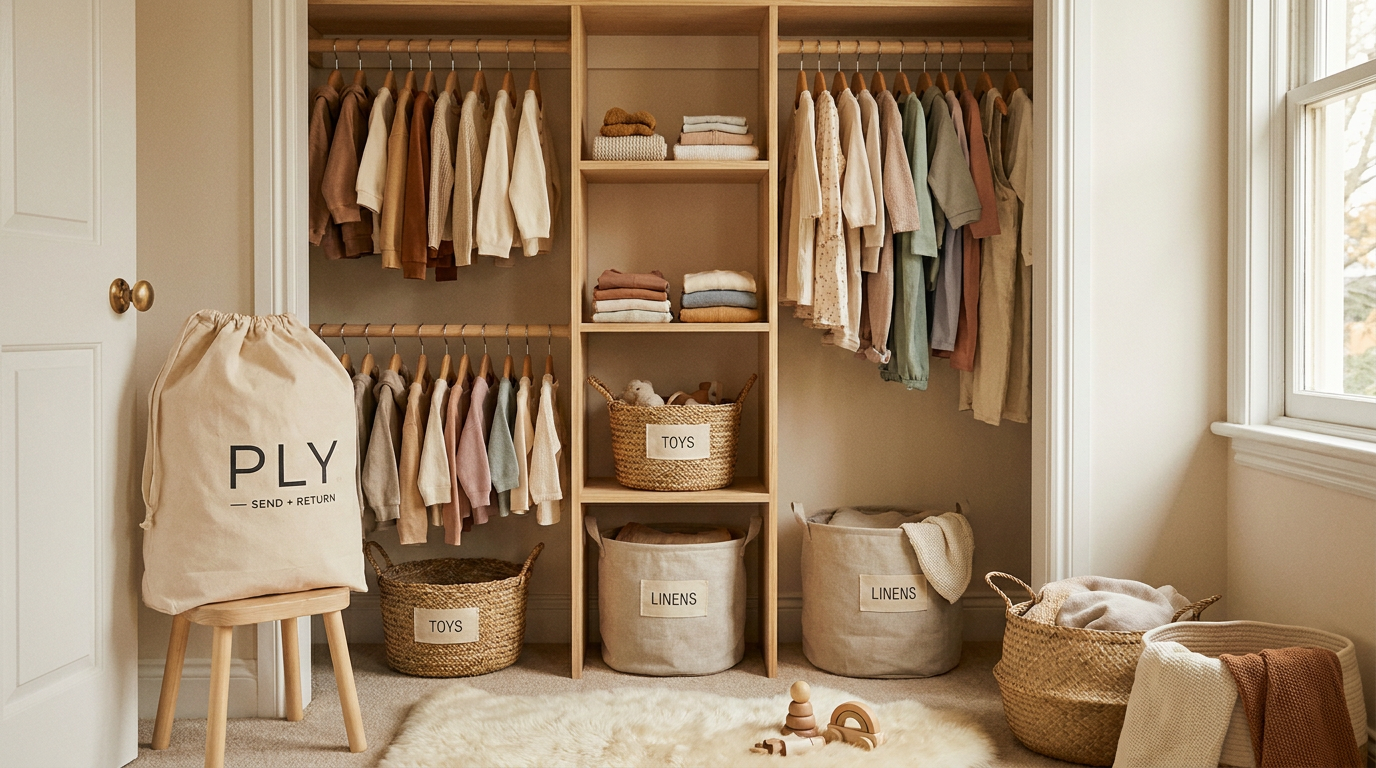
One audit is useful. It saves money, reduces overwhelm, and gives you a cleaner start to the school year. But a system that repeats — season after season, year after year — is transformative. It turns what felt like an annual crisis into a manageable, even satisfying, household rhythm.
This is exactly what the Prelove You membership model is built for. The structure is simple: at the start of each season, send in the pieces that have been outgrown. Earn credits. Use those credits to shop for what comes next. The audit becomes the annual trigger that keeps the system moving. The bag in the trunk gets filled on purpose, sent with intention, and replaced by a shopping list that actually makes sense. Nothing sits in limbo. Nothing accumulates guilt. The cycle moves forward cleanly.
The “bag in the trunk” problem — the one where outgrown pieces sit in your car for three months because you never quite get around to dropping them at the charity shop — is solved by having a destination that comes to you, not one you have to drive to. PLY’s send-in model removes the friction that causes the system to stall. And PLY’s textile recycling partnership means that even the pieces that aren’t suitable for resale have a responsible next chapter. Nothing goes to landfill. Nothing requires a difficult judgment call. Everything moves.
For families ready to become a Prelove You member, the membership tiers are designed to meet families where they are. The Lite tier ($35/month) suits families with one child or a more relaxed send-in pace. Luxe ($65/month) works well for families with multiple kids or a higher volume of seasonal transitions. Limitless ($95/month) is built for families who want maximum flexibility across every season. Think of it as: choose the level that fits your family’s pace, not a fixed idea of what a “perfect” system looks like.
The back-to-school audit is the ideal entry point into membership — both for families who are new to PLY and for existing members who are deepening an established habit. It is a natural moment of transition, a high-motivation window when the desire to get organized is at its peak. Use that energy. Let it become a system, not just a one-time clear-out. For context on why the household clothing cycle keeps breaking without this kind of infrastructure, and how to fix it for good, that piece closes the loop on everything introduced here. And if you’re looking for more practical back-to-school momentum, Prelove Lab’s Back-to-School Hacks is a companion resource worth bookmarking alongside this guide.

The back-to-school wardrobe audit is not a chore. It is a reset — one that saves money, removes the weight of not knowing, and creates the conditions for a household clothing system that actually works. The pieces sitting in your child’s closet right now are telling you something. The audit is how you listen. What’s outgrown doesn’t have to disappear into a bag in the basement or a bin at the end of the driveway. It can become credits, new pieces, and a cycle that keeps moving with intention.
Clothing is the thread. Follow it.
Prelove You gives your family a smarter, more beautiful way to manage the constant cycle of children’s outgrown clothing — season after season. No sorting into “good enough” and “not good enough.” No guilt about the worn-out pieces. Just a system that moves.
Already a member? Your credits are waiting.
Shop New Arrivals
New to Prelove You? See exactly how it works — from the first send-in bag to the credits you’ll use to shop what comes next.
How PLY Works

