



 Sustainability Scoop
A Letter to Parents on National Parents’ Day: You’re Already Doing More Than You Know
You’ve moved it three times — from the hook by the door to the top shelf, from the top shelf to the bag on the floor, from the bag on the floor back to a hanger because you couldn’t quite bring yourself to close the zipper on it for good. It’s a small thing. Quilted, maybe. A little worn at the elbows. The kind of jacket that got worn every single day for one entire season, requested loudly every morning, and is now two sizes too small for a child who no longer remembers wearing it.
You remember, though.
That’s the thing nobody mentions — the way parenthood accumulates in fabric. In zippers that stick. In pockets still holding a smoothed-over stone or a crumbled receipt from a place you went together on a Tuesday that felt ordinary at the time. You didn’t know you were making a memory. You were just trying to get out the door.
It’s 11pm now. The kids are asleep. You’re running through tomorrow’s list in your head — who needs what, which bag needs which thing, whether the shoes still fit or whether you need to deal with that this weekend. The jacket is still there. The bag is still on the floor. And somewhere between the logistics and the love, you are doing something extraordinary that almost no one is naming.
This is not a listicle. It is not a roundup of parenting hacks or a guide to getting it all together. National Parents’ Day is observed every fourth Sunday in July — this year, that’s July 26th, 2026 — and we wanted to mark it differently. Not with a trophy. Not with a greeting card. With something closer to the truth.
This letter is for you.
Most people have never heard of National Parents’ Day. That’s not a criticism — it’s a fact worth sitting with. Unlike Mother’s Day and Father’s Day, which each come with their own gifting infrastructure, their own flower aisle and restaurant rush and socially enforced rituals, National Parents’ Day arrives quietly on the fourth Sunday of July and leaves the same way. There is no standardized card for it. No designated brunch. Most families let it pass without a word.
That absence is telling.
National Parents’ Day was recognized by a Congressional Resolution signed by President Bill Clinton in 1994, establishing the fourth Sunday of July as a permanent annual observance. The intent was deliberate and distinct: unlike the two holidays that honor parents individually by gender, this one was designed to celebrate the collective act of parenting. Both parents. All family structures. Single parents and co-parents and grandparents raising grandchildren. The full, pluralistic weight of what it means to raise another human being.
The fact that this holiday has never developed the cultural gravity of the others isn’t a failure of the calendar. It reflects something real about how society treats parenting as a whole — specifically, the part of parenting that doesn’t belong to either individual parent but to the shared, invisible labor between them. It’s the part that doesn’t have a spokesperson or a hashtag. It’s the part that just gets done, or doesn’t, and either way nobody is handing out awards.
What National Parents’ Day is really asking — underneath the official proclamation and the fourth-Sunday placement — is a simple, radical question: what if we actually stopped to look?
Not to celebrate in a performative way. Not to post about it. Just to look, with honesty and care, at what parenting actually is. What it costs. What it requires. What it produces, not just in children, but in the people doing the raising.
And when you look — really look — you start to see the clothing.
This might seem like a small detail. But clothing is one of the most constant, tactile, time-stamped expressions of parenting that exists. Every outfit chosen, every size tracked, every morning spent hunting for the one specific shirt that has to be that shirt — it is all an act of care. Every bag of outgrown clothes sorted through, every piece wrestled into or out of a donation pile or a resale stack or a box under the bed — that is labor. Real labor, performed by real people, on top of everything else they are already holding.
The holiday asks us to notice. We’re going to try.
Here is something that is true and rarely said plainly: the mental load of parenting is not evenly distributed. And the portion that falls to the primary caregiver — most often, though not exclusively, the mother — is staggering in its scope and almost entirely invisible in its execution.
The mental load is the cognitive and emotional labor of running a household that never appears on a to-do list because it lives entirely in someone’s head. It is the part of family management that doesn’t get assigned, tracked, or thanked. It is knowing which permission slip is due when, which child is going through a phase that requires a softer tone at bedtime, which pair of shoes has been outgrown and needs to be replaced before the next school photo. It is anticipation as a full-time job, running underneath every other full-time job a parent already has.
Mothers handle approximately 71% of household mental load tasks — including planning, scheduling, anticipating, and organizing — while fathers manage approximately 45%. This gap doesn’t close when income equalizes. It doesn’t close when both partners work full-time. It persists across education levels, income brackets, and relationship structures with a consistency that researchers describe as structural, not incidental. This is not a character flaw in any individual household. It is a pattern so deeply embedded in how domestic life is organized that most people experiencing it have never had words for it.
According to a recent study, 75% of mothers reported that their household labor goes completely unnoticed by the people around them — including their partners. Three quarters of the people doing the invisible work are doing it without acknowledgment, without recognition, without even the small relief of having someone say: I see what you’re carrying.
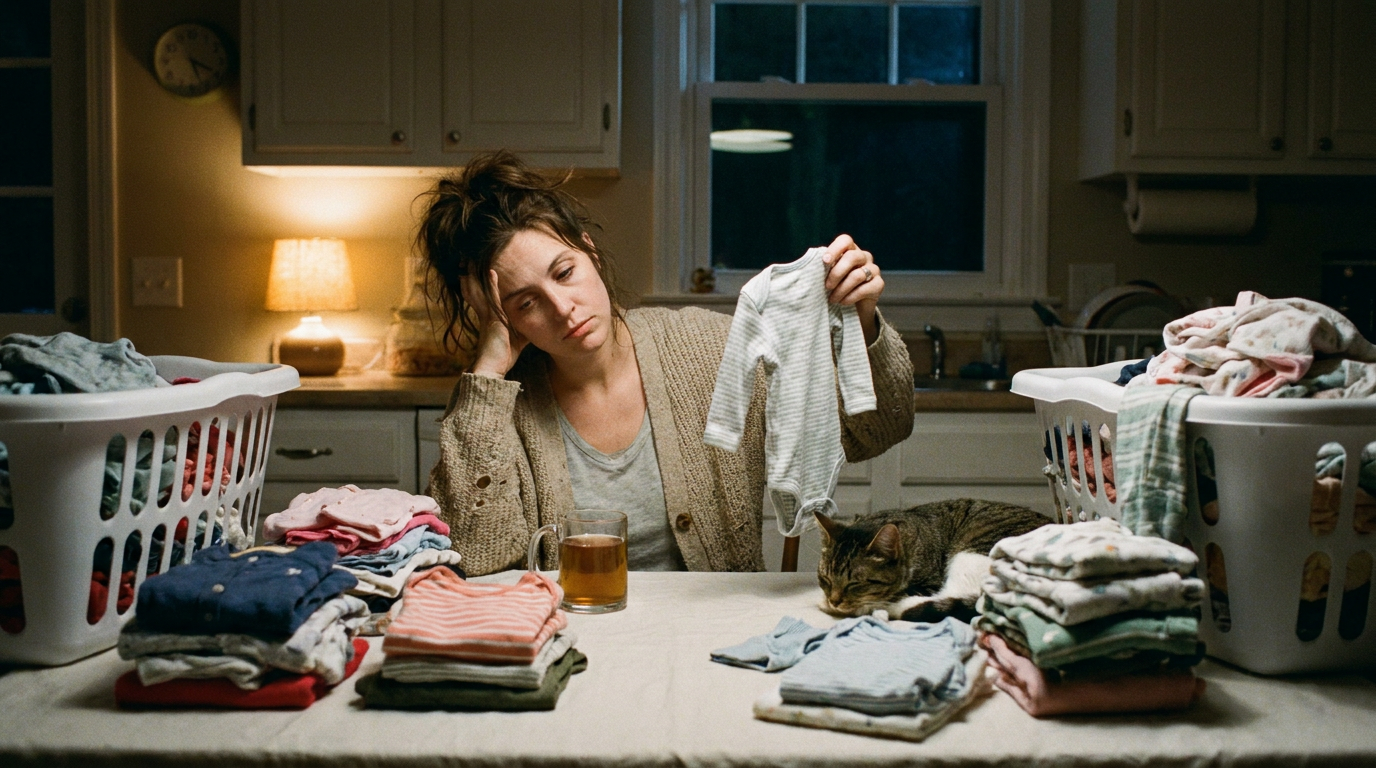
And for working parents, the boundary between work and family is consistently blurred in ways that make the mental load even harder to set down. The workday ends on paper. The parenting cognitive load never does. It follows you into meetings, into the shower, into the six minutes you were supposed to spend doing nothing. There is no clocking out from knowing that the next size up is going to be needed soon, or that the costume for the school play needs to be sourced by Thursday, or that the jacket in the closet is two sizes too small and something needs to be done about it.
Narrow the lens further, and the clothing dimension of the mental load is its own chapter entirely. It includes tracking what fits across multiple children at different rates of growth. It includes knowing what’s stained beyond recovery and what might survive one more wash. It includes the mental negotiation of what to do with the pile — donate it, sell it, keep it, feel guilty about it either way. It includes the grief, small and real, of watching a child grow out of every piece you chose with care.
This isn’t a complaint. It’s an accounting. And it matters, because acknowledgment is where relief begins.
The Mental Load Is Real — Even When No One Sees It
“You’re not imagining it. The tracking, the sorting, the guilt about what to do with the pile — that’s labor. It counts. Even when no one else is counting.”
The load doesn’t go away when someone finally names it. But something shifts. And that shift — from invisible to seen — is the first real form of relief available to a parent who has been carrying something alone for a very long time.
From the labor of managing clothing, there’s a deeper layer worth naming: why this particular category of things is so hard to let go of, and why that difficulty isn’t a flaw in your wiring.
Children’s clothing is not just fabric. It never really was.
It is time-stamped in a way that almost nothing else in a household is. The onesie from the hospital, washed so many times it went translucent. The dress worn on the first birthday, carefully preserved in a bag that you haven’t opened but cannot bring yourself to fold into a donation box. The shirt they asked to wear every single day for three months straight — the one with the small dinosaur print that faded from too many washes — until one day they just stopped asking and you realized it no longer fit anyway. You didn’t mark the last time they wore it. You didn’t know it was the last time.
That’s the particular ache of it. You never know the last time is the last time until it has already passed.
The way we form emotional attachments to objects is deeply rooted in psychology. What we experience as attachment to a garment is almost never really about the garment. It’s about the moment the garment holds — the weight of a specific afternoon, the sound of a specific laugh, the version of your child that existed in that size and won’t exist again. The object is just the container. The feeling is yours.
Child psychoanalyst Donald Winnicott introduced the concept of the transitional object — the beloved blanket, the worn stuffed animal — as a way of understanding how children use objects to navigate the gap between their inner world and the external one, particularly during periods of change. Parents experience a version of this in reverse. The outgrown jacket becomes a transitional object not for the child, who has already moved on, but for the parent, who is still processing the passage. Holding it means holding the stage. Letting go of it means admitting, physically, that the stage is over.
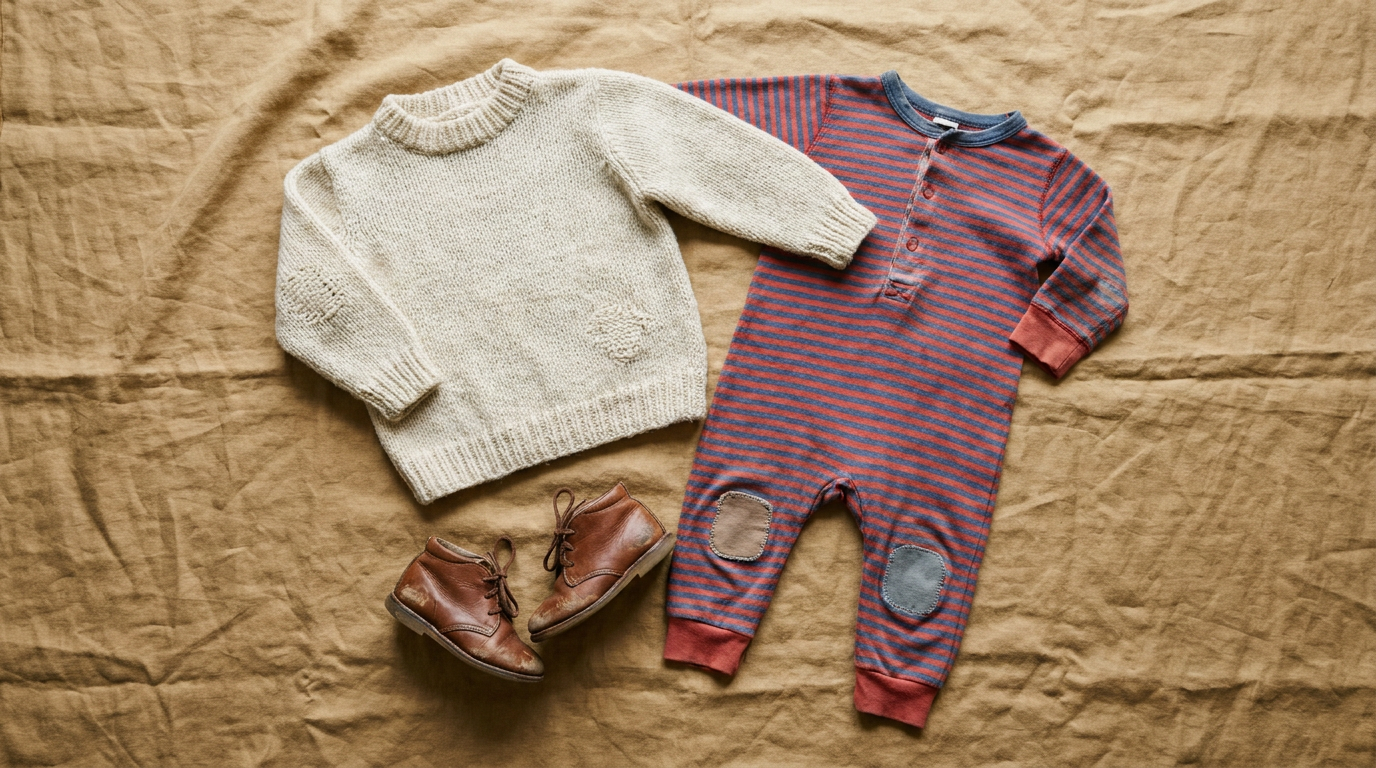
This is not hoarding. It is not disorganization. It is love in a physical form, and it deserves to be named as such rather than treated as a decluttering problem to be solved with a bin bag and a firm afternoon.
As we’ve written before — you probably can’t throw away that tiny first-day-of-school outfit, and there are real, human reasons why. The backpack that was almost as big as the child wearing it. The shoes they picked out themselves because they wanted the ones with the light-up soles. The top that was new and clean and optimistic on that particular morning. These are not just clothes. They are evidence that something happened, that a child grew, that you were there for it.
The Prelove You philosophy begins here: with the truth that clothing holds memory, identity, and the story of a child’s growth. That story doesn’t end when the size no longer fits. The thread continues — it just needs somewhere to go.
And for many parents, the question of where it goes becomes its own source of exhaustion. Which leads to a feeling that’s worth naming, even if it’s uncomfortable to sit with: the guilt.
There is a specific kind of guilt that lives in the bag of outgrown clothes sitting in the trunk of your car for three months.
You know the bag. You put it there with good intentions — you were going to sort it, photograph the good pieces, list them somewhere, get something back for all those barely-worn items that fit for six weeks and then didn’t. Or you were going to drop it somewhere on the way to something else. But the somewhere else kept being more urgent, and the bag kept riding along, and now it has become part of the car in the way that things do when you stop seeing them.
This is not laziness. It is decision fatigue, stacked on top of exhaustion, stacked on top of not knowing the right answer. The guilt has layers. There’s the guilt about waste — the knowledge that throwing things away feels wrong, that fast fashion has real consequences, that the industry produces more than the planet can absorb. There’s the guilt about effort — not having the time or the energy to do the selling and sorting that would feel like the responsible choice. There’s the guilt about the stained pieces, the ones with the small tear at the hem, the ones that are genuinely worn out — the uncertainty about whether they’re “good enough” to give somewhere, and the discomfort of admitting they might not be.
Children’s fashion is one of the most wasteful categories in consumer goods. Children outgrow clothing faster than almost any system — donation, resale, or recycling — was built to accommodate. The industry produces at a pace designed for growth spurts, not for thoughtful cycles. The guilt that parents carry around the pile isn’t a personal failing. It’s a symptom of a broken system that never gave you a good answer and then left you holding the bag — literally.
The pressure to be both a fully present parent and a fully sustainable consumer is its own invisible labor. It is a standard that was not designed to be met by a person who is also doing everything else. As we’ve explored in depth before, there are real, manageable ways to shrink your kids’ clothing footprint without the guilt — but the most important first step is understanding that the guilt was never really yours to carry in the first place.
The system was broken. You were adapting to it as best you could.
Relief arrives not when you finally find the willpower to solve the pile, but when someone builds a system that removes the decision entirely. When someone says: send it all. We’ll sort it. We’ll handle it. Even the stained ones. Even the worn-out ones. Nothing needs a judgment call from you.
That’s a different kind of help. And it turns out it changes everything.
The bag in the trunk was never the problem. The problem was that there was no clear, easy, trustworthy place for it to go.
Prelove You was built for exactly the parent described in this letter. The one with the bag in the trunk and the guilt about the stained piece and the emotional weight of the outgrown jacket they can’t quite donate to somewhere anonymous that will never know what it meant. The one who wants to do right by the environment, by their children, by the chaos of managing what kids wear — but who doesn’t have four more hours in the week to photograph, list, negotiate, and ship.
Here’s how it works: you send in what your children have outgrown — everything, including the end-of-life pieces — and receive credits. You use those credits to shop for high-quality, pre-loved items for what comes next. No sorting burden on you. No photographing. No listing or negotiating or refreshing an app to see if anyone’s offered. No decision about whether the stained piece qualifies. It all has a place. The decisions are removed.
The end-of-life acceptance is worth pausing on, because it is a real and specific form of relief. The knowledge that you don’t have to make one more exhausting judgment call — that nothing needs to be deemed worthy or not worthy of the system — is the kind of friction removal that parents don’t know they’ve been craving until it’s gone. The whole pile goes. All of it. And then you can breathe.
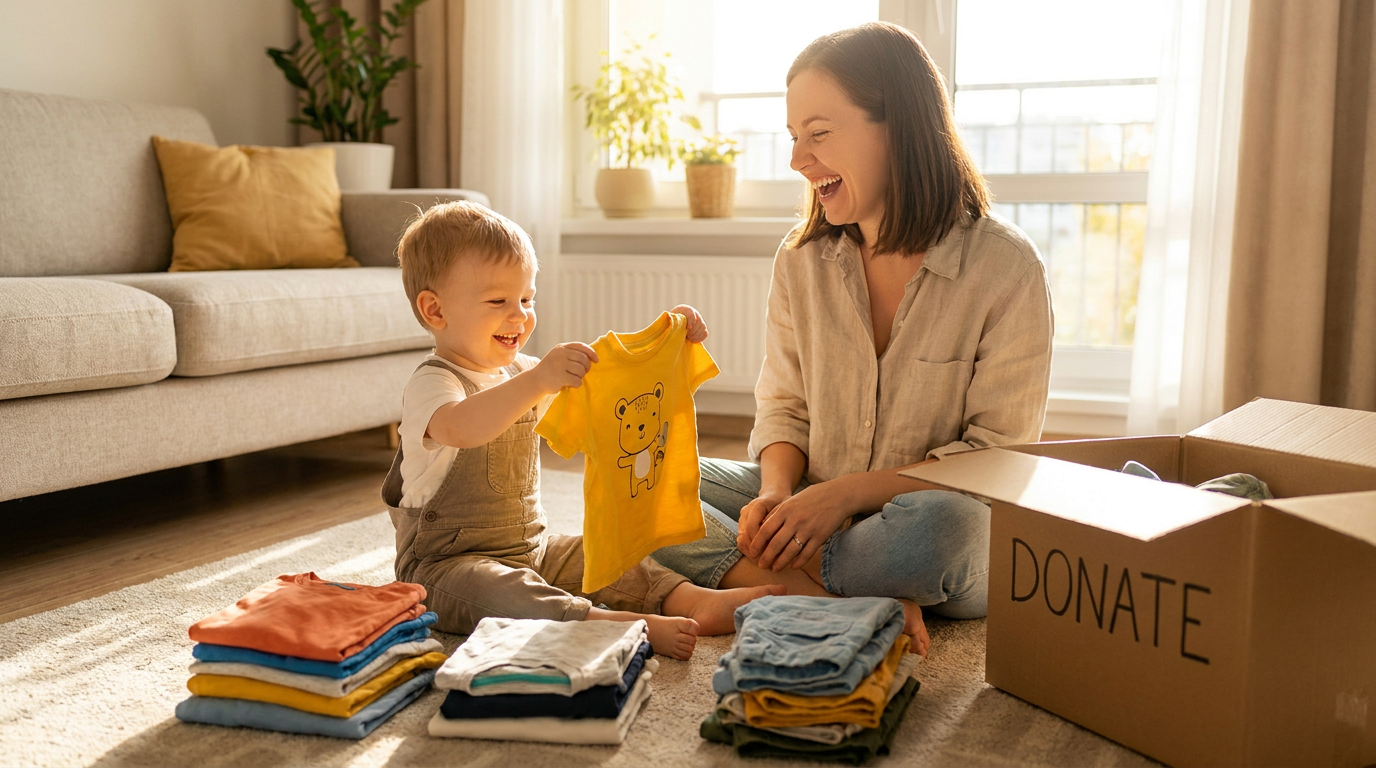
The credit system does something else, too — something that matters beyond the logistics. It makes children participants in the process, not just recipients of it. When a child understands that the things they’ve outgrown have value — real, spendable, tangible value — and that they get to choose what comes next, they are learning something that has nothing to do with clothing. They’re learning about circularity, about stewardship, about the fact that things have stories and that stories continue. As we’ve seen firsthand with families navigating this together, even children who initially resist the idea of passing things on can become its most enthusiastic champions once they understand what happens next.
There’s also the thread of continuity — the digital record that follows a beloved piece forward, so that the experience of letting go never feels anonymous or forgotten. The jacket that no longer fits your child doesn’t simply disappear. It has a next chapter. And you can follow it there.
Membership is designed as a repeatable household system, not a one-time fix. Become a Member at the Lite, Luxe, or Limitless level — $35, $65, or $95 per month — and the cycle becomes the rhythm. Season after season, growth spurt after growth spurt, the system holds. You don’t have to solve it again every six months. You just follow the thread.
What the System Was Always Supposed to Feel Like
“The bag of outgrown clothes used to just sit in my trunk for months. Now I know exactly where it’s going — and I come back with credits to shop for whatever comes next.”
— Jill, mom of Quinn + Cameron
This is what it looks like when a system is built around the reality of a parent’s life, rather than asking a parent to adapt their life to the system. And from here, we want to say something directly — the thing this whole letter has been building toward.
A letter.
You woke up before the alarm again.
Not because you had to. Because your brain had already started — running through the list, checking the mental inventory, flagging the things that needed handling before anyone else in the house was awake. You do this without thinking. You’ve done it so long it no longer registers as effort.
We want you to know: it’s effort. It counts.
You are the one who notices when the shoes are getting tight before anyone else mentions it. You are the one who does the mental math of what’s coming — the season changing, the growth spurt that’s clearly been happening, the fact that the whole wardrobe is about to shift and you haven’t had a moment to deal with it yet. You carry the forward planning for an entire small person, or several small people, while also carrying the forward planning for the rest of your life. You do this simultaneously, constantly, with a competence so complete that it reads as effortless — and that invisibility is exactly the problem.
You are the one who held that hospital onesie in your hands last spring and couldn’t put it in the pile. Not because you forgot to. Because you knew what you were letting go of, and you needed one more minute with it. You gave yourself that minute in the quiet of a Tuesday afternoon, and then you kept moving, because there was more to do and there always is. That minute mattered. The care behind it mattered.
You are the one who stands in the school pickup line thinking about whether the coat will last the rest of the season, or whether you need to start looking now, and whether buying new feels like the wrong choice when there must be a better one — while also remembering what happened at drop-off, and whether to follow up with the teacher, and whether there is anything left in the fridge for dinner.
You are doing all of this at once. You have been doing all of this at once. You will do it again tomorrow.
We are not saying this to add weight to it. We are saying it because it is true, and because truth, simply stated, is sometimes the thing a person needs most.
The choices you make with intention — choosing quality over convenience when you can, keeping pieces in circulation, treating what your children wear as something that carries meaning rather than something to be disposed of — those choices are not small. They add up into something larger than any one jacket or any one season. They are building a value system that your children are absorbing, even when they don’t seem to be paying attention. They are paying attention.
The thread you follow — through every season, every growth spurt, every piece outgrown and sorted and passed forward — is not invisible to us. We built this for you. We built it because we believe that the way a family manages what their children wear is an act of intention, and intention deserves a system worthy of it.
You don’t have to have it all figured out. You don’t have to solve the pile by yourself. You don’t have to feel guilty about the stained piece or the bag that’s been in the trunk or the jacket you’re not ready to let go of yet.
The thread continues. Even when you set it down for a minute.
Especially then.
On National Parents’ Day — July 26th, 2026, and every ordinary day around it — we see you. The early mornings and the late nights. The mental list and the emotional weight and the extraordinary, unremarkable love that runs through all of it.
We see the thread. And we’ll help you follow it.
— Prelove You
Follow the Thread.
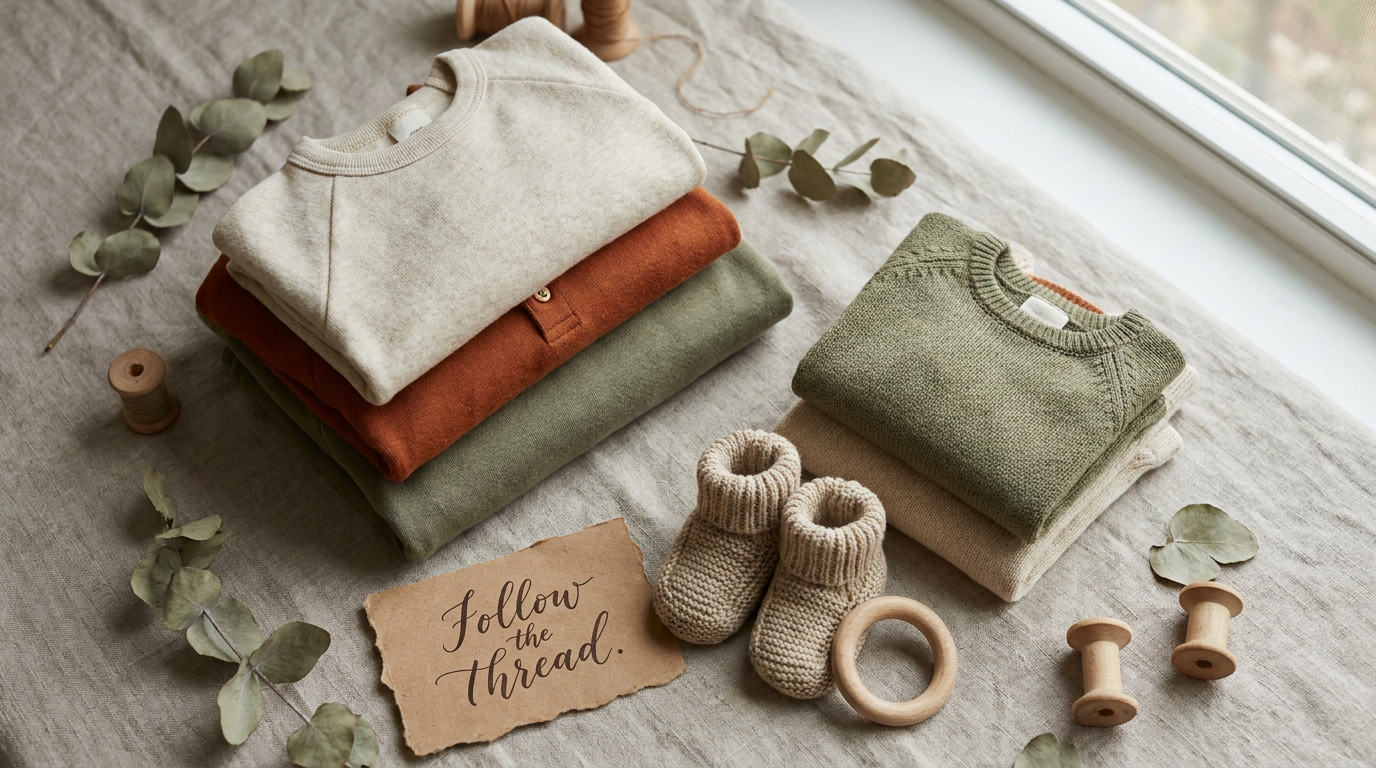
National Parents’ Day arrives on July 26th this year, quiet as it always does, without the infrastructure of a major holiday and without the fanfare it probably deserves. But the truth it points to — that parenting is relentless, invisible, and profoundly important — doesn’t live only in the fourth Sunday of July. It lives in every morning before the house wakes up, every mental inventory run while standing in the checkout line, every piece of clothing sorted with care and set down with a feeling you didn’t quite have words for.
What you do with the things your children wear is a small expression of a much larger act of love. It is an act of intention. And intention, repeated season after season, builds something lasting — not just in the circular system that keeps clothing in use and out of landfills, but in the children watching you make these choices, absorbing the message that things have value, that stories continue, that care is not a finite resource.
The thread doesn’t stop when the season ends. Neither does what you’re building.
Prelove You is the household system for modern families who want ease, intention, and beauty in how they manage what their children wear. Send in what they’ve outgrown — everything, even the worn-out pieces — and shop for what comes next. Season after season, the system holds.
Want more from Prelove You? Explore the Prelove You Post — our content hub for parents navigating the beautiful, exhausting, extraordinary work of raising children with intention. And when you’re ready to learn the full story behind the system, find out who we are and why we built it.

