



 Sustainability Scoop
The Household Clothing Cycle: Why It Keeps Breaking (And How to Fix It)
It’s not a willpower problem. It’s an infrastructure problem — and there’s a system that actually solves it.
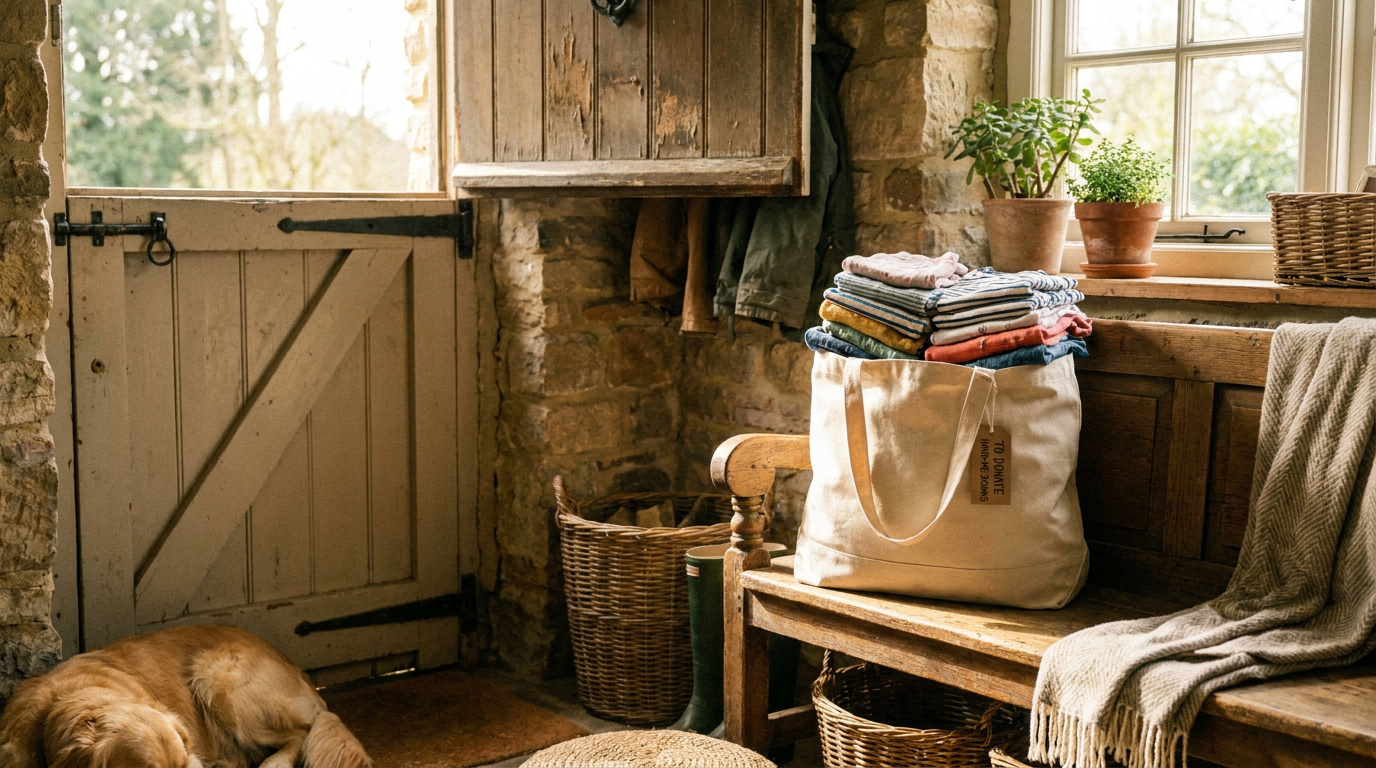
And then there’s the bag. You know the one. It started as a grocery tote, then became the temporary home for three pairs of outgrown jeans and a stack of shirts that no longer button. You told yourself you’d deal with it this weekend. That was three weeks ago. Now it’s colonizing the trunk of your car, riding along to soccer practice and the farmers market and everywhere else, half-forgotten but never quite gone.
Here’s what nobody tells you: this is not a failure of effort. It is not a failure of organization, or intention, or follow-through. You are not the problem. The absence of a system is the problem — and it’s a problem that repeats itself every six to nine months, for every child in your household, year after year, until someone names it clearly and builds a better path forward.
That’s what this post is for. We’re going to diagnose exactly why household clothing management breaks down for most families — not vaguely, but at the specific structural points where the cycle collapses. Then we’re going to map a fix for each one. And we’re going to show you what it looks like when the whole system actually works: not perfectly, but repeatably.
Because that’s the goal. Not a pristine closet. A cycle that completes itself.
Before we can fix the cycle, we need to see it clearly. Most parents experience the clothing cycle as a vague, recurring stress — the sense that there’s always something to deal with, always something piling up. But the cycle is actually a defined sequence, and once you name its stages, you can see exactly where your household’s version of it is breaking.
The household clothing cycle has five stages: Acquire → Wear → Outgrow → Exit → Replenish. Read that sequence again, slowly. Every family is running this loop, for every child, multiple times per year. And here’s the thing: most households have strong infrastructure for the first two stages. Acquiring children’s clothing is easy. There are stores, websites, gift-givers, seasonal sales, and hand-me-down networks. Wearing the clothing is what children naturally do. These steps largely take care of themselves.
The system begins to fracture at stage three. Children outgrow clothing every six to nine months on average — meaning this loop completes itself two or more times per year, per child. For infants and toddlers, the pace is even more unforgiving: a newborn can outgrow a clothing size within days. Some pieces labeled for three months fit for only three weeks. A gifted set of onesies in the same size might each be worn once before the window closes. The math of children’s growth is relentless, and it does not pause for busy schedules.
When a child outgrows something, that item needs to exit the household. That’s stage four, and it is where the entire system stalls. Because for most families, there is no defined exit route. There is no place the item goes, no process it follows, no moment when it moves on. Instead, it goes back in the drawer. Or it lands on a chair. Or it makes its way into a bag that then moves, slowly and silently, to the trunk of a car.
Without a clear exit path, outgrown items accumulate faster than they can be addressed. The pile grows. The decision of what to do with each piece gets deferred, then deferred again. And by the time stage five — replenishment — arrives, the family is buying new clothing while the old clothing is still technically somewhere, unresolved, a low-grade source of cognitive friction that nobody can quite name.
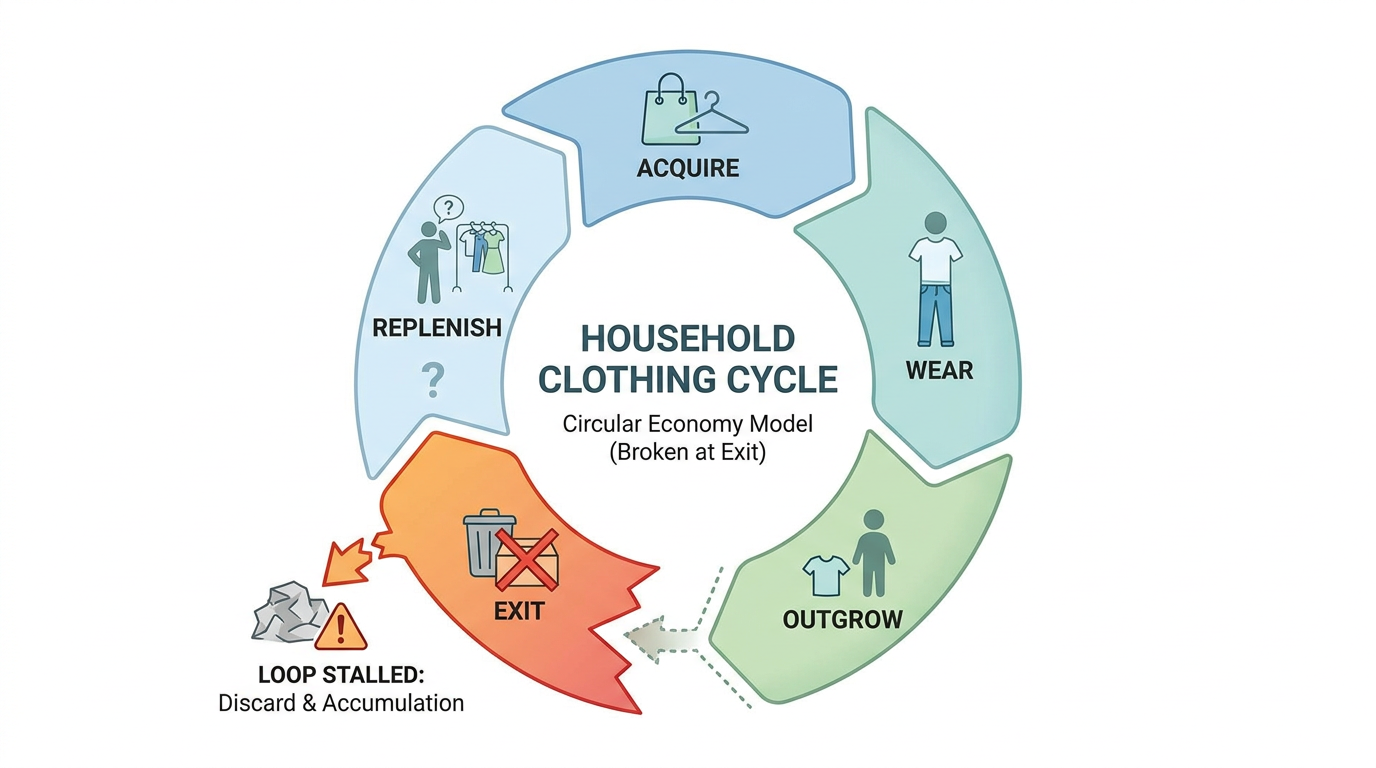
The linchpin of the entire cycle is the exit. Not the acquisition. Not the wearing. The exit. When the exit stage has no infrastructure behind it — no designated space, no process, no channel — the loop cannot complete. Items that should have moved on six months ago are still sitting in drawers, in bags, in the back of closets, quietly blocking the cycle from resetting.
As a year of closet data from Prelove You shows, the rhythm of children’s wardrobes is entirely predictable. The problem is never that parents don’t know it’s coming. The problem is that the system behind it — the infrastructure that would make the exit automatic — has never been built.
Understanding why the exit fails is the first step to fixing it. And it fails for five very specific reasons.
This is the diagnostic section. Read it as a recognition exercise — not as a list of things you’ve done wrong, but as a precise map of what’s actually happening in your home. Every single one of these break points is structural, not personal. And every one of them has a fix.
The most fundamental reason the clothing cycle stalls is also the simplest: there is nowhere for outgrown items to go. Not a vague “somewhere,” but a specific place — a designated box, bag, or bin that exists in a consistent location, that everyone in the household knows about, that serves as the official first stop for anything that no longer fits.
Without that physical exit point, every outgrown item requires an on-the-spot decision about where it should live while you figure out what to do with it. More often than not, it goes back into the drawer. Or onto the floor. Or into the bag that has now been in the trunk for three weeks. The absence of a designated exit doesn’t just slow the cycle — it prevents it from starting at all.
The clothing review that happens reactively — when the drawer is already overflowing, when the child is standing in front of you in too-short pants — is the most stressful version of this task. It’s done under pressure, with no plan, and it produces the worst outcomes.
What works is a proactive cadence: a set rhythm tied to the calendar, not to a crisis. The start of summer. The beginning of the school year. The seasonal shift in October. When the clothing review is a scheduled appointment — something that happens on a predictable date, like any other household task — it stops being a looming problem and becomes a manageable routine. But most families never build this rhythm, so the task only happens when the situation is already chaotic.
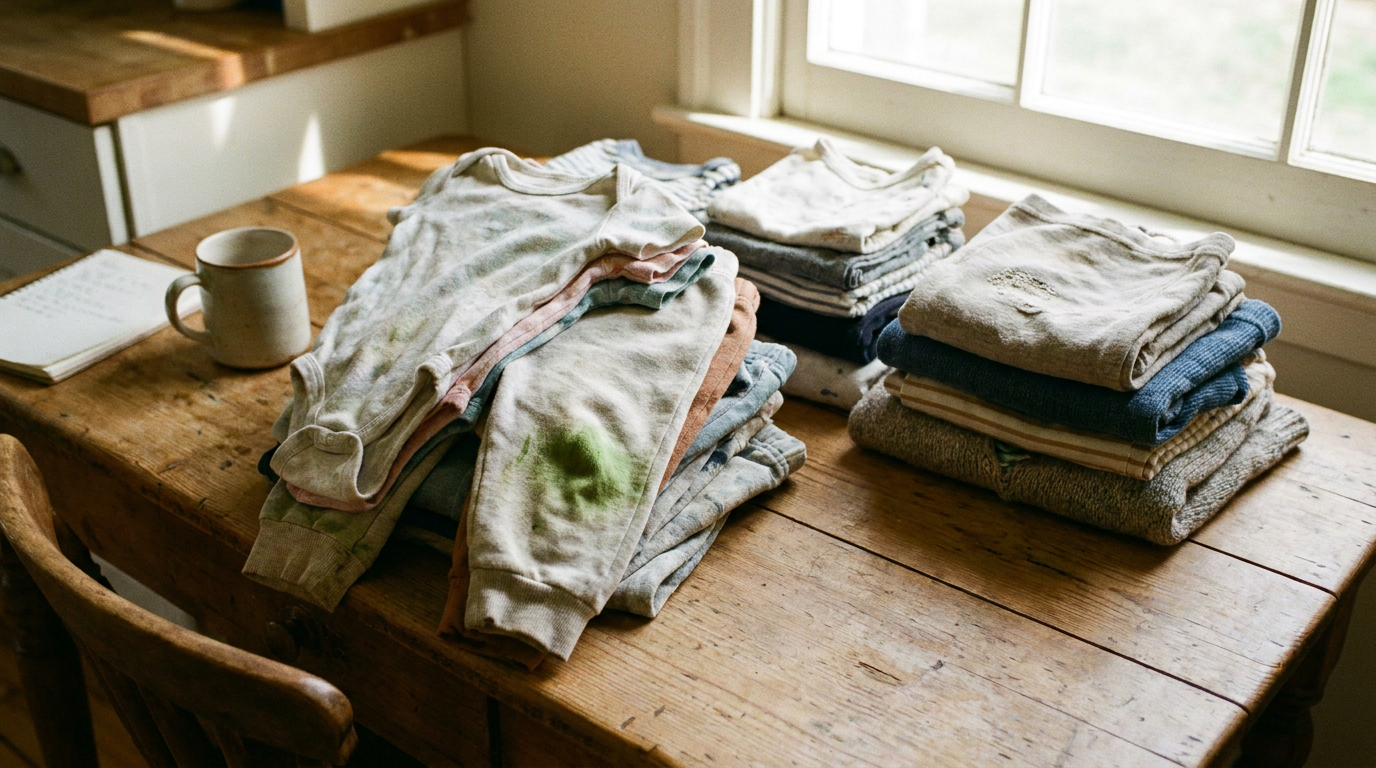
Here is a specific and under-discussed reason the exit stage stalls: the stained shirt. The worn-through knees. The beloved pajama top that has been through so many washes it has gone a slightly different color than the bottom.
Parents know, intuitively, that these items cannot be donated. Most donation centers won’t accept them. They can’t be sold. And throwing them away feels genuinely wrong — wasteful in a way that’s hard to sit with. So these items enter a kind of purgatory: too worn to donate, too guilty to trash, too sentimental to let go of entirely. They sit in the pile. They become the physical embodiment of a decision that was never made. And their presence makes the entire exit process feel harder and more fraught than it needs to be.
Even when the items are in good condition, the exit stage demands a micro-decision for every single piece. Keep it? Donate it? Sell it online? Pass it to a sibling? Try to find a resale platform? Box it for a friend who has a younger child? With thirty or forty items per seasonal review, that cognitive load is enormous — and it compounds across every child in the household.
Decision fatigue is a real and well-documented phenomenon: the more decisions we make, the lower the quality of each subsequent decision. When the exit stage requires dozens of individual choices with no clear default, the easiest decision is always to postpone. The bag stays in the trunk. The drawer stays full. The cycle doesn’t complete.
This is perhaps the most quietly powerful of the five break points, because it’s the one that parents feel most reluctant to admit. Children’s clothing is not just fabric. It is the first-day-of-school outfit. It is the onesie they came home in. It is the jacket they refused to take off all winter, the one that smells faintly like them even after it’s been washed.
Moving these items along doesn’t just feel like decluttering. It can feel like letting go of a moment that cannot be retrieved. And so the item stays. Not because the parent doesn’t know it needs to go, but because the act of sending it out the door feels too final, too much like closing a chapter that isn’t quite ready to close.
“Children’s clothing isn’t just fabric. It’s the first-day outfit, the favorite pajamas, the jacket they refused to take off all winter. When the exit feels like erasure, no wonder parents can’t move forward.”
— Prelove You
The data behind all of this is striking. According to research compiled from Mercari’s Family Reuse Report, approximately 100 million children’s and baby items worth $4.5 billion were discarded in 2021 — not because parents didn’t care, and not because they were indifferent to the waste. But because no better path existed. The items piled up until the only remaining option was a trash bag. The system offered nothing else.
This is the scale of what happens when the exit stage has no infrastructure. And it’s also, critically, what makes the kids clothing overwhelm solution not a personal goal but a structural one. The fix is not trying harder. The fix is building the infrastructure that makes trying unnecessary.
Understanding where the cycle breaks is only half the picture. The other half is understanding what it costs — not just in physical clutter, but in the invisible, unacknowledged labor that parents carry just to keep things from completely falling apart.
There is a version of household clothing management that never appears on a to-do list, never gets checked off, and never gets acknowledged — because it happens entirely in the mind. It is the anticipation of the next size change before it happens. The mental note that the winter coat might not make it another season. The calculation of whether the shoes will last until spring. The emotional processing that happens in the three seconds before deciding whether a stained shirt goes in the bag or back in the drawer.
This is invisible labor. And it is, in many households, a nearly continuous background process.
Research published in Sex Roles and indexed on PubMed documented this phenomenon with striking clarity. In a study of 393 U.S. mothers, researchers Lucia Ciciolla and Suniya S. Luthar found that a majority of women reported being solely responsible for household routines involving organizing schedules and maintaining household order. Crucially, this disproportionate responsibility — especially around child adjustment — was directly associated with strains on personal well-being and lower relationship satisfaction. The invisible labor isn’t just inconvenient. It has real consequences for the people carrying it.
The mental load of children’s clothing is a particularly dense cluster of invisible tasks. It includes anticipating size changes before they become urgent. It includes tracking what’s needed for the next season while the current season is still happening. It includes making judgment calls about condition, sentimentality, and destination for dozens of items at a time. It includes managing the emotional weight of items that carry genuine memory. And it includes doing all of this without any external system to lean on — which means recreating the decision-making framework from scratch, every single season.
What makes this labor invisible is precisely that it happens in the mind. The bag in the trunk is the physical symptom of cognitive work that was started but never completed. The overflowing drawer is the visible evidence of a mental process that stalled out under the weight of too many inputs and not enough infrastructure. The pile on the chair is not laziness. It is unfinished cognitive labor, waiting for a system that was never built.
This is why framing household clothing management as a systems problem — rather than a personal organization problem — is so important. When there is no system, one person in the household absorbs the cognitive weight of inventing the system, repeatedly, from scratch, every season. They become the default manager of the cycle: the one who notices, the one who anticipates, the one who carries the ambient awareness of what needs to happen next. And they do this whether or not anyone else recognizes it as work.
Building a repeatable system doesn’t just solve a logistics problem. It redistributes and reduces an invisible burden. It converts a recurring source of cognitive friction into a background process that runs automatically — freeing up mental bandwidth that was previously consumed by a task that should have been designed out of the equation entirely.
If you’ve been quietly carrying this alone, this is the part where we say clearly: that was never your failure to manage. It was always an infrastructure gap. And infrastructure gaps, unlike personal shortcomings, can be fixed.
With the full scope of the problem now in view — structurally and emotionally — the question becomes: what does a working system actually look like?
A working household clothing cycle does not require perfection. It does not require a beautifully organized closet, color-coded bins, or a weekend dedicated to the project. It requires five structural fixes — one for each of the break points identified above. Each fix is simple in isolation. Together, they make the cycle self-completing.
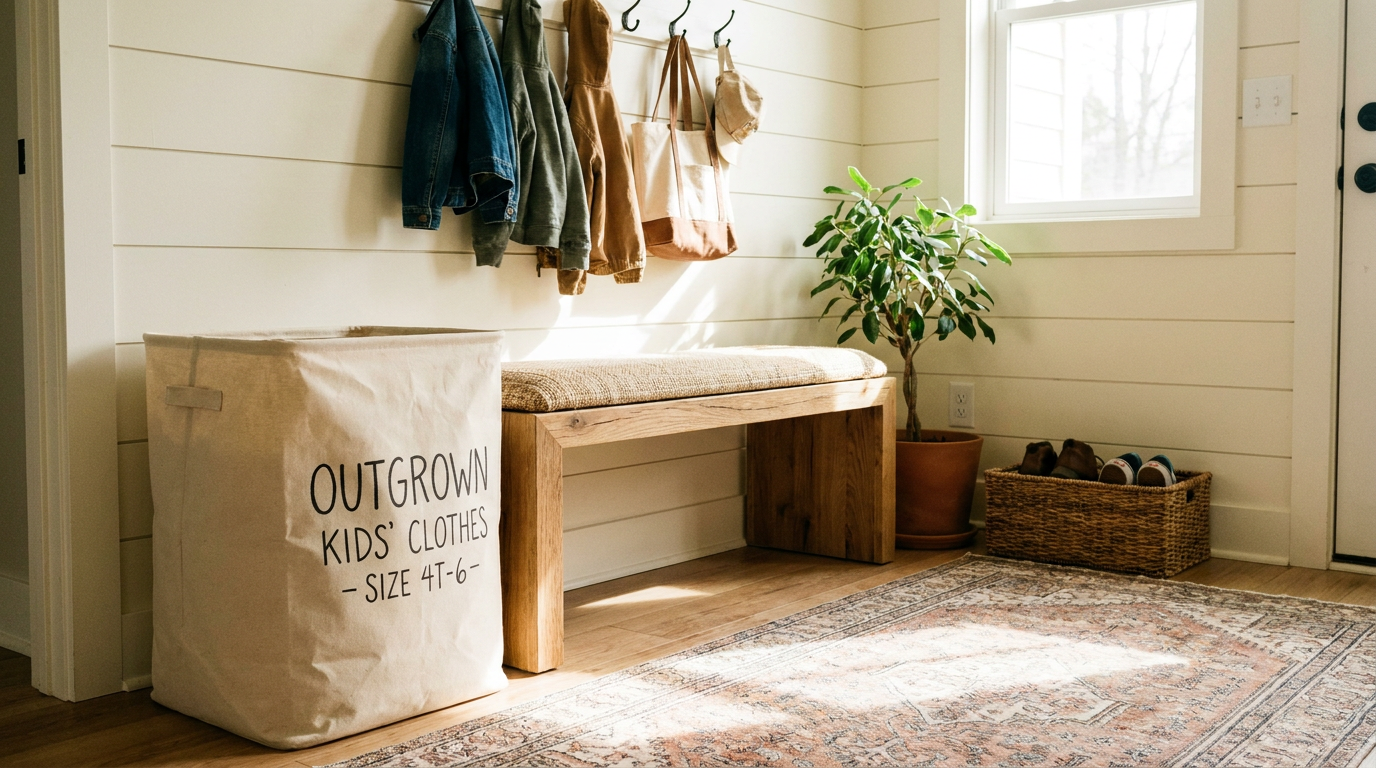
Choose a specific container — a fabric bin, a large tote, a designated corner of the closet — and make it the official home for outgrown items. Not a temporary resting place. A permanent fixture with a clear purpose: when something no longer fits, it goes directly there. Not back in the drawer. Not onto the chair. Into the exit bin.
This sounds almost too simple, but the physical container does important cognitive work. It removes the first and most common decision (where does this go right now?) and replaces it with a default. The item has a place. The place is known. The decision is already made.
Put the clothing review on your calendar the same way you’d schedule a dentist appointment or a car service. Twice a year at minimum: the start of summer, and the start of the school year. Three times if your child is in a particularly rapid growth phase. The date is non-negotiable and it’s set in advance, which means the task never becomes a reactive crisis — it’s always anticipated, always planned for.
This is the shift from managing clothing chaos to running a household system. The back-to-school season is a natural anchor point for the fall review. The beginning of summer — when school routines dissolve and children suddenly have time and flexibility — is ideal for the mid-year pass. Add it to the calendar now, before the moment arrives.
The stained shirt should never be a reason the exit stage stalls. But it will keep being one until you have a channel that accepts end-of-life items without judgment or sorting requirements.
Prelove You accepts all item conditions — including pieces that are stained, faded, or worn past their wearable life — and routes them responsibly through upcycling and recycling channels. This means the guilt trap disappears entirely. Everything goes into the exit bin. Everything goes out through a single channel. Nothing requires you to pre-sort by condition or feel ashamed of the state of a shirt that was worn hard and loved well.
Instead of deciding the fate of each item individually — donate? sell? recycle? trash? — use a platform that makes that decision for you. Send everything through one channel. Let a grading process handle categorization. Receive credits automatically. The cognitive cost of the exit stage drops to near zero.
This is the structural fix for decision fatigue. Not willpower, not a better sorting method — a single exit point that handles everything downstream, without requiring you to manage each piece individually. The PLY system is built exactly for this: members send in outgrown items, the platform grades and routes them, and credits return to fund the next round of clothing. One action. One channel. Everything handled.
The sentimental items deserve a home that isn’t the whole drawer. A small memory box — physically bounded, intentionally curated — is where the truly irreplaceable pieces live. The first-day outfit. The onesie from the hospital. One or two pieces per year, chosen deliberately, set aside with care.
Everything else moves forward. This is not erasure. It is the difference between honoring a memory and being held hostage by it. When memory has its own dedicated space, the rest of the wardrobe can flow freely through the cycle — without the emotional weight of a hundred undifferentiated items slowing everything down.
“The goal isn’t a perfect closet. It’s a system that repeats — one that works even on the weeks when everything else doesn’t.”
— Prelove You
It’s also worth noting the broader context that makes a working exit system urgent. According to the EPA, 11.3 million tons of textiles were landfilled in 2018 alone. Every piece of children’s clothing that exits through a responsible channel — rather than a trash bag — is a meaningful contribution to a better outcome. A working household system is not just good for the family. It matters beyond the mudroom.
The five fixes work for adults, and they work as a household system. But there is one dimension of the clothing cycle that most families overlook entirely — one that, when activated, makes the whole thing easier, more meaningful, and more durable. It starts with inviting the children in.
There’s a common assumption built into most approaches to household clothing management: it’s a parent task. Kids are the recipients — of the clothing, of the decisions, of the system. But this framing leaves a significant opportunity untapped, both for the household and for the child.
Children who participate actively in the clothing cycle — who help decide what stays, what moves on, and what comes in — develop something that goes far beyond a tidy wardrobe. They develop a relationship with the concept of value. They begin to understand that the things they own have worth that extends beyond the moment of use, that ownership is not just about having but about stewarding. These are not small lessons. They are foundational ones.
The credit system makes this tangible in a way that abstract conversations about sustainability never quite can. When a child watches an outgrown item leave the home and sees credits arrive in return, the concept of circular value becomes concrete and real. That jacket they loved? It didn’t just disappear. It became something. You can earn credits through the PLY platform that translate directly into access to new-to-them clothing — and children who are part of that process understand it viscerally in a way that no lecture about sustainability could produce.
“When a child understands that the jacket they loved can become credits for something they’ll love just as much — that’s not just a transaction. That’s a lesson in how value moves.”
— Prelove You
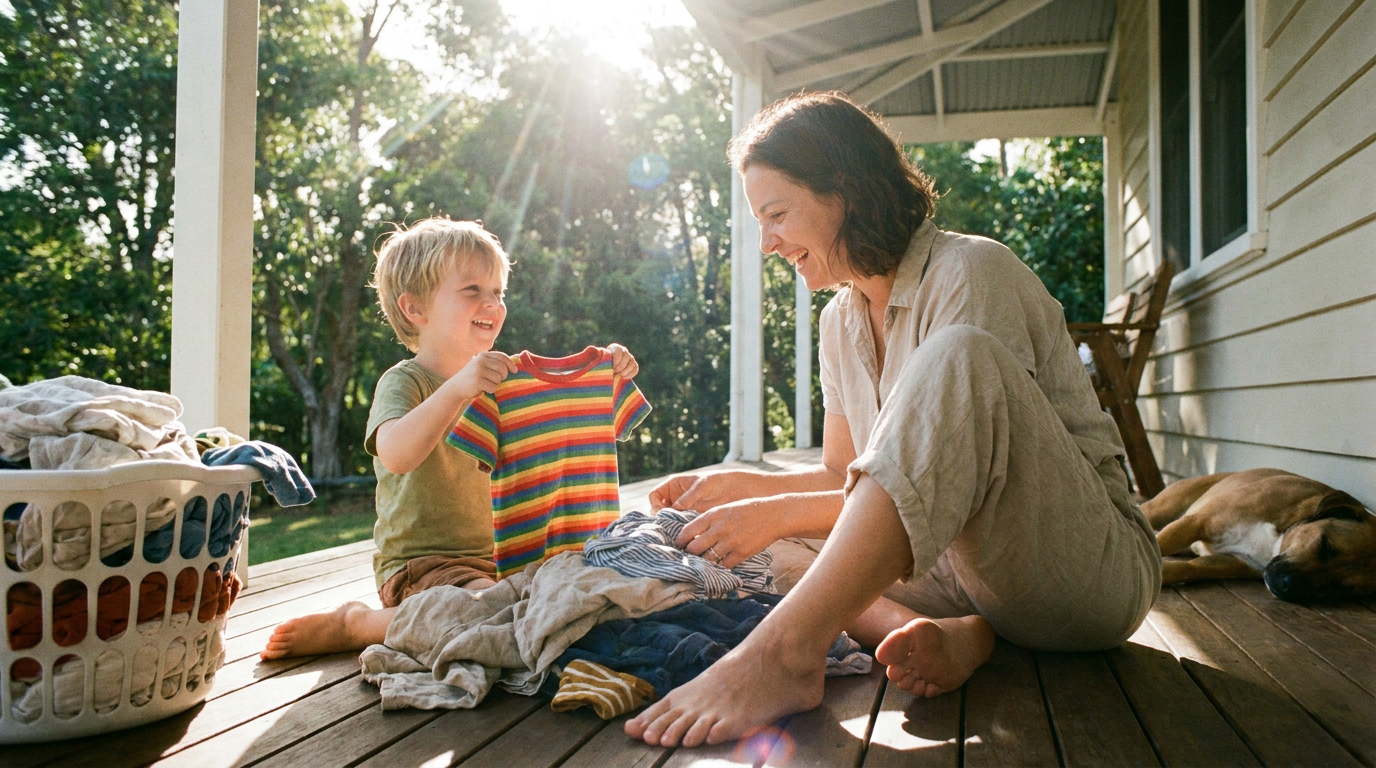
The seasonal clothing review, when treated as a shared ritual rather than a parent-only chore, also becomes something unexpected: a genuine point of connection. Children are, by nature, curators of their own experience. They have strong opinions about what they love, what they’ve outgrown in preference as well as size, and what they’re excited to find next. Inviting them into the review doesn’t just reduce the parent’s workload — it makes the process more accurate and more honest. A child who says “I never wear this” is giving you better information than a parent guessing from the outside.
Clothing is also, quietly, a vehicle for confidence and self-expression. When children have real agency over what they wear — not just passive acceptance of what appears in their drawer — they develop a stronger sense of self. They learn to articulate what they like, to make choices, to build a personal aesthetic. As Prelove You has explored in depth, shopping with children — rather than for them — is an act of respect that pays forward in ways that have nothing to do with clothing.
Summer is, practically speaking, the ideal time to begin this practice. There is no school-morning rush. Children have more time, more patience, and more openness to new rhythms. A Saturday afternoon closet review in late June — approached as a collaborative project rather than a chore — can become the starting point for a household ritual that repeats naturally, season after season. The family that builds this habit now will find, a year from now, that the seasonal review is something the children remind the parent to do.
It’s also worth acknowledging the complexity that sometimes comes with involving children in clothing decisions. Not every child embraces the idea of letting go, especially when the item in question carries emotional weight. That tension is real and worth honoring. The approach isn’t to override it — it’s to make the exit feel like something gained rather than something lost. When the credit comes back, when the child gets to choose what comes next, the letting-go becomes part of a cycle they can trust.
With children in the cycle and a clear system in place, one question remains: how do you make sure the system doesn’t just work once, and then dissolve under the pressure of the next busy season?
A one-time fix is not a system. It is a temporary relief — useful, but limited. What families with multiple children in active growth phases need is not a solution they have to rediscover every six months. They need infrastructure: a structure that holds the cycle in place, that makes the right choice automatic, that requires less effort over time, not more.
This is the difference between solving the problem and ending the problem.
The clothing cycle, when properly supported, should run something like this: at the start of summer, the exit bin gets sorted into a PLY send-in bag. The bag goes out. Credits arrive. The seasonal shop happens. At the start of the school year, the process repeats. In between, outgrown items go directly into the exit bin as they happen — not into drawers, not into the trunk, not into a pile on the chair. The bin fills slowly, naturally, continuously. And when the review moment arrives, the work is already half done.
This is what membership makes possible. Not just access to a circular clothing platform, but the integration of the clothing cycle into the household rhythm in a way that feels effortless rather than effortful. The PLY system is built around the specific mechanics of household clothing flow: members send in outgrown items, the platform’s grading process categorizes them by type, designer, condition, sustainability profile, and cleanliness, and credits return automatically. Members shop for high-quality secondhand pieces. The cycle completes.
The end-of-life acceptance is particularly significant here. It is the structural fix for Break Point #3 that no other platform offers in the same way. When every item — regardless of condition — can exit through a single channel, the entire guilt-trap category of decision disappears. There is no longer a class of item that creates paralysis. Everything moves forward. The bin empties. The cycle resets.
The market data supports the direction this is heading. According to research compiled by Firebird Kids, 62% of parents already purchase secondhand items for their children. The behavior is mainstream. What’s been missing is not the willingness to participate in circular clothing — it’s the infrastructure to make it effortless. The secondhand children’s market is projected to reach $12.8 billion by 2030, and the families driving that growth are the ones who have figured out that a good system beats a good intention every time.
For families considering where to start, Prelove You memberships are structured around different household rhythms:
There is also a gifting option — which makes joining Prelove You a meaningful gift for a new parent, a growing family, or anyone who has been quietly struggling with the bag in the trunk for longer than they’d like to admit.
The frame for this decision is not “is this a nice-to-have?” It is: how much does the current absence of a system cost — in time, in cognitive load, in guilt, in clothing that goes to landfill when it could have gone somewhere better? For most families, the math resolves quickly.
Before moving to the conclusion, here are the answers to the questions parents most commonly ask when they’re ready to start — direct answers, no spin.
What is the best system for managing children’s outgrown clothing?
The most effective system has three core components: a designated physical exit point in the home (a bin or bag where outgrown items go immediately, not eventually), a seasonal cadence (a recurring clothing review tied to school year transitions, summer, or seasonal changes), and a single exit channel that handles everything — including stained or worn items — without requiring parents to sort, list, or negotiate each piece individually. A membership-based circular platform like Prelove You removes the decision-making from the exit step entirely: members send in outgrown items, receive credits, and shop for high-quality new-to-them pieces. The system repeats automatically, season after season.
What should I do with clothes my child has outgrown?
That depends on condition. Items in good condition can be donated, passed along, or entered into a circular clothing platform for credits. Items that are stained, faded, or worn past their wearable life are often the hardest to deal with — most donation centers won’t accept them, and throwing them away feels wrong. Prelove You accepts all conditions, including end-of-life pieces, and routes them responsibly through upcycling and recycling channels. This means parents can send everything through a single exit — no sorting, no guilt, no purgatory pile.
How do I get my kids involved in managing outgrown clothes?
Make it a seasonal ritual they participate in. Let them decide what moves on and what stays. Show them how the credit system works — that what they send in has real value that comes back to them as choices in new clothing. When children understand that the cycle isn’t about losing things but about exchanging them for something they’ll love just as much, they become willing — often enthusiastic — participants. Starting in summer, when there’s no school-schedule pressure, makes the first pass especially smooth.
Is a circular clothing membership worth it for families?
For families with children in active growth phases — particularly those with kids between ages 0 and 12 — the math works clearly. Children outgrow clothing every six to nine months. Without a system, the exit step costs time, energy, and quiet guilt every single season. A membership that handles the exit, provides credits, and gives access to quality secondhand items converts a recurring household problem into a repeating household system — one that gets easier, not harder, over time.
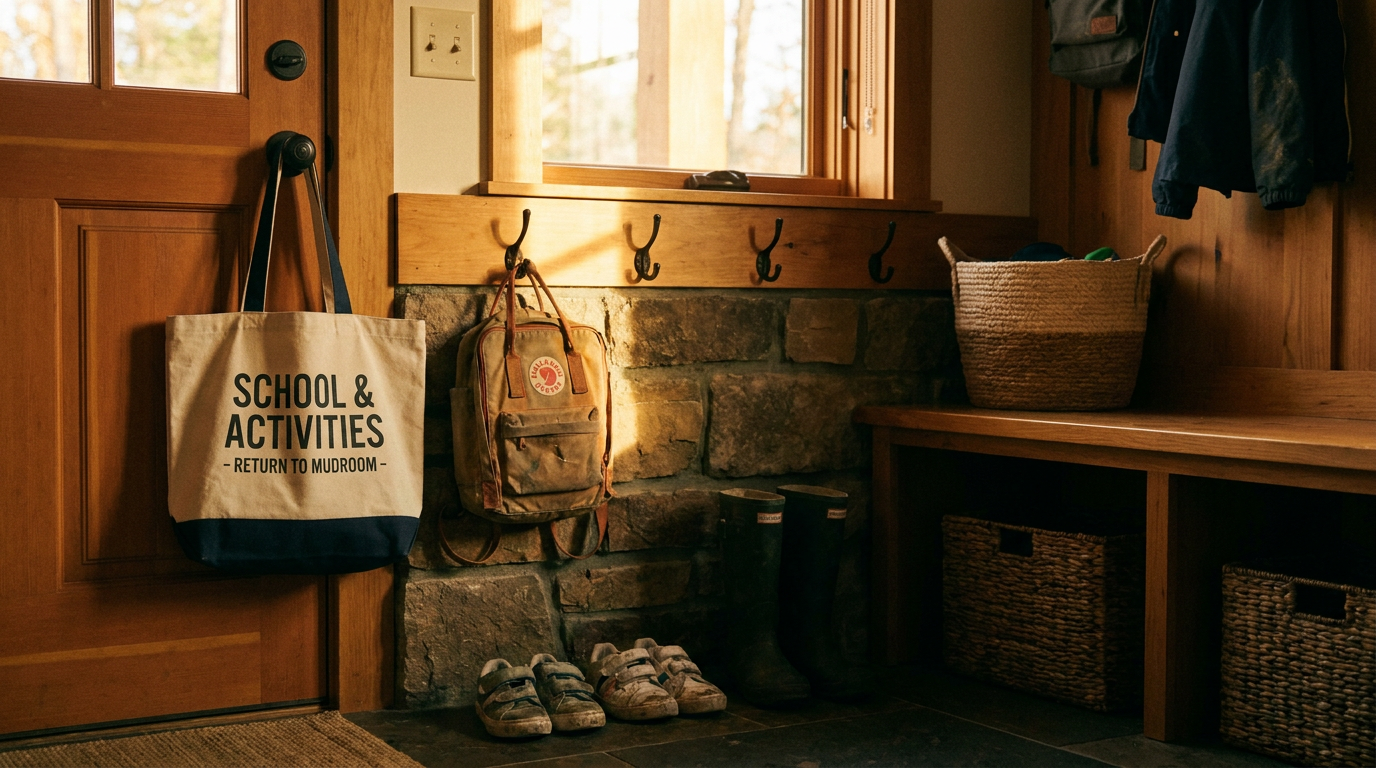
Let’s go back to the beginning. The overflowing drawer. The too-small sandals. The bag that has been “almost dealt with” for three weeks, riding along to every errand, a quiet companion in the passenger seat of an already-full life.
You were never failing to manage that bag. You were living with an infrastructure gap that nobody designed a solution for — until now. The clothing cycle was always going to repeat itself every six to nine months. It was always going to produce outgrown items faster than a reactive approach could handle them. The only thing that was missing was the system to make the exit automatic.
That system is not complicated. It is a bin, a calendar date, a single exit channel that accepts everything, and a child who understands that what they send out comes back as something new. It is five structural fixes to five structural break points. It is the difference between managing chaos every season and running a household system that takes care of itself.
Children’s clothing holds memory, identity, and the story of a child’s growth. A good system honors that. It makes room for the one or two pieces that truly deserve to be kept, while allowing everything else to move forward — through a cycle that replenishes as naturally as it outgrows. The family that builds this system in June will be the one that, come September, handles the back-to-school clothing review in an afternoon instead of a month of postponed intentions.
The household clothing cycle, when it works, is one of the most quietly satisfying systems a family can have. It runs in the background. It reduces friction. It turns a recurring problem into a repeating solution. And it starts with a single, simple decision: to stop solving the same problem from scratch every season, and to build something that lasts instead.
The bag in the trunk doesn’t have to be a recurring problem. It can be the start of a system.
Join Prelove You — memberships from $35/month. Send in what they’ve outgrown. Earn credits. Shop for what’s next. Repeat.
Want to see how the credit system works before you commit?
Explore how PLY works →

