



 Sustainability Scoop
The Back-to-School Closet Reset: A System, Not a Scramble
How modern families build a repeatable closet flow that survives September — and every season after it.
Late August. The closet holds three sizes at once, and only one of them fits. A drawer has stopped closing entirely because a pair of jeans from two summers ago refuses to compress. The shorts that fit in June now cut in at the thigh. And by the back door, two bags have been sitting since spring break — sorted, tied, and going absolutely nowhere.
Here is the part nobody says out loud: the sorting was never the problem. You sorted. You did it well. The pile simply had no exit route, so it relocated to the mudroom, then the trunk, then the basement, and the system quietly died in transit.
A scramble has an end date. A system has a cadence. This post is the cadence — a numbered sequence you can run in ninety minutes, two decision tables, a realistic wardrobe count by age, and a rhythm that holds through October and past it.
This is not a decluttering post. There are no matching bins in it, and nobody is going to be asked to fold anything into a rectangle. Prelove You appears here as household infrastructure: the outbound channel that turns a good intention into something that actually repeats.
So let’s start with why the last four attempts came apart.
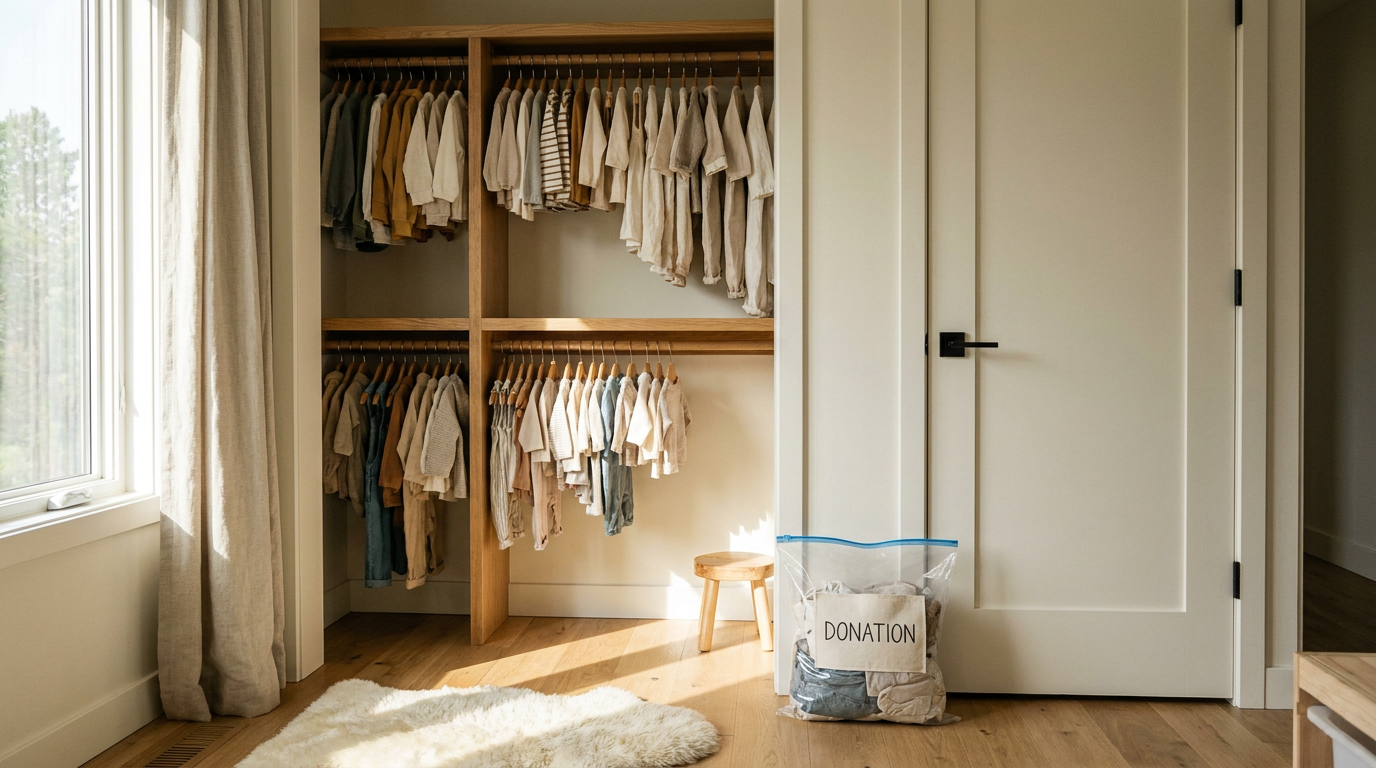
Most back-to-school closet resets fail because they are events, not systems. A purge produces a sorted pile with no exit route, so the pile migrates to the trunk or the basement and the closet refills within weeks. A reset only holds when the outbound step is scheduled, effortless, and already decided before the sorting begins.
There are three distinct failure modes at work, and they compound. Naming them precisely matters, because the wrong diagnosis produces the wrong intervention — which is how most households end up with a storage solution to a flow problem.
A reset designed with an end state can only fail. That is not pessimism; it is arithmetic. Children grow continuously and unevenly. A closet is not a project with a completion date, it is a channel with a throughput rate. When you treat a channel like a project, you build something that produces one satisfying afternoon and then degrades from the moment you close the closet door.
The language gives it away. Getting the closet done. Finally tackling it. Once and for all. Every one of those phrases assumes an end point that the underlying reality does not offer. The closet is never done, in the same way the dishwasher is never done. Nobody feels like a failure for running the dishwasher again on Tuesday. The closet deserves the same grace and the same structure.
A single closet pass can demand hundreds of micro-decisions. Does it fit? Will it still fit in November? Is that stain past saving, or does it disappear once it’s tucked in? Does the younger one grow into this, and if so, where does it live for fourteen months? Is this worth the effort of doing something with, or is it easier to keep it?
Each one is small. Together they are a courtroom. Every garment becomes a tiny case with evidence, precedent, and a verdict — and the parent is judge, jury, and the person who has to live with the ruling. This is why a closet reset produces a specific and disproportionate kind of tiredness. It is not the labor of lifting and folding. It is the adjudication.
That distinction is the whole reason these resets stall, and it is genuinely well documented as a category of invisible household work. If you want the underlying research, the mental load of kids’ clothes is real, and we’ve written about what it actually costs. The short version: this is cognitive load, not a personal organizational shortcoming. You are not bad at this. You are carrying a decision queue nobody scheduled.
This is the real one, and it is the one nobody addresses.
The sorted pile has no destination attached to it. It exists in a suspended state — no longer part of the closet, not yet part of anywhere else. And because there’s no scheduled route out, the pile inherits the least demanding possible answer: put it somewhere and deal with it later. Mudroom. Trunk. Basement shelf. Under the guest bed.
Sorting without an exit route is not a reset. It is moving the problem to a different room and paying for the privilege in floor space.
Which brings us to the genre this post is deliberately not part of. Containers organize a problem; they do not resolve it. Twelve matching bins are a storage solution applied to a flow problem, and storage is the wrong tool — it makes the stalled pile tidier and more permanent at the same time. A labeled bin of clothes that no longer fit is still a bin of clothes that no longer fit. The label just makes it feel handled.
Prelove You exists as a category correction to exactly this. Not a storage strategy, not an organizing method, but a household system with the outbound channel built in. The pile has somewhere to go before you start sorting, which means the sorting produces resolution instead of relocation.
Once the exit is solved, the sort itself becomes almost trivially fast. Here is how it runs.
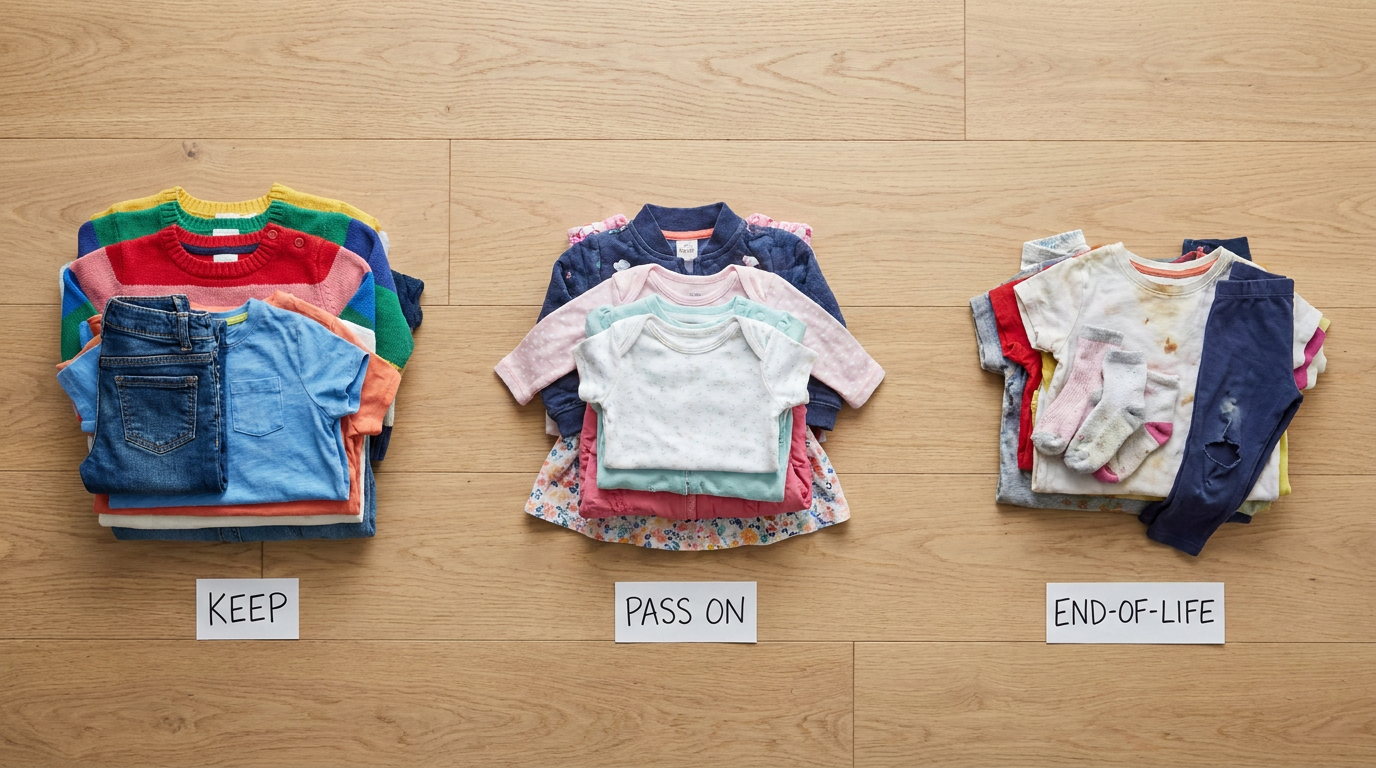
Sort your child’s clothes in one pass using a fixed sequence: empty the closet, try on only the ambiguous pieces, split everything into three routes — keep, pass on, end-of-life — then bag the outbound routes and put them by the door the same day. Sorting by route, not by condition, is what keeps it fast.
Before the sequence, the governing principle, because it does most of the work: sort by destination, not by condition.
Condition-sorting asks you to evaluate every garment on its merits. Is this still good? How good? Good enough for what? That is the adjudication problem from the previous section, reproduced at scale, one item at a time.
Destination-sorting asks a single question: where does this go next? Three possible answers. The evaluation collapses into a routing decision, and routing is dramatically faster and emotionally lighter than judgment. You are not deciding what something is worth. You are deciding which pile it belongs to.
The reset is designed to be finishable in a single sitting, and that constraint is load-bearing rather than aspirational.
A system that requires a free Saturday will not run four times a year. It will run once, in a burst of late-August resolve, and then never again — because free Saturdays in a school year are a fiction. Ninety minutes is a window that exists. It fits inside a nap, a practice, an afternoon where somebody else is handling pickup.
Designing for ninety minutes forces the useful discipline, too. You cannot deliberate for ninety minutes across an entire wardrobe. The clock does what willpower cannot: it makes you route instead of ruminate.
One note on doing this with your child versus around them. Both are legitimate, and the answer changes by age and by kid. A child in the room will slow the session down — that is a feature, not a bug, and there is a good reason for it. The final section handles that properly.
The sequence produces two outbound piles. Which raises the question almost every parent stalls on: what actually happens to the clothes that didn’t survive the summer.
Route summer outgrowns into three destinations: keep for a younger sibling, pass on while the pieces are still wearable, or send end-of-life items onward for upcycling and recycling. With Prelove You, wearable and end-of-life pieces go into the same send-in, so parents never have to judge whether a marked shirt is good enough to count.
The pile does not stop because the parent is disorganized. It stops at one specific garment.
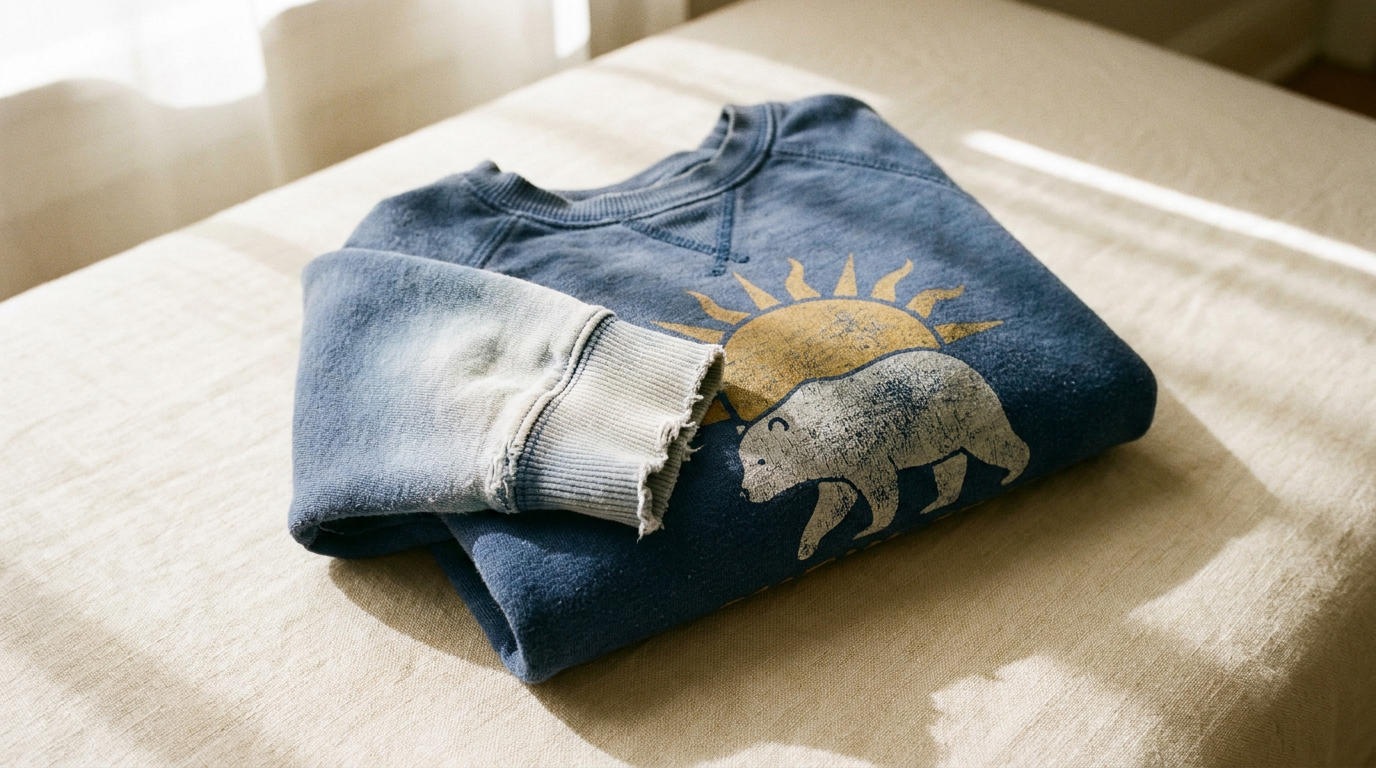
The marked t-shirt. The grass-stained knee. The cardigan with a single pilled elbow. That item goes back into the drawer — not out of sentiment, not out of indecision as a character trait, but because deciding costs more than keeping. And here is the mechanical problem: one deferred decision stalls the entire pile queued behind it. The reset doesn’t collapse gradually. It collapses at an item.
So the answer is to remove the judgment from the equation entirely.
Read the third column again, because it is doing something specific.
The end-of-life column exists so that you never have to fill it in with worry. With Prelove You, stained, worn, and past-wearable pieces go into the same send-in as everything else, and they are routed responsibly through upcycling and recycling channels from there. You are not grading garments. You are not deciding which items have earned onward passage and which are too far gone to bother with. One bag. One decision. Not sixty.
That single design choice is what unblocks the stall at the marked t-shirt, and it is worth going deeper on if that drawer is currently the reason your reset is stuck — here is the full case for why you should stop deciding about stained kids’ clothes altogether.
Hand-me-downs are legitimate and often genuinely economical. But they need two things attached to be real: a specific size and a specific season. Someday is not a storage plan.
When a keep-for-later pile has no date on it, the closet stops being a wardrobe and becomes an archive nobody curated and nobody chose. Keeping a labeled set of next-size-up winter pieces for a child who will be that size in fourteen months is a decision. Keeping four bags of assorted anything because it feels wasteful not to is deferral wearing the costume of thrift.
The environmental outcome here is real and worth stating once: pieces that leave through a routed channel are reused or recycled rather than discarded. That is a consequence of running the system, not the reason to run it, and it does not need a paragraph.
Some garments are not wardrobe. The coming-home outfit. The first-day dress from the year everything changed. Keeping a small, deliberate number of those is part of a good system, not evidence of a failed one. Choose them on purpose, keep them somewhere that isn’t the working closet, and let the rest go without a ceremony.
With the outbound routes settled, the next question is what should be left hanging in the closet — and it is almost always less than you’d expect.
Most school-age children need roughly seven to ten tops, five to seven bottoms, one week of underwear and socks with a buffer, two pairs of shoes, and one to two outerwear pieces per season. Younger children need more changes of clothing; older children need fewer pieces but considerably more say in choosing them.
The logic before the numbers, because the logic is what makes the numbers stick.
Build to laundry cycle plus one buffer day. Not to “enough for every possible scenario.” Wardrobes inflate because parents provision against imagined emergencies — the week laundry doesn’t happen, the unexpected spill run, the phantom cold snap — rather than against an actual, observable week. A real week has five school days and one laundry cycle in it. Provision for that, add a day of slack, and stop.
Treat this as a working baseline rather than a rule. A child with a long bus ride and a muddy field at recess sits at the top of the range. A child with a washer running most days sits at the bottom.
A uniform school changes the math substantially and in a direction most families under-adjust for. The typical shape is five uniform sets — enough for a full week without a mid-week wash — plus a materially smaller non-uniform rotation for weekends, after-school, and free-dress days.
The mistake is keeping a full non-uniform wardrobe in addition to the uniform sets. In a uniform household, the everyday closet can be genuinely small, because it only has to cover two days a week plus whatever the evening brings.
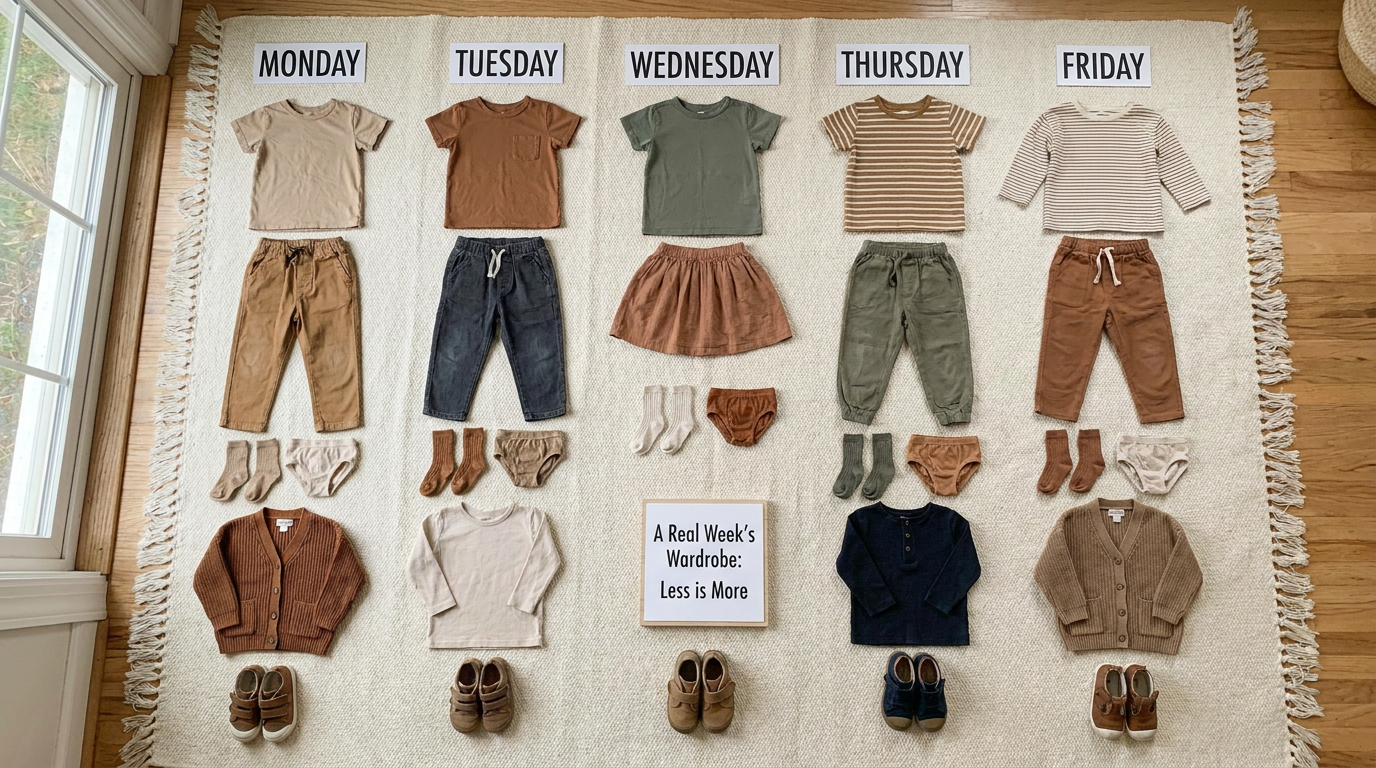
In nearly every closet, three or four pieces are doing the overwhelming majority of the work. There is also a long tail that never gets chosen — pieces that are perfectly nice, perfectly clean, and perfectly ignored.
The reset is a rare, useful chance to notice which is which. Not to feel bad about the tail, but to learn something specific about what your child actually reaches for. That information is worth more than the garments themselves, because it changes what you buy next. It also happens to be the most interesting conversation you can have with a child about clothing, which the last section gets to.
Household spending on this category is rising. The 2026 Deloitte Back-to-School Survey found that families plan to spend 22% more on clothing and accessories this year as they replace worn items and allow for selective splurges.
That increase is not the problem. Replacing things that genuinely wore out is exactly what should happen, and choosing one real splurge on purpose is a legitimate pleasure. The problem is spending 22% more against a closet nobody has actually looked at — buying a fifth pair of leggings because the first four are buried behind a size that stopped fitting in April.
Counting is what converts the increase from drift into intent. You are replacing what wore out, filling three to six identified gaps, and choosing the splurge deliberately rather than accumulating it in increments.
This is also where Prelove You does quiet arithmetic on your behalf: credits from what you send in make the gap list straightforward to fill without a full-price run, and the counted gap list is precisely what turns those credits into a working wardrobe rather than an impulse haul. The list comes first. The shopping follows it.
Knowing what to keep and what to buy raises the last logistical question — when all of this should actually happen.
Run the back-to-school closet reset two to four weeks before the first day of school. That window sits late enough that summer growth has settled and early enough that gaps can be filled without paying a rush premium. Most families shop inside this same window, so working at the front of it is a real advantage.
There is good evidence for where that window sits. PwC’s US Consumer Poll on Back-to-School Shopping, published June 24, 2026, found that 71% of families complete their back-to-school purchases between two weeks and two months before the first bell.
The useful interpretation is not “shop when everyone else shops.” It is that your reset should sit at the front edge of that window rather than the back, because the entire purpose is to shop against a known gap list instead of a guess. Reset first. Then buy. Doing it in the other order is how households end up with three new long-sleeve tops and no pants that fit.
A July reset gets undone by an August growth spurt. Feet in particular have an unhelpful habit of changing size in the last three weeks of summer, and a mid-July shoe purchase can be a mid-August problem.
Reset too early and you simply do it twice — once for real, once in a hurry, with the second pass carrying all the panic the first one was meant to prevent.
A reset the weekend before school starts is a scramble by definition. There is no time to order anything, no time to exchange a size, and no slack in the schedule when a gap turns out to be four items instead of two.
The shopping that follows a late reset is panic-priced and reliably over-bought. You are buying under time pressure against incomplete information, which is the worst combination available.
The back-to-school pass is the big one, but it is not the only one. A cadence is what separates this from a seasonal tip:
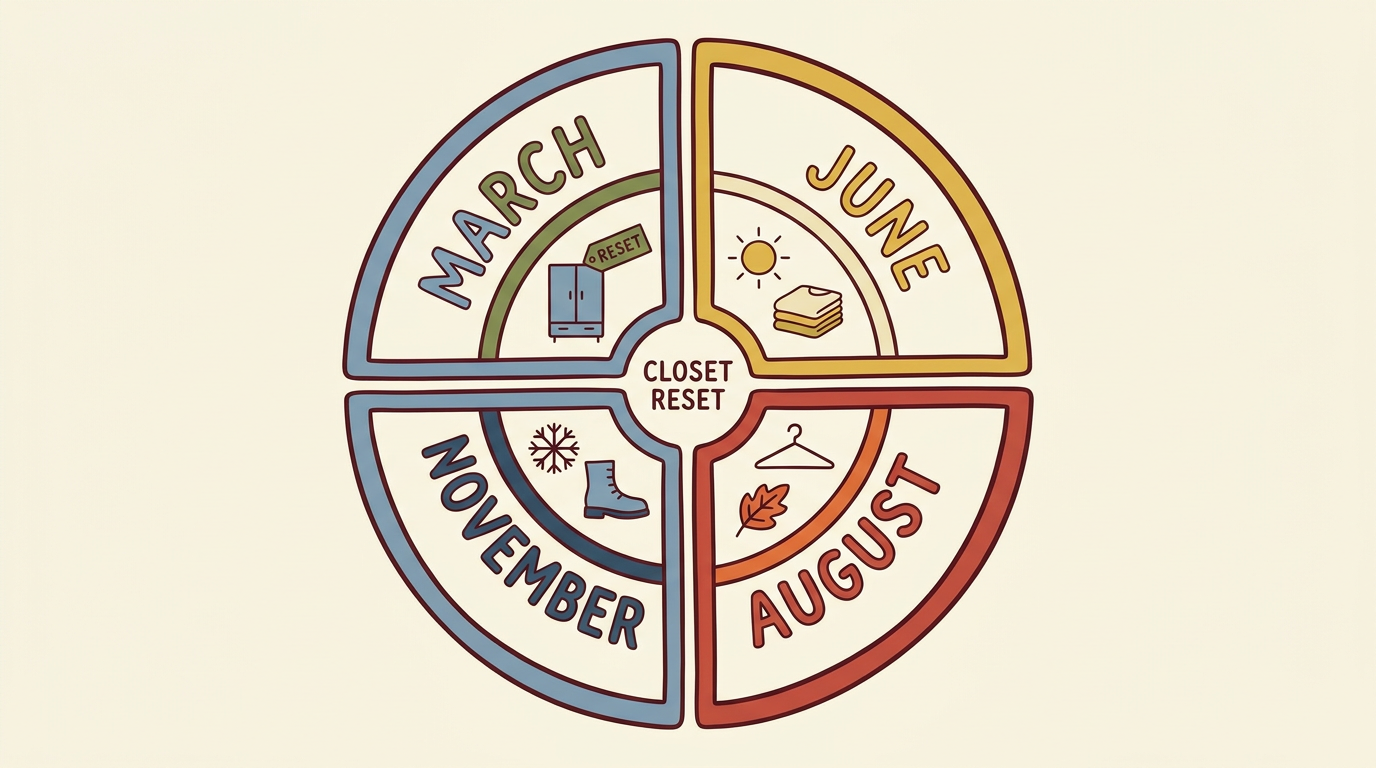
Only the August reset needs ninety minutes. The other three are thirty-minute passes, and that is not optimism — it is what happens when the closet has not been allowed to drift for a year. You are correcting a small deviation instead of excavating.
That is the whole mechanism. Each reset is small because the system is already running between them.
Prelove You maps to this rhythm directly: a send-in aligned to each reset means the outbound step is already scheduled before you start, which is exactly the failure point identified at the top of this post. For a family that wants the cadence without a monthly commitment, the $195 seasonal membership lines up cleanly with four passes a year. That is information, not a pitch — the cadence works regardless of how you route the bag.
A cadence on paper is easy. The real test is whether it survives the first busy month of the school year.
Keep the reset alive by making the outbound step permanent rather than occasional. Designate one visible spot for outgrown pieces, add to it as things stop fitting, and send the whole thing on a fixed schedule. When clothes have a standing exit route, the closet self-corrects instead of quietly refilling behind you.
The habit that carries all of this is smaller than you’d think, and it fits in a corner.
One permanent, deliberately visible spot for outgrown items. Not a hidden bin in a closet you rarely open — a decided location you walk past. By the laundry room door. At the end of the upstairs hall. Wherever the household actually moves.
Items go in as they stop fitting, in real time. The jeans that pinched at breakfast go in at breakfast. The shoes that pressed at the toe go in the moment they come off. Nothing accumulates in anticipation of a future sorting event, because there is no future sorting event — there is only a bag that fills and gets sent.
This is the single highest-leverage habit in the post, and it costs nothing to adopt.
The reset stops being an event the moment the outbound step becomes standing.
You are no longer performing a purge four times a year. You are emptying a channel that fills itself continuously. The seasonal pass shrinks from an excavation to a verification — you check the counts, catch what the daily flow missed, and send the bag.
That is the difference between a system and a scramble, and it is the promise in the title of this piece, delivered.
Note carefully what this does not depend on. It does not require you to become more disciplined, more organized, or more of a morning person. It works by eliminating decision points, which is a design choice rather than a character improvement. Systems that run on willpower are just deferred failures with a friendlier interface. If you want the research on why decision elimination matters so much in this specific domain, the mental load of kids’ clothes is well studied and genuinely worth reading about — particularly if your honest objection right now is that you don’t have the bandwidth for another household system.
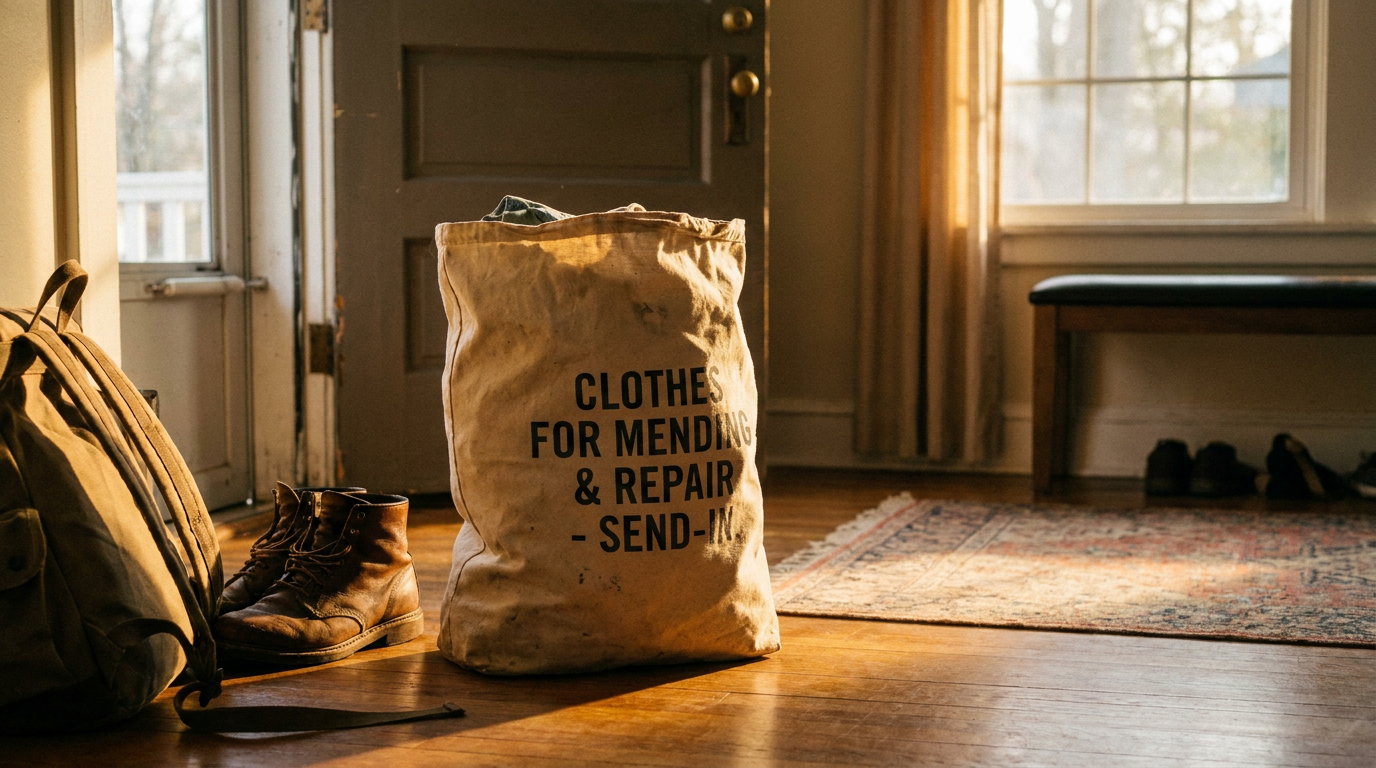
Prelove You is the standing channel. Send in what your children have outgrown — including the pieces that are past wearing — receive credits, and shop for high-quality, new-to-them pieces when the gap list says you need something. One loop, repeating on your cadence.
The membership structure is straightforward: Lite at $35/month, Luxe at $65/month, and Limitless at $95/month, plus the $195 seasonal membership for families who prefer to run four passes a year rather than a monthly rhythm. That is the whole of the pricing conversation.
One clarification worth making plainly, because the category language in this space is muddy: Prelove You is a membership ecosystem — not resale, not consignment, not a thrift platform. The distinction is not cosmetic. A marketplace asks you to do the labor: photograph the item, write the listing, price it, answer questions, negotiate, package, ship, repeat. A system removes that labor entirely. You are not running a small business out of your child’s closet. You are emptying a channel.
There’s one more piece in development that matters more than its size suggests. Prelove You is building a digital library book card system — so families can follow the journey of the pieces they send on, and see where a well-loved jacket goes next.
It is a small detail that keeps the loop from feeling anonymous. A bag that leaves the house and disappears is logistics. A bag that leaves the house and can be followed is a thread. That is the tagline, Follow the Thread, made literal.
With the system running, the last question is the one that makes it worth running at all — what happens when your child steps into it.
Involve your child by giving them real decisions rather than supervision. Let them choose which pieces stay, notice which ones they reached for most often, and spend credits on what comes next. Children who participate in the reset develop taste, understand value, and stop treating clothing as something that simply appears in a drawer.
Let’s be honest about the reason, because the usual one is wrong.
You are not bringing your child into this for help with the labor. A child will slow the reset down, sometimes considerably, and will occasionally advocate passionately for a shirt with a hole in the armpit. That is fine. The point is not the sorting. The point is what your child learns while the sorting happens.
Clothing arrives in most children’s lives the way weather does — externally generated, non-negotiable, mildly mysterious. A child who has never participated in a wardrobe decision has no framework for cost, for wear, for why one thing lasted three years and another fell apart in a term. The reset is a rare, natural, low-stakes classroom for all of it.
This deserves saying plainly, because it is the most meaningful thing on the platform and it is easy to mistake for a loyalty mechanic.
With Prelove You, credits give a child a finite, real resource and a genuine choice about how to use it. That combination is rare in a child’s life. Most of what they choose between is either free or entirely someone else’s decision.
A child standing in front of two things they genuinely want, with an actual constraint that means one of them isn’t happening today, is learning value in a way no conversation can teach. They will weigh it. They will change their mind twice. They will occasionally choose badly and remember it — which is the good kind of expensive lesson, priced in credits rather than consequence.
That is worth more than a tidy closet.
How to Talk About “Most Worn” With Your Kid
“Remember that one thing you wore again and again this year? That’s because it made you feel amazing. Clothes that feel good help us feel brave, comfy, and confident — aka the best style recipe ever.”
A child who understands that the jacket they loved goes on to another child is learning something about endings that has very little to do with clothing. Things can be over and still have been good. That lesson arrives more gently through a coat than through most other doors.
Keep it light. Don’t turn it into a lecture — the restraint is what makes it land.
And tape the bag closed together. It takes eleven seconds, it marks the end of something, and rituals are what make systems stick.
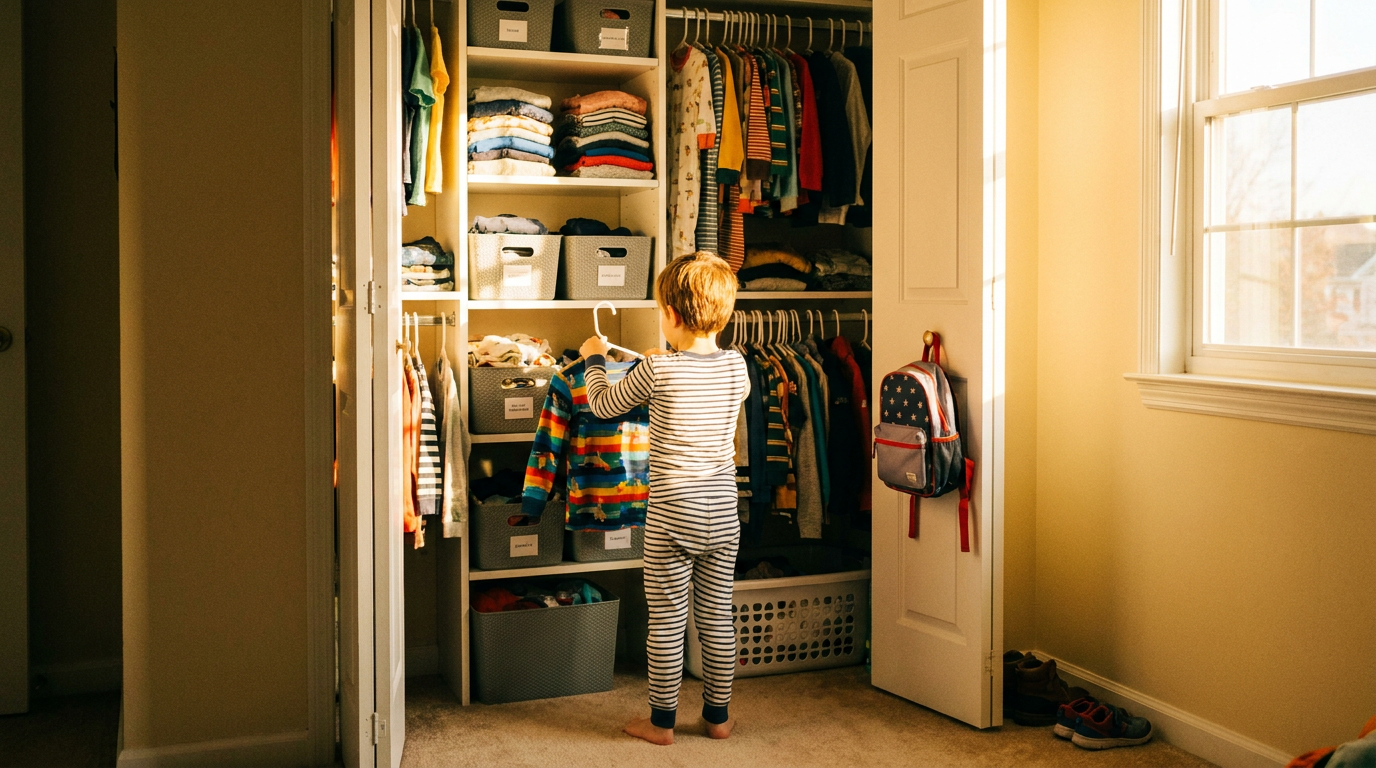
Late August again. The closet holds one size now. The drawer closes. And the bag by the back door is there on purpose — filling, scheduled, going somewhere.
Three beats carry the whole thing: sort by destination, count against a real school week, and keep the exit route standing. Everything else in this post is detail hanging off those three.
The back-to-school closet reset is not a weekend project you survive once a year and quietly dread. It is a household rhythm you run — ninety minutes in August, thirty minutes three more times, and a channel that empties itself in between.
Prelove You is the infrastructure underneath that rhythm. Not a bin, not a method, not a burst of resolve. Just the outbound channel that makes the whole thing repeat.
You’ll know the one. The jacket they wore until the cuffs went soft, the shirt they’d have slept in if you let them. Somewhere out there, it’s about to become somebody else’s favorite thing.
Stop managing the overflow. Start building the system.
Send in what your kids have outgrown — including the pieces that are past wearing — receive credits, and shop for high-quality, new-to-them pieces against a list you actually made.
Lite — $35/month. Luxe — $65/month. Limitless — $95/month. Seasonal membership — $195. Gifting memberships are available, for the parent who has everything except a plan for the closet.
Begin the reset — or read The Household System first, if you’d like the framework before the membership.

