



 Sustainability Scoop
Age-by-Age Guide: When Kids Can Start Making Their Own Wardrobe Choices
From the toddler who insists on wearing the same shirt five days in a row to the preteen building a wardrobe that’s entirely their own — here’s what the research says, and how to meet your child where they are.
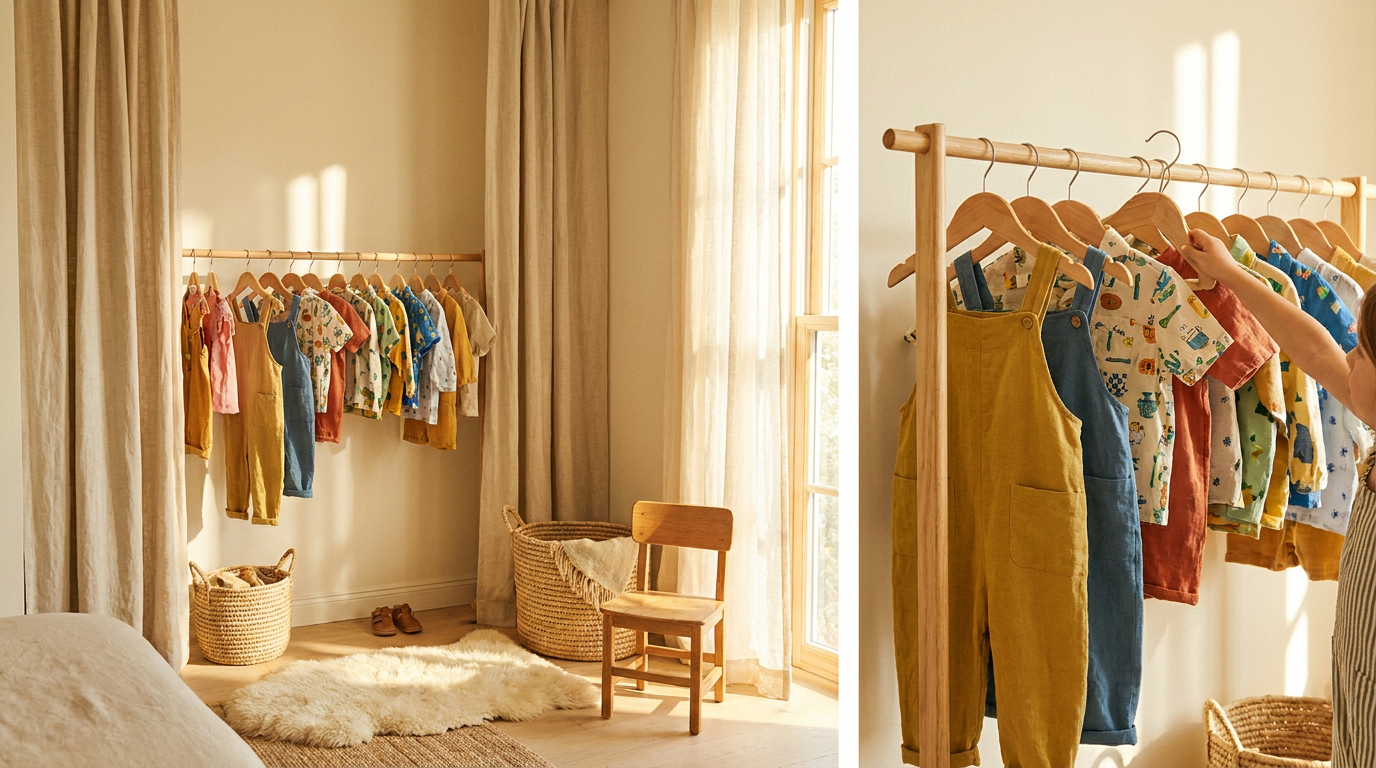
It starts in summer. The school bag is finally in the closet, the uniform is balled up at the bottom of the laundry basket, and suddenly — freedom. Your child stands at the drawer and pulls out the swimsuit. It is 9am. You are not going swimming. They are wearing it anyway, pulled over yesterday’s shorts, with the cape from last Halloween layered on top. They are completely, radiantly, non-negotiably certain about this outfit.
You have two choices: the battle, or the moment.
This guide is an invitation to see the moment. Because what looks like stubbornness — the insistence on the rain boots with the sundress, the refusal to retire the beloved dinosaur shirt that barely skims the belly button anymore, the four-year-old who needs exactly this tutu for a Tuesday trip to the grocery store — is not really stubbornness at all. It is something more interesting, and more important. It is a child practicing being themselves.
Kids’ wardrobe choices by age are one of the earliest and most consistent arenas in which children try on identity, test preference, build agency, and discover the rudiments of self-expression. Getting dressed is not a logistical task to your child. It is, in its own very real way, an act of becoming.
This guide is not about managing morning meltdowns. It is not a battle-avoidance strategy, and it is not a behavior management plan. It is a developmental map — an age-by-age look at what children are actually doing when they insist on that outfit, what they’re ready for at each stage, and how you can involve them meaningfully in the whole clothing cycle: what comes in, what goes out, and what the whole thing teaches them along the way.
Summer is the ideal moment to begin. No dress codes. No uniforms. More time, lower stakes, and a drawer full of possibility. Whether your child is two or twelve, the season has just handed you an open window. Here is how to climb through it together.
There is a version of this conversation that treats a child’s clothing opinions as a phase to manage. Cute when they’re little, irritating when it slows you down, something to be navigated around. But what the research shows is something different — and significantly more interesting.
Children begin using clothing as a social and cognitive tool far earlier than most parents realize. A 2022 study published in ScienceDirect found that children as young as three use attire to infer in-group and out-group membership — to identify who belongs to the same social world as they do. This is not about vanity. It is about social cognition. By the time your child is throwing a fit about wanting to wear the same dinosaur shirt as their best friend, they are engaged in something developmentally sophisticated: using clothing as a social signal, the way humans have done for centuries.
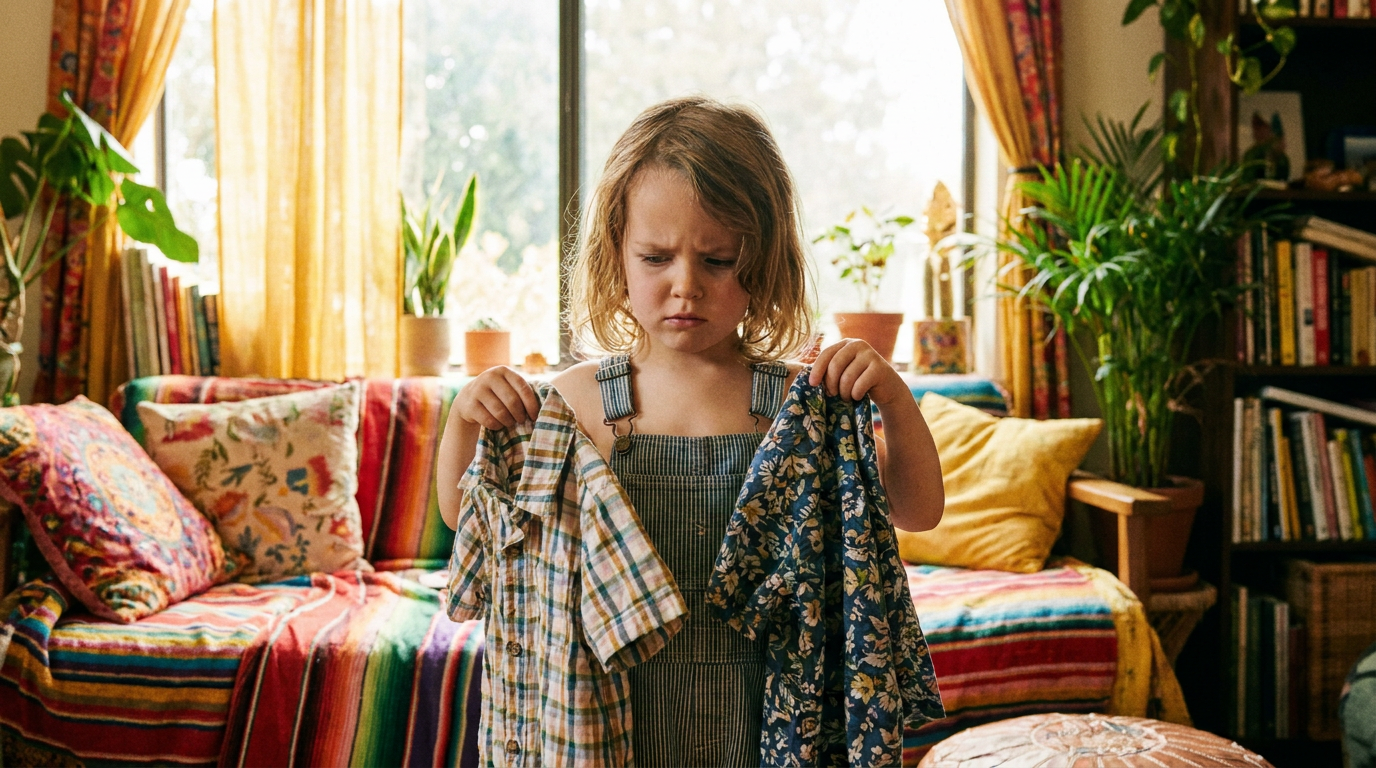
The connection between clothing autonomy and self-perception deepens as children grow. A peer-reviewed study of K–5 children published in SAGE Journals found that as children age, their involvement in clothing acquisition and care increases — and that this involvement directly correlates with positive self-perception. Children who participated more in decisions about what they wore reported stronger senses of self. The shirt is not just a shirt. It is, in the language of child development, a vehicle for identity formation.
And the bodies that study children most closely agree. The American Academy of Pediatrics recognizes that allowing children to make simple choices — including clothing choices — from as early as ages three to five actively builds decision-making confidence and supports the development of healthy autonomy. Clothing offers exactly what developmental experts say children need: low-stakes, high-frequency opportunities to practice choosing. Every morning is a small classroom in preference, consequence, and identity.
What this means practically is important: the child who insists on the dinosaur shirt is not being difficult. They are being developmental. They are doing something normal, healthy, and research-supported. Naming that distinction does not mean every outfit battle disappears overnight. But it changes the parent’s experience from frustration to recognition — from why are you doing this again? to oh, this is how they’re growing. That shift is everything.
This is also the foundation of what Prelove You is built on: the belief that children are not passive recipients of clothing. They are participants in its story — from the first time they reach for something because it feels like them, all the way to the moment they’re ready to pass it on. That participation starts remarkably early. And it starts here.
Now that we know why this matters, let’s look at when — age by age, stage by stage, beginning with the very smallest people and their very big feelings about socks.
If you have ever watched a toddler systematically remove every sock from their foot the moment you put it on, you have witnessed the earliest form of children’s fashion autonomy in action. It does not look like fashion. It looks like a very small human waging war on your morning schedule. But what is actually happening is something much more interesting: your child is discovering that they have a body, that things are on it, and that they have opinions about that.
According to developmental research from Vivvi, children as young as twelve months begin to show awareness of their clothes by removing socks, hats, and shoes. This is not defiance — it is sensory processing. Between twelve and eighteen months, children are becoming newly conscious of their bodies and the things touching them. The sock that felt fine an hour ago suddenly registers. Off it comes.
By ages two and three, this sensory awareness graduates into something that looks much more like preference. Toddlers at this stage develop strong attachments to texture (the scratchy collar is not happening, ever), silhouette (elastic waistbands are life, buttons are the enemy), and visual identification — the shirt with the dog on it, always, forever, no substitutions. These preferences can feel baffling from the outside, but they are entirely logical from the inside. The toddler is building a vocabulary of comfort and belonging, one item of clothing at a time.
What you can do at this stage:
At ages one through three, the goal is not to build a wardrobe or teach a lesson. It is simply to establish something foundational: that your child’s preferences are real, and that they matter. The most practical way to do this without surrendering your household to complete chaos is the structured binary choice. Instead of opening the drawer and asking what they’d like to wear — which is genuinely overwhelming for a two-year-old — you hold up two options. “The red one or the blue one?” The choice is real. The confidence it builds is real. The fact that both options were parent-approved before the question was ever asked is something you don’t need to mention.
What to skip: the power struggle. If the rain boots go with the sundress on a dry Tuesday, this is not the battle that matters. The confidence being built in that small moment of “I chose this” is worth far more than a weather-appropriate shoe pairing. The stakes are genuinely low. The developmental payoff is genuinely high.
“You don’t have to sort, grade, or second-guess. Send it all — and let your child be part of the goodbye. The story of that piece doesn’t end when it leaves your drawer.”
Involving them in the clothing cycle:
Even at this age, you can begin planting the seed of what comes next. When a onesie is officially retired — too small, worn to its absolute limit, loved right to the last thread — a toddler can participate in the goodbye. Wave goodbye together. Narrate it out loud: “This is going to another little one who will love it just as much as you did.” You are not asking for a decision. You are telling a story. But it is the beginning of a story your child will be able to participate in more meaningfully with every passing year — the story of where things go, and why that matters.
For parents using Prelove You’s clothing system, this is where the cycle begins. At this stage, you’re doing the sending. But you can narrate it to your toddler. You are laying the emotional groundwork for everything that comes later.
As toddlers grow into preschoolers, preferences become something new: opinions. Strong, loud, occasionally baffling, completely unwavering opinions. That is exactly what comes next.
There is a particular kind of morning that every parent of a preschooler knows. The outfit has been selected — by the child, with great ceremony and absolute certainty, the night before. You arrive at 7am to find that the outfit is no longer correct. It is unclear why. The reasoning, if offered, does not fully track. The conviction is total.
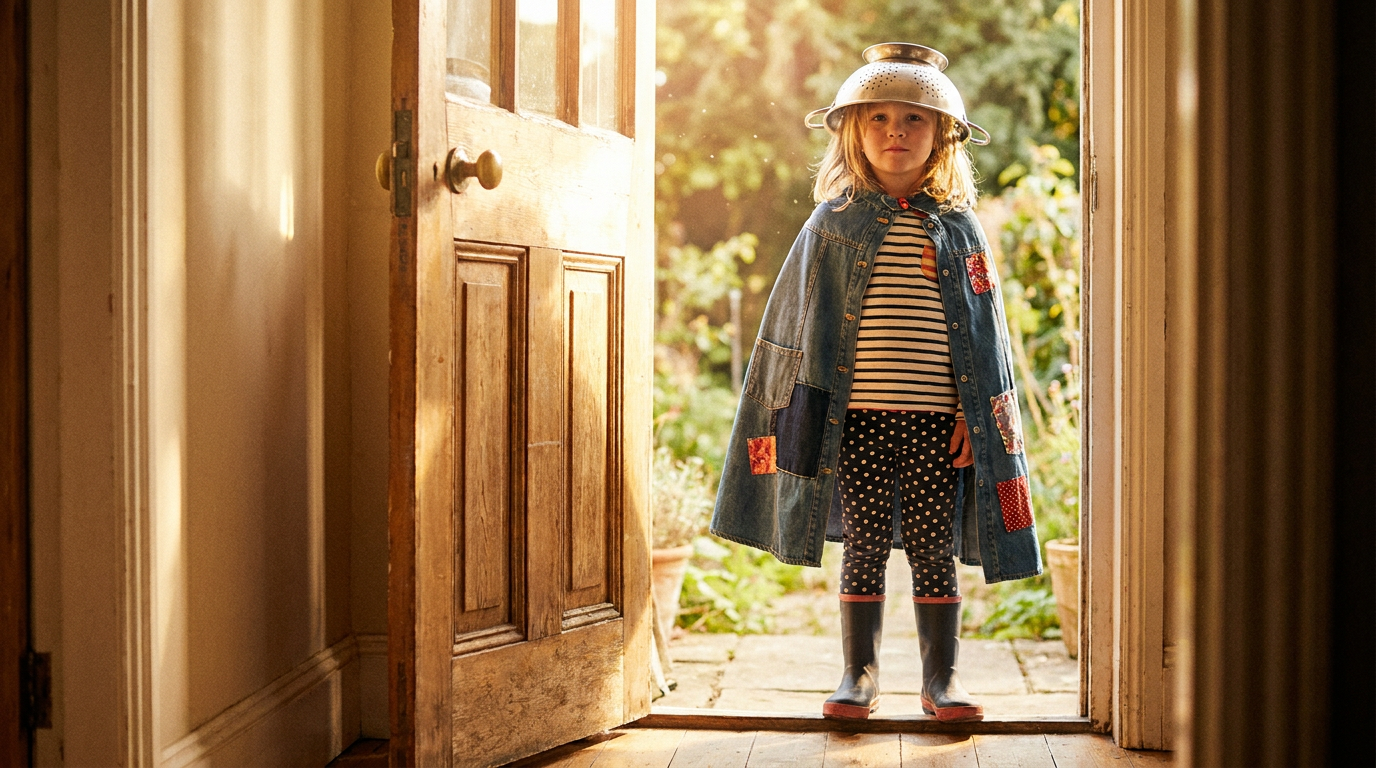
Welcome to ages three through five, where clothing becomes a full-blown arena of identity exploration. This is the stage most parents think of when they think of “battles over what to wear.” But reframing it changes everything. What you are actually watching is a child using clothing to try on different versions of themselves — the superhero at the library, the princess at the park, the person who wears stripes and polka dots simultaneously because that is a valid aesthetic choice. This is not chaos. This is imaginative self-construction, and research on child development consistently supports the value of honoring it.
Developmental milestones for this age range show that preschoolers can dress in simple clothing with minimal assistance, managing most pull-on items independently. But what defines this stage is not the physical capability — it is the emotional investment. A four-year-old is not just putting on clothes. They are making a statement. The statement might be “I like dinosaurs and I will not be told otherwise.” The statement might be “today I am a ballerina-firefighter.” Both are valid. Both are developmental. Both deserve a moment of recognition rather than redirection.
What you can do at this stage:
The most effective practical tool for preschooler clothing choices is what you might call the curated drawer. You — the parent — select a wardrobe of options that are all parent-approved: age-appropriate, seasonally suitable, no sequin ball gowns for December mornings. Then you step back. Within that curated selection, every choice is entirely theirs. The perception of complete freedom, the reality of a guided wardrobe. It is not deceptive. It is developmentally appropriate scaffolding, and it works remarkably well.
You can also begin building the vocabulary of dressing without the veto. Instead of “it’s too hot for that,” try “it’s summer — does this feel like a hot-day outfit or a cool-day outfit?” You are teaching them to connect what they wear to the world around them. You are building reasoning skills, not just issuing directives. The distinction matters enormously to a child this age, for whom because I said so is approximately the least satisfying answer in existence.
Here is something worth knowing about the strong attachment to specific pieces at this age. The same ScienceDirect study that found toddlers using clothing as a social marker suggests that the beloved, worn-to-tatters favourite shirt is not simply a comfort item. It may represent belonging, identity, and social connection. The child who wears the same shirt five days running may be anchoring themselves to something — a feeling, a person, a version of themselves they want to hold onto. This does not mean it never gets washed. But it means the attachment deserves acknowledgment rather than dismissal.
Involving them in the clothing cycle:
This is a wonderful age to introduce the seasonal sort as a game. Get out everything from the drawer. “Does this still fit? Let’s see!” Try-on sessions with stickers to mark the “growing pile” are genuinely fun for most preschoolers. You’re not asking them to make a sacrifice — you’re inviting them into a ritual. The growing pile is not a loss; it is evidence of something exciting. You grew out of this. Look how big you are now.
Summer is the perfect season to start. No uniforms, no dress codes, just a drawer full of mix-and-match options and the freedom to decide. Let them lead. Watch what they choose. You might learn something about who they’re becoming.
By the time children reach school age, something shifts in how they look at clothing. They start looking outward. Peers arrive. Social comparison begins. And the wardrobe becomes a significantly more complex piece of the social world.
Something changes when children start school. The world gets larger. Other children arrive — with opinions, with clothing, with the subtle but powerful social signalling that comes from what you wear and who wears what. For six, seven, and eight-year-olds, clothing begins its evolution from personal expression to social language. And that shift is entirely normal, developmentally expected, and worth understanding rather than worrying about.
By ages six through eight, most children achieve full independence in dressing — including tying shoes, selecting complete outfits, and managing the physical mechanics of getting dressed without assistance. But the more significant development at this stage is internal: children develop strong, consistent personal style preferences, and they begin to notice and care about what their peers are wearing. This is not shallowness. It is how belonging gets navigated at this age. Clothing becomes a social tool, a way of signalling I am like you or I am part of this group. The research backs this up, and understanding it shifts the parent’s response from concern to curiosity.
What you can do at this stage:
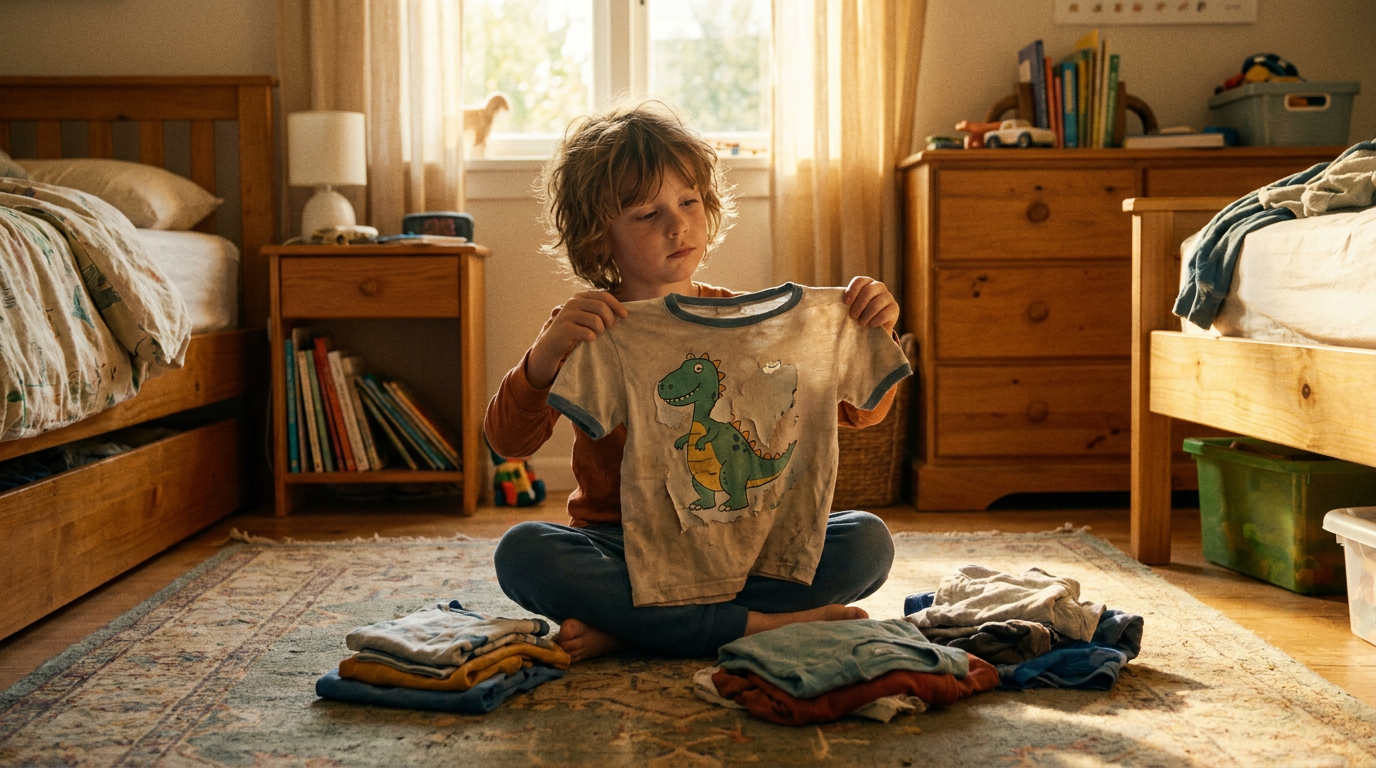
Seasonal wardrobe edits become genuinely useful — and genuinely collaborative — at this age. Go through the drawer together. What fits? What doesn’t? What do they love, what have they grown past emotionally as well as physically? Give their preferences real weight in this conversation. A seven-year-old who is consistently asked “what do you think?” in the context of their own wardrobe is building something valuable: a sense that their taste is legitimate, that their preferences matter, and that their voice belongs in decisions that affect them.
One practical tool worth trying: the “most worn” list. With your child, identify the five or six items they reach for constantly — the ones that are always at the top of the drawer or always first off the hanger. Build the wardrobe around those pieces rather than filling the space and hoping for the best. A smaller wardrobe of things they actually wear beats a full one of things that never see the light of day. This is also the beginning of something they’ll grow into: the idea of a curated wardrobe, chosen with intention.
When kids can understand clothing and value:
Research shows that children begin to perceive value in their possessions from around age seven, developing the ability to weigh benefit against sacrifice. They start to understand that things have worth — not just in cost, but in use, in meaning, in how much they’re actually loved and used. This makes ages six through eight exactly the right moment to start conversations about what things are worth, and what happens to them when we’re done.
This is the age when children can begin to understand where outgrown clothes go — and why it matters that they go somewhere good. The concept of another child who needs this lands with real empathy at this stage. They can pack the bag. They can be part of the send. And if there’s a system in place — something like Prelove You’s credit-based model, where the act of sending something on earns value toward what comes next — you can introduce that concept simply and concretely: when we send this, we earn credits for something new for you.
“Remember that one thing you wore again and again this year? That’s because it made you feel amazing. Clothes that feel good help us feel brave, comfy, and confident — aka the best style recipe ever.”
The final age range in this guide is where children’s autonomy around clothing becomes genuinely and fully their own — and where the opportunity to teach real-world values reaches its richest expression.
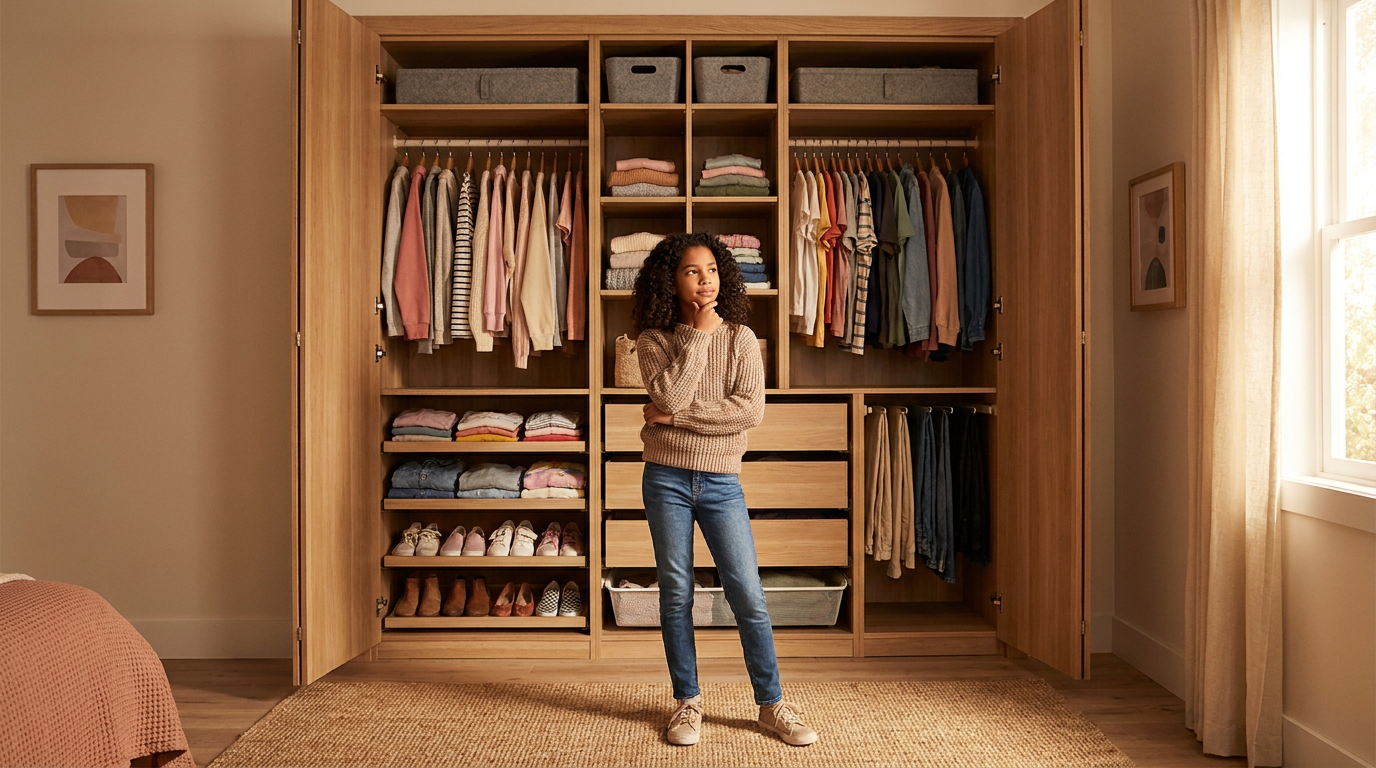
By the time a child reaches the preteen years, something remarkable has happened. They are no longer just choosing clothes. They are curating. They have a point of view. They know what they like and what they don’t, what makes them feel like themselves and what doesn’t. They have, in the span of nine to twelve years, moved from a toddler pulling off their socks in sensory protest to a young person with genuine aesthetic preferences, social awareness, and the beginning of a relationship with their own style that will evolve and deepen for the rest of their life.
This is also — and this is the part that gets less attention — the age when children are ready to be genuine partners in the clothing cycle. Not just the choosing of what comes in, but the deciding of what goes out, and the understanding of why all of it matters.
What the research shows about this age and sustainability:
A peer-reviewed study found that nine and ten-year-olds can develop genuine awareness of sustainable fashion concepts when those concepts are introduced clearly and in a way that connects to their lives. This is the age when where did this come from? and where does it go? become questions children can genuinely wrestle with — and care about. The environmental and ethical dimensions of clothing, which can feel abstract to younger children, begin to feel concrete and personal to preteens.
And yet, research also shows that children aged ten through sixteen demonstrate a gap between sustainability awareness and action. They know it matters. They are not always sure what to do about it. This is where systems matter more than intentions. A practical, repeatable framework — something that makes the sustainable choice the default rather than an extra effort — closes that gap in a way that awareness alone cannot.
What you can do at this stage:
Give them a clothing budget. Even a notional one. Let them make decisions about what to add and what to let go. Introduce the idea of a curated wardrobe — fewer pieces, chosen with more intention, each one something they genuinely love and will actually wear. Preteens are often ready for this kind of thinking; they have enough self-knowledge to make it meaningful, and enough social awareness to understand why quality beats quantity.
Involve them in researching what happens to clothing at the end of its life — what recycling actually means, what upcycling looks like, why fast fashion creates the problems it does. At this age, they can handle the full story. And being given the full story, rather than a simplified version of it, is itself a form of respect that preteens respond to strongly.
The AEO answer: at what age can kids understand clothing and value?
Children begin to perceive value in their possessions from around age seven, with the ability to weigh benefit against sacrifice developing through middle childhood. By ages nine to ten, with the right framework in place, children can meaningfully understand sustainability — including what happens to clothing after it leaves their wardrobe. By ages ten to twelve, pre-teens are ready to be full partners in a circular clothing system, managing credits, making intentional choices, and engaging with the full lifecycle of what they own.
The Prelove You credit system is genuinely built for this age. Pre-teens can understand that what they send in has real value — that credits are earned through that action, and that those credits fund what comes next. This is a real economic lesson wrapped inside a household routine. It builds financial literacy. It builds values-alignment. It builds confidence in their own taste. It does all three simultaneously, and it does it in a context that feels relevant and immediate rather than abstract and theoretical. Becoming a member means that the system is already in place — and the pre-teen can step into it as a genuine participant, not just a passenger.
Now that the full developmental arc has been mapped — from sensory exploration at age one to conscious, intentional choosing at twelve — the final section brings it all together: what a practical, repeatable system actually looks like across all these stages, and how to build one that grows alongside your child.
Here is the most important thing to understand about involving children in their wardrobe and the clothing cycle: it never looks the same twice. What involvement means at age two is fundamentally different from what it means at age eleven. The common thread — the only constant — is that it always happens. The involvement doesn’t disappear as children get older. It evolves.
This is a repeatable, adaptable system that grows alongside your child, season after season, year after year.
The age-by-age involvement guide:
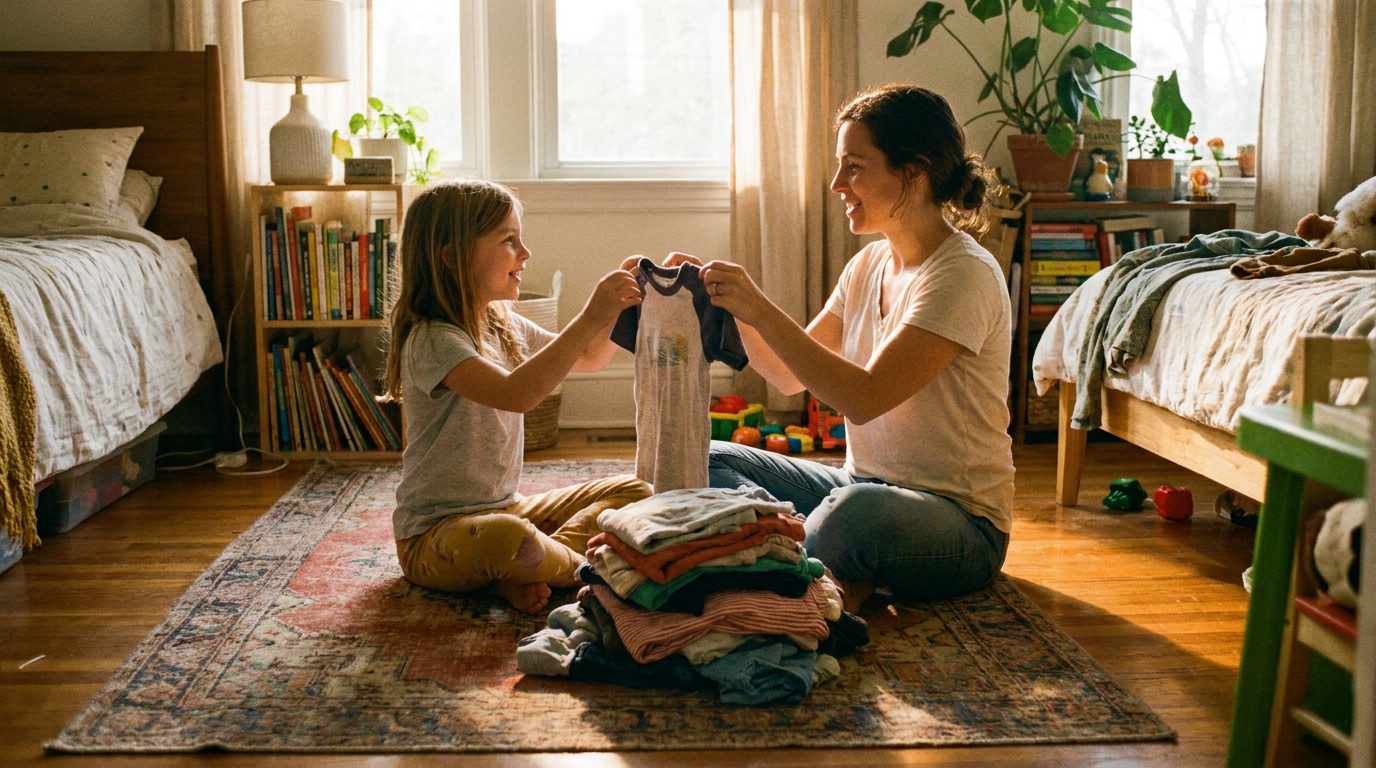
Ages 1–3 — Narrate the send. You are doing the deciding. Your toddler is along for the story. When something is outgrown, involve them in the goodbye. Wave together. Say the words out loud: “This is going to another little one.” No decisions required from your child at this stage — just the beginning of a narrative they will grow into.
Ages 3–5 — Make sorting a game. Try-on sessions are genuinely fun for preschoolers. Pull out the drawer, try things on, hand out stickers for the “too small” pile. A seasonal ritual becomes something they look forward to — not a chore, not a loss, but an event with a satisfying outcome and evidence of how much they’ve grown.
Ages 6–8 — Involve them in the pack and the story. Children at this age can understand where outgrown clothes go — and why it matters that they go somewhere good. They can pack the bag. They can choose what leaves. You can introduce the credit concept in concrete terms: when we send this, we earn credits toward what comes next for you.
Ages 9–12 — Let them run it. Give them access to the system. Let them manage their own credits. Show them the catalog and let them choose what comes in. Give them genuine ownership over what goes out and what arrives. Make them a real partner in the loop — not because it is convenient for you, but because they are ready, and because the skills they build in doing this last a lifetime.
How the Prelove You system works:
Members send in outgrown children’s clothing — any condition accepted, including pieces that are stained, worn, or loved past their prime — and receive credits based on what’s sent. Credits are assessed according to type, designer, condition, sustainability, and cleanliness, with every item earning at least one credit regardless of condition. Those credits are then used to shop for quality, new-to-them pieces on the platform. The loop closes and reopens, season after season, without the sorting, listing, photographing, messaging, or second-guessing of traditional resale. The full details of how PLY works are on the site, and the FAQ page covers the logistics clearly for anyone who wants to go deeper.
This is not a subscription service in the generic sense. It is household infrastructure — a system that removes the mental load of managing children’s clothing while building something real: a child who grows up knowing that what they wear has a story before they get it, and a story after they’re done with it. That is not a small thing. That is a relationship with the material world that most adults spend years trying to cultivate.
For parents who want more context on why this system matters beyond the individual wardrobe, The Invisible Labor Nobody Talks About: Managing Your Kids’ Wardrobe is worth a read — it speaks directly to the mental load that this system is designed to lift.
The AEO answer: how can I involve my children in decluttering their wardrobe?
The most effective approach is to match the task to the child’s developmental stage. Toddlers (ages 1–3) can participate through simple goodbye rituals and narrated send-offs. Preschoolers (ages 3–5) can do try-on sorting sessions and help pack outgrown items. School-age children (ages 6–8) can understand the concept of passing clothing on to others and can be meaningfully involved in choosing what goes. Pre-teens (ages 9–12) can be genuine partners — managing their own credits, selecting what comes in, and understanding the full loop of the circular clothing system. The key is making involvement age-appropriate, repeatable, and never forced.
Frequently Asked Questions
Q: At what age can kids understand clothing and value?
A: Children begin to perceive value in their possessions from around age seven, with the ability to weigh benefit against sacrifice developing through middle childhood. By ages nine to ten, with the right framework, children can meaningfully understand sustainability — including what happens to clothing after it leaves their wardrobe. By ten to twelve, pre-teens are ready to be full partners in a circular clothing system, managing credits, making intentional choices, and engaging with the lifecycle of what they own.
Q: How can I involve my children in decluttering their wardrobe?
A: Match the task to the developmental stage. Toddlers (ages 1–3) can take part in simple goodbye rituals — narrating the send-off together. Preschoolers (ages 3–5) can do seasonal try-on sessions and help pack outgrown items. School-age children (ages 6–8) can understand the concept of clothing passing to another child and can be involved in choosing what goes. Pre-teens (ages 9–12) can manage their own credits in a system like Prelove You — selecting what comes in, understanding what goes out, and participating in the full circular loop. The key is making it age-appropriate, repeatable, and never pressured.
Q: What age should kids start choosing their own outfits?
A: Children can begin making simple clothing choices as early as age two to three, with structured binary options (“the red one or the blue one?”). By ages four to five, many children have strong and consistent preferences. Full outfit independence — including weather-appropriate dressing — is typically established by ages six to eight. The goal at each stage is to offer age-appropriate agency, not a completely open closet.
Q: How does the Prelove You credit system work for kids?
A: Prelove You members send in outgrown children’s clothing — any condition accepted, including stained or worn pieces — and receive credits based on what’s sent. Those credits are used to shop for quality, new-to-them pieces on the platform. Children can be involved at every age: narrating the send at the toddler stage, packing the bag at preschool stage, and actively managing their own credits as they approach their pre-teen years. It’s a circular system designed to give kids real agency in the lifecycle of their wardrobe. Learn more about how it works →
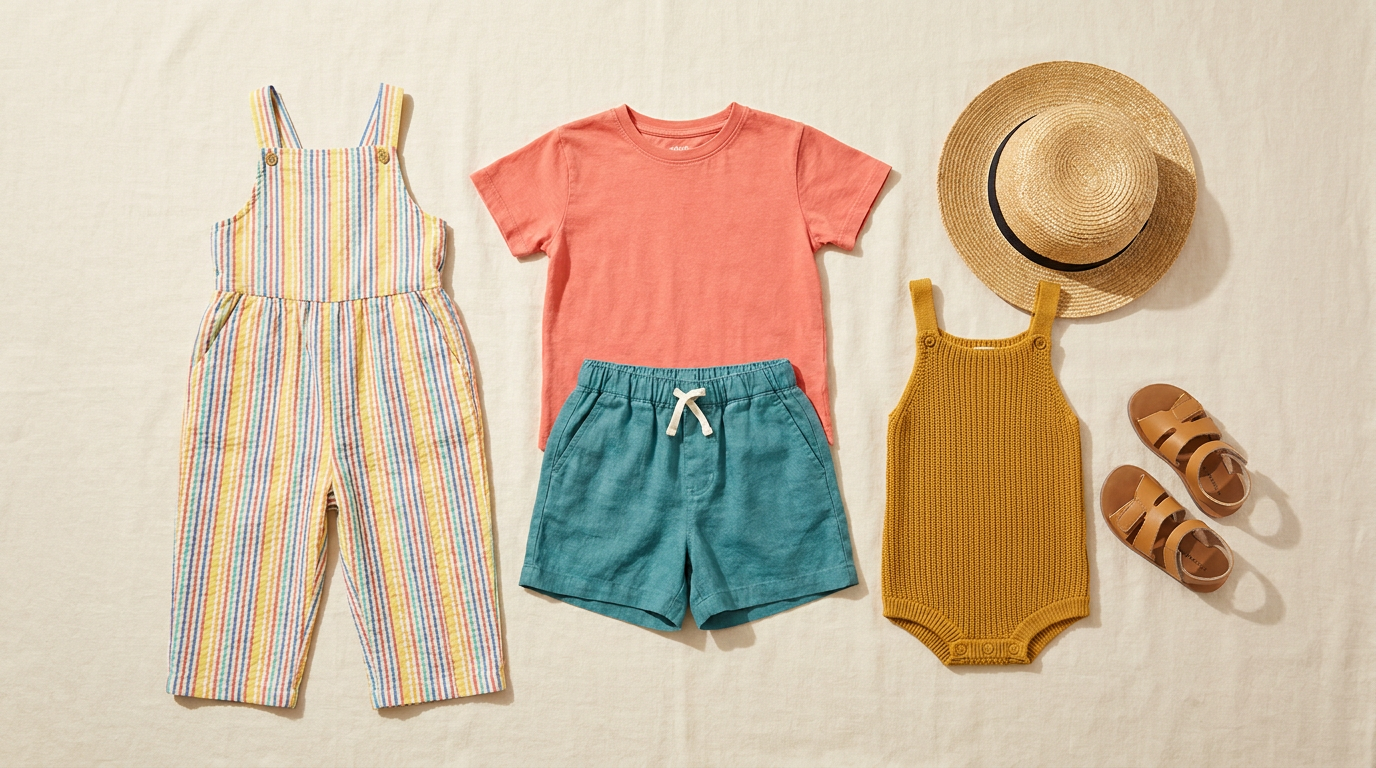
Go back to that summer morning for a moment. The swimsuit over the shorts. The Halloween cape. The dinosaur shirt that has been washed so many times the print is nearly gone. The rain boots with the sundress, worn with complete confidence onto the sun-warmed pavement.
You know now what those moments actually are. Not battles. Not phases. Not something to manage or redirect. They are a child practicing being themselves — in the earliest and most concrete way available to them. They are milestones. Small, bright, occasionally exasperating milestones that run all the way from the toddler pulling off their sock at twelve months to the preteen standing in front of their carefully chosen wardrobe at eleven, making decisions that reflect who they are and what they care about.
The system around clothing matters as much as the choices within it. A child who grows up with a repeatable, values-aligned framework for what comes in and what goes out is building something real — financial literacy, environmental awareness, and a relationship with their things that is thoughtful rather than disposable. Those qualities do not come from a lecture. They come from seasons and seasons of doing something small and consistent, together, in a way that grows with the child.
It does not have to be complicated. The system exists. The credits do the work. The involvement happens naturally at each stage when the framework is there to support it.
Clothing is, in the most literal sense, the common thread of childhood. It holds memory — the first-day-of-school cardigan, the birthday dress, the coat that made it through three winters and two siblings. It holds identity — the dinosaur shirt, the cape, the stripes-with-polka-dots declaration of self. And it holds the story of a child growing, season by season, into someone remarkable.
The job of a good system is to honor that — and to make the letting go feel as meaningful as the choosing.
Prelove You is the household clothing system for modern families — built to remove the mental load, honor the emotional weight of what your children wear, and give your kids real agency in the cycle of what comes in and what goes out.
Send in everything your child has outgrown — stained, worn, loved to threads. Earn credits. Shop for what comes next. Follow the thread, season after season.
Not sure yet? See how it works or read our FAQs.

