



 Sustainability Scoop
The Mental Load Map: Everything You’re Managing Around Your Child’s Clothing Without Realizing It
You already knew it was a lot. Here’s what it actually looks like when you put it all on paper.
It’s 7:14 AM. You’re making lunches. Somewhere between slicing the apple and zipping the bag, a background process fires: the spring bin hasn’t been sorted since March. And the sneakers — the ones that were “still fine” six weeks ago — are cutting into your older one’s toes now. You noticed at bath time, which means the mental note has been filed, but the action hasn’t happened yet, and the action requires first knowing what size comes next, and whether last year’s backup pair still fits, and if not, whether there’s budget for new ones before the weekend trip. None of this is on a list. All of it is on your mind.
This is what the mental load of parenting actually looks like. Not a single heavy thing — a hundred small running processes, executing simultaneously in the background, drawing on the same finite cognitive resources you need for everything else in your life.
If you could draw a map of every cognitive task you manage around your children’s clothing alone — every anticipation, every decision, every unresolved queue — what would that map look like? This post is that map. It names every node. It explains why the terrain is heavier than it appears from the outside, why it defaults to one parent’s mental architecture, and what it actually looks like when a functioning system removes the weight instead of just redistributing it.
According to a landmark 2024 study from the University of Bath and University of Melbourne, mothers handle 71% of all household cognitive tasks — 60% more than fathers. Children’s clothing management sits squarely inside that 71%, and it is among the most persistent, least visible, and most structurally underestimated domains on the entire map.
You’ve been carrying this without a name for it. Here’s the name. And here’s the full picture.
The mental load of parenting is not the laundry. It is not the school drop-off, the packed lunch, or the permission slip. It is the invisible cognitive work that precedes, orchestrates, and follows all of it — the thinking, planning, anticipating, monitoring, and deciding that happens constantly in the background, without a visible output, without acknowledgment, and without end.
Researchers who study this phenomenon have identified three distinct components that together constitute what is formally termed the invisible family load — a construct defined and validated in peer-reviewed research published in the Journal of Business Psychology. Understanding these three components is the key to understanding not just what you’re carrying, but why it feels like it never stops.
The first component is managerial labor — scheduling, planning, coordinating, and directing. This is the project management layer: knowing what needs to happen, when, and in what sequence. For children’s clothing, this shows up as tracking what’s needed for next season before this season ends, planning a shopping trip around a growth spurt, coordinating hand-me-downs between siblings or cousins.
The second component is cognitive labor — the knowing, remembering, anticipating, and processing. This is the mental database: holding in active memory what size each child currently wears, which pieces are getting tight, what’s in the bin upstairs, and what needs to be sourced before the weather turns. It is the background processor that never fully closes, even during rest.
The third component is emotional labor — the worrying, the weighing, the feeling-through of decisions that carry emotional weight. Which pieces do you keep? What do you do with the stained ones? What does it say about you if the seasonal transition bin sits in the hallway until December?
Together, these three layers constitute the mental load. And the research is unambiguous about who carries them.
The Mental Load Map
“The mental load isn’t the laundry. It’s knowing the laundry needs doing, remembering which child has PE tomorrow, noticing the detergent is running low, adding it to the list — and holding all of it in a background process that never fully closes.”
The 2024 University of Bath and University of Melbourne study — drawing on data from 3,000 US parent respondents — found that mothers handle 71% of household cognitive tasks overall. For daily, repetitive tasks specifically — the category that most directly captures clothing management — mothers carry 79% compared to fathers’ 37%. And critically: fathers systematically overestimate their contribution, while mothers systematically underestimate the degree of the imbalance. This is not a communication failure. It is a structural feature of invisible labor — a feature that a systematic review of gendered mental labor in Springer Nature’s journal Sex Roles confirms is documented, studied, and real.
Why does it keep growing? Because children grow. And with growth comes a new cycle of every task on the map — forever, at a rolling frequency that never reaches a stable endpoint. There is no point at which children’s clothing management is finished. Every season resets the clock. Every size transition reopens every node. The load is not heavy because of any single task. It is heavy because it never completes.
With the framework established, the next step is the map itself — rendered in full, node by node, so that what has been living in the body without words can finally be seen on the page.
This is the section most parents will want to screenshot and send to someone without comment. Because what follows is not a vague description of “the mental load of kids’ clothes.” It is a precise, enumerated map of the specific cognitive tasks you have been managing — probably for years — without ever having seen them laid out all at once.
Nine nodes. Each one real. Each one ongoing. Together, they form a web that never closes.
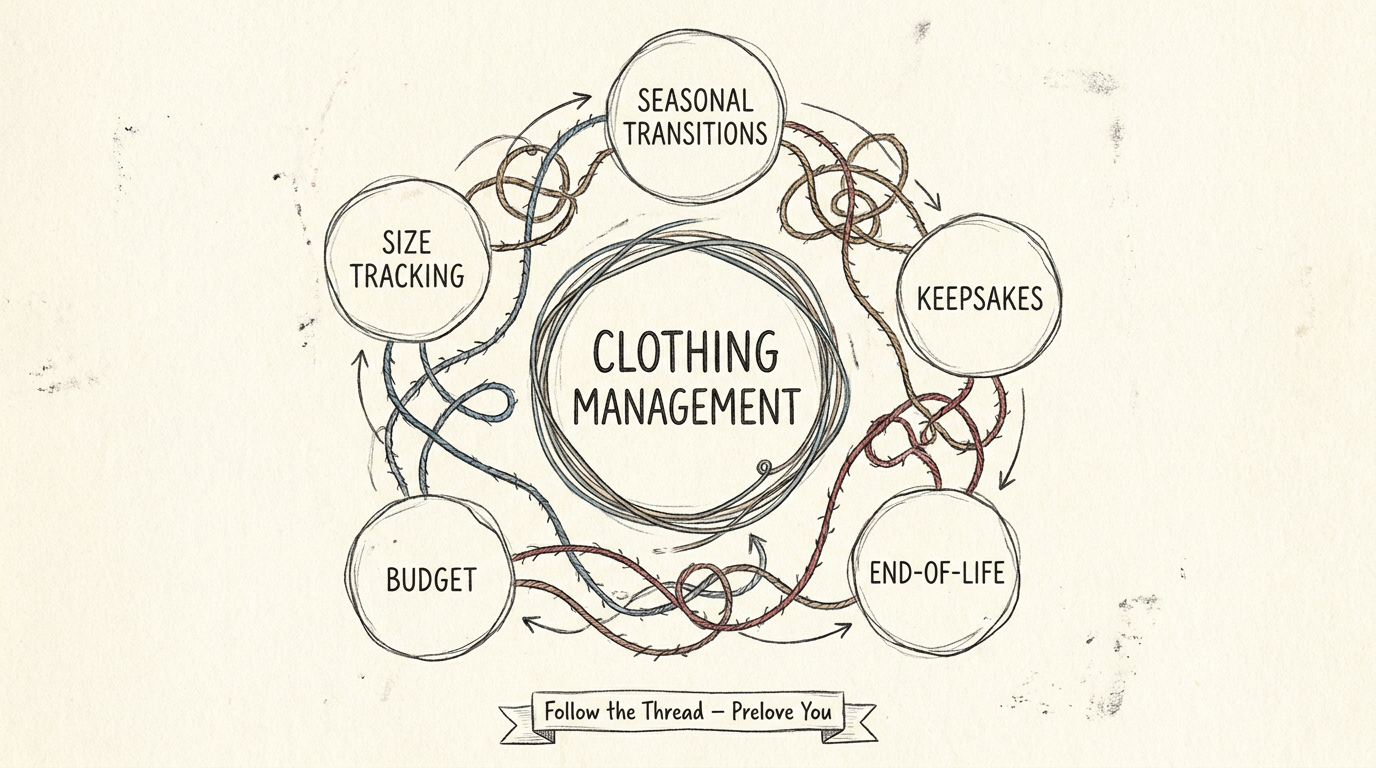
Node 1 — Size Tracking and Growth Anticipation
Knowing what size each child is in right now is only the entry point. The actual cognitive task is noticing when something is fitting tight before it becomes a problem — before the waistband leaves a mark, before the sleeves stop at the wrist, before the shoes are causing pain that the child doesn’t have words for yet. It’s doing this simultaneously across every category: tops, bottoms, outerwear, shoes, sleepwear, swimwear. And it resets constantly because children’s bodies do not grow on a schedule that respects a parent’s bandwidth. Babies cycle through as many as 7–8 sizes in the first two years of life, and school-age children outgrow clothing roughly every six weeks to four months depending on their age and growth phase. Size tracking is not a task you complete. It is a monitoring function that runs continuously.
Node 2 — Seasonal Transition Management
Every spring and fall, the same process: pull out the bin from storage, assess what still fits from last year, identify the gaps, make the list, source what’s needed — ideally before the season arrives, because buying reactively (when your child is already cold) is both more expensive and more stressful than buying ahead. This happens at minimum twice a year per child. In practice, it happens more often — a winter that turns early, a summer that lingers, a child who outgrows a size mid-season. The season does not wait. And neither does the cognitive work of staying ahead of it.
Node 3 — School Dress Codes and Uniform Logistics
For families navigating school dress codes or uniforms, this node adds a separate layer of complexity. There’s the tracking of what the code requires, the management of keeping compliant pieces clean and accessible for the days they’re needed, the sourcing of replacements when items are lost, outgrown, or worn beyond use. And layered underneath all of that is the daily negotiation between “what they’re allowed to wear” and “what they’ll actually put on without a fight” — which is its own low-grade daily exercise in child psychology and strategic compromise.
Node 4 — Sports Uniforms, Activity Gear, and Occasion Clothing
Alongside the main wardrobe, a secondary queue runs in parallel: the sports kit with its specific sizing and replacement cycle, the dance costume that needs ordering six weeks before the recital, the swim team suit that goes through chlorine daily and needs replacing every few months, the holiday outfit that last year’s version no longer fits. These pieces are each tracked on their own timelines, sourced through different channels, and stored in different places. Each category has its own cognitive overhead. Together, they constitute a significant supplementary load.
Node 5 — The Outgrown Pile Decision Tree
Here is where the bag ends up in the trunk for three weeks.
Everything that gets outgrown goes somewhere — but where? Sell it (photograph it, list it, respond to inquiries, negotiate, pack, ship, leave feedback)? Donate it (to which organization? do they take stained pieces? what’s the drop-off hours? do they actually resell it or does it go to landfill?)? Pass it to a specific person (does she need this size yet? should I text her first?)? Store it for a younger sibling (where? how? labeled with what?)? Each outgrown piece triggers this decision tree. Each unanswered decision adds to the pile — and the pile adds to the mental load.
Node 6 — Keepsake and Memory Decisions
Not every outgrown piece is a logistics question. Some of them are something else entirely. The first-day-of-school outfit. The birthday dress worn in every photo from that year. The pajamas they insisted on wearing every single night for seven months until the fabric finally gave. These pieces aren’t going in the donation bag, but they also aren’t going in a labeled bin. They sit in a different part of the mind — the part that holds memory and identity and the story of a child’s earliest years. Deciding what to keep, how to store it, and what to let go of is not a logistical decision. It is an emotional one. And because it requires the particular knowledge of someone who was actually there — who knows which outfit matters and why — it is nearly impossible to delegate and very easy to defer.
Node 7 — End-of-Life Sorting
Then there are the pieces that are simply too worn or stained to donate or sell. The beloved shirt with the torn collar. The jeans with both knees blown out. Throwing them away feels wasteful. Researching textile recycling options takes time and usually turns up limited results. Attempting to upcycle them requires skills, supplies, and time that most parents don’t have on hand. This node is small in isolation, but it carries its own low-grade emotional friction — a category of guilt that lives quietly in the bag you’re not sure what to do with.
Node 8 — Budget Tracking and Value Recovery
Children’s clothing is expensive, and it doesn’t stay fitting long enough to justify the cost unless you actively recover value. This node is the financial dimension: tracking what’s been spent this season, calculating whether resale is worth the time investment, deciding what quality level to buy next (knowing it’ll be outgrown in four months), mentally accounting for what you’ve gotten out versus what you’ve put in. For most families, the math runs in one direction — money out — because the outgoing side of the equation has no efficient infrastructure.
Node 9 — The Next Purchase Queue
And finally: what comes next. Knowing what needs to be bought before the child actually needs it — next size shoes before the current ones cause problems, a warmer coat before the weather turns, the dress for the spring wedding that’s eight weeks away. The next-purchase queue is always running. It is never complete. And it requires a parent to hold a detailed model of each child’s current state, anticipated growth rate, upcoming calendar, and existing wardrobe — simultaneously, and without ever being asked to.
That is the map. Nine nodes. All live. All yours, most likely. For more on the invisible labor of wardrobe management and how it accumulates across a family’s life, Prelove You’s companion piece goes deeper into the broader context of this category of work.
Having named every node, the question becomes: why does this particular domain carry so much more weight than people realize? Section 3 answers that.
There are plenty of household domains that contribute to the mental load — meal planning, medical appointments, school logistics, emotional monitoring. So why does children’s clothing sit in a category of its own when it comes to invisibility? Why is it the domain that most consistently remains unnamed, unaddressed, and silently absorbed by one parent long after a household has begun to have conversations about sharing the load more fairly?
The answer lies in a convergence of structural features that make this domain uniquely difficult to see, name, delegate, and solve.
It never ends. Most household tasks have a completion state. You file the taxes. You organize the garage. You finish the school project. The children’s clothing cycle has no completion state. Every season resets it. Every growth spurt restarts it. The nine nodes on the map are permanently live — they just rotate through different stages of urgency. There is no “done.” There is only “currently managed” or “currently deferred.”
It’s incremental, and therefore invisible. The cognitive weight of this domain accumulates in pieces so small that no single moment registers as significant. A too-tight waistband noticed at bedtime. A seasonal bin mentioned and not acted on. A bag added to the pile in the corner. There is no equivalent of a sink full of dishes — no moment where the full scale of what’s been accumulated becomes visually undeniable. The burden exists almost entirely inside one parent’s head, which is precisely why it is so difficult for the other parent to perceive.
It defaults to mothers by structural assumption. Childcare-adjacent tasks — and clothing management sits squarely in that category — are assumed by default to belong to mothers in most households. The research on invisible household labor frames this as mothers functioning as “captains of the household,” managing domains that aren’t explicitly assigned but are culturally expected. No conversation establishes this. No agreement is reached. The assignment happens through assumption, and it persists through inertia.
The emotional weight calcifies it into one parent’s domain. Because decisions about keepsakes, memory pieces, and emotionally weighted clothing require the specific knowledge of the parent who knows which outfit matters and why, these decisions become functionally impossible to delegate — not because of a lack of willingness, but because of a lack of context. The emotional layer of this work becomes a structural barrier to sharing it.
The available “solutions” don’t actually remove the cognitive burden. This is perhaps the most important point, and the one most often missed. Every common response to the outgrown-clothing problem — donating, reselling, consigning — requires a parent to make decisions, sort items, evaluate condition, research logistics, and complete a multi-step process. None of these options remove the cognitive load. They redistribute it into a new set of decisions and tasks. The pile moves from the bedroom to the car trunk. The mental queue moves from “what do I do with this?” to “when am I doing that?”
The guilt layer. Finally: the guilt. Parents feel guilty about the waste of clothing going unused. Guilty about the bags that have been sitting in the same corner for two months. Guilty about the nice pieces they never got around to listing. Guilty about not knowing what textile recycling options exist in their zip code. This guilt is not passive — it occupies cognitive space, returns unbidden at inconvenient moments, and adds its own low-grade weight to an already heavy domain. It is, in every sense, part of the load.
Research published in Archives of Women’s Mental Health confirms that cognitive household labor is directly linked to women’s depression, stress, burnout, and overall mental health — and that the cognitive dimension is more disproportionately gendered than even the physical dimension of household work. This isn’t a subjective experience. It is a documented, measurable phenomenon with documented, measurable consequences.
If the nodes are the map and this section explains why the terrain is so heavy, the next question is: what happens when you carry this map for years?

The mental load of children’s clothing is not, in isolation, a crisis. No single node on the map is unbearable. The problem is not any one task — it is the compounding effect of nine permanent, rolling tasks, executing simultaneously alongside every other cognitive demand in a parent’s life, without rest and without recognition.
Decision fatigue is the first consequence, and it’s measurable. Every micro-decision on the map — does this still fit? is this worth listing? should I keep this one? — draws from the same finite pool of cognitive resources used for work performance, relationship quality, creative thought, and rest. Research on maternal decision fatigue documents this as an “invisible burden” with real, consequential outcomes. A parent who has spent cognitive bandwidth managing clothing transitions, outgrown-item decisions, and next-purchase planning throughout the day arrives at 9 PM with a depleted resource pool. The tiredness is real. The reduced capacity is real. And because the source of the depletion is invisible, it often goes unacknowledged — even by the parent experiencing it.
The mental load doesn’t pause when you sit down. Unlike physical labor, cognitive labor has no clear off switch. The background processes of tracking, anticipating, and planning continue even during ostensible rest. This is why parents who report having done “nothing” on a Saturday afternoon still feel exhausted. The processor is still running. The queue is still active. The rest is not as restorative as it appears because the load was never set down.
The mental health consequences are not subtle. Research published in Archives of Women’s Mental Health (2024) links cognitive household labor — the planning and anticipating dimensions specifically — directly to elevated rates of depression, anxiety, stress, and burnout among mothers. Women who feel solely responsible for household management report significantly lower life satisfaction and higher emotional exhaustion. These are not feelings. They are documented outcomes of a structural imbalance that has persisted long enough to accumulate.
“Mothers are twice as likely as fathers to consider reducing their working hours or leaving their careers due to parental cognitive load. The mental load is not a domestic inconvenience — it has professional consequences.”
The career dimension deserves particular attention. A recent Gallup study cited in the University of Bath research found that working mothers are twice as likely as fathers to consider reducing their hours or leaving their jobs entirely due to parental responsibilities. The invisible labor of running a family — including the nine-node clothing management map — is not staying at home when parents go to work. It follows them. It sits in the background during meetings. It fires mid-conversation. And it accumulates over time into a toll that has measurable career consequences.
Then there is the relationship dimension. Resentment builds slowly, in the gap between the cognitive load one partner carries and the other’s perception of that load. It doesn’t typically build because of bad intention or indifference. It builds because the imbalance is structurally invisible — because the partner who isn’t carrying the load genuinely does not see its full scope, and because raising it requires the exhausted parent to also become the educator, the advocate, and the solution architect. The labor of naming the problem is itself another form of labor.
This section is not here to alarm. It’s here to name. Because naming it with precision — connecting the specific, invisible work of children’s clothing management to its documented outcomes in health, career, and relationships — is the precondition for doing something about it. Not managing it better. Not making a better list. Doing something about it.
The practical answer is not a conversation or a spreadsheet. It’s a system.
The instinctive response to the map above is to want a strategy. A better organizational method, a more efficient donation process, a shared app, a clearer division of who handles what. Strategies are reasonable. They are also, ultimately, insufficient — because strategies require decision-making every time you deploy them. You have to decide to use the strategy, execute the strategy, and evaluate whether it worked. A strategy is a thing you do. A system is a thing that runs.
The goal is not to manage the children’s clothing map more efficiently. The goal is to remove as many nodes from the map as possible. Permanently. Without ongoing cognitive overhead.
This requires a fundamental frame shift: from optimizing the load to eliminating nodes.
What a functioning system removes from the map:
The outgrown pile decision tree — Nodes 5 and 7 — is the most cognitively expensive part of the outgoing cycle. A functioning system eliminates this entirely. Everything that’s been outgrown, regardless of condition — stained, worn, loved-to-threads, pristine — goes into a single outgoing channel. No sorting. No grading. No decision-making about which items are “good enough” and which are not. The cognitive tax of evaluation disappears.
End-of-life guilt dissolves alongside it. When items that can no longer function as wearable clothing are routed through responsible upcycling and textile recycling channels — rather than sitting in a bag awaiting a decision that never comes — the low-grade anxiety of “I don’t know what to do with this” is replaced with a process that handles it. You don’t have to research the options. The system holds them.
The outgoing asymmetry — the fact that most families have a process for clothing coming in but no equally frictionless process for clothing going out — is closed. The loop becomes circular rather than linear.
Budget and value recovery (Node 8) gains a different shape. Credits received for what goes out can be applied directly to what comes in. The financial flow becomes bidirectional, which changes the calculation of what it costs to dress children through their fastest-growing years.
What a functioning system preserves:
The emotional thread is not lost. Prelove You’s digital library book card system allows parents to follow the journey of pieces they’ve sent — to see where the first-day-of-school dress went next, to know that the loved item continues its story rather than ending in a bin. The common thread holds. The experience does not feel cold, discarded, or anonymous.
Children’s agency enters the cycle in a meaningful way. When children understand that what they’ve outgrown has value and goes somewhere real — and when a credit system gives them genuine participation in choosing what comes next — the mental load begins to shift. It stops being something one parent carries alone and becomes something the family moves through together. That is a different kind of household infrastructure.

Prelove You’s membership model is built with this in mind — not as a resale platform, not as a donation alternative, and not as a consignment service with its own logistics and waiting periods. It’s household infrastructure: a system that closes the outgoing loop, handles the end-of-life question, and returns value to the family. Membership tiers — Lite ($35/month), Luxe ($65/month), Limitless ($95/month) — are designed for real families at different stages and volumes, not positioned as a luxury accessible only at one income level. Explore what each tier includes.
Follow the Thread
“You don’t need to sort it, grade it, or decide what’s good enough. You send it. We handle the rest. That’s what a system feels like.”
This is what Prelove You is, at its core: not a product category, but a household behavior shift. The infrastructure layer that modern family life has been missing — the one that closes the outgoing side of the loop with the same intentionality that families bring to everything else they do for their children.
The FAQ section that follows addresses the specific questions parents are searching for — the ones that land in search bars at 11 PM, between one task and the next.
What is the mental load of parenting?
The mental load of parenting refers to the invisible cognitive and emotional work required to manage family life — the planning, anticipating, organizing, and deciding that happens in the background before any physical task begins. It includes tracking schedules, monitoring children’s needs, managing household logistics, and holding the mental model of what the family needs today, tomorrow, and next season. Research shows mothers carry approximately 71% of this cognitive work, though the labor remains largely invisible to both partners.
What household tasks contribute most to parenting burnout?
Daily, repetitive tasks that reset constantly — like managing children’s clothing, tracking schedules, anticipating needs, and coordinating childcare logistics — contribute most significantly to parenting burnout. These tasks are particularly draining because they have no completion state: they return each day, season, and growth cycle without pause. The cumulative weight of these tasks, combined with their invisibility, drives the decision fatigue and emotional exhaustion that researchers link directly to burnout in parents, particularly mothers.
Why do mothers carry more of the mental load than fathers?
Research consistently shows that childcare-adjacent tasks — including clothing management, scheduling, and emotional monitoring — default structurally to mothers in most households. This is not typically the result of explicit negotiation, but of cultural default and assumption. Compounding the imbalance: fathers systematically overestimate their contribution to cognitive household labor, while mothers underestimate the degree of the gap. The result is an invisible inequality that is persistent, measurable, and rarely named clearly enough to be addressed.
What is the cognitive load of managing children’s clothing?
Managing children’s clothing involves a continuous cycle of overlapping tasks: tracking sizes across every category, anticipating seasonal transitions, managing school dress codes and sports uniforms, deciding what to do with outgrown items, making keepsake decisions, handling end-of-life pieces responsibly, tracking budget, and maintaining a rolling next-purchase queue. Because this cycle repeats indefinitely as children grow — resetting with every season and every size transition — it represents a permanent, rolling draw on cognitive resources with no natural endpoint.
How can I reduce the mental load of children’s clothing management?
The most effective approach is replacing ad-hoc decision-making with a repeatable system — one that removes specific nodes from your mental queue entirely, rather than just organizing them differently. A functioning system is most impactful on the outgoing side of the cycle: what to do with everything that’s been outgrown, stained, or worn past use. Prelove You’s membership model is built specifically to close this loop — send everything, receive credits, shop for what’s next. No sorting. No condition grading. No decision tree.
Is the mental load affecting my health?
Yes — and the research is direct on this point. Studies published in peer-reviewed journals link high cognitive household labor to elevated rates of depression, anxiety, stress, and burnout, particularly among mothers. The division of cognitive labor — not just physical labor — is associated with women’s overall mental health and relationship functioning. Decision fatigue compounds over time, depleting the same cognitive resources used for work, relationships, and rest. Reducing this load — not just managing it more efficiently — has documented positive effects on mental health and life satisfaction.

You’ve seen the map now. All nine nodes. The managerial layer, the cognitive layer, the emotional layer. The decision trees that end with a bag in the trunk. The guilt that lives in the pile by the door. The anticipation work that fires at 7 AM before the day has properly started.
You’ve also seen why this particular domain has been so hard to set down — why it defaults structurally to one parent, why the available options don’t actually reduce the load, and why “just asking for help” misses the point entirely. This was never a communication problem. It is a structural problem. And structural problems require structural solutions.
The mental load of children’s clothing management is real. It is documented. It is disproportionate in ways that have measurable consequences for health, careers, and relationships. And it is — crucially — addressable. Not through a better organizational system. Not through a more efficient donation run. Through infrastructure that removes the nodes rather than reorganizing them.
Clothing is, in every literal sense, the common thread. It holds the record of a child’s growth — the sizes cycled through, the pieces loved to wearing-out, the first-day outfits and the birthday dresses and the pajamas that became identity before they became fabric. A system built around that truth — one that honors what those pieces have meant, handles the outgoing responsibly, gives families real value back, and allows the story to continue — is not a transaction. It is the infrastructure that treats a family’s life as worth that level of care.
The map doesn’t have to be this heavy. And you don’t have to carry it alone.
You’ve been carrying this map for a long time. Now you know what’s on it — every node, every decision tree, every piece that got stuck in the trunk. You also know there’s a system for it.
Prelove You is the household infrastructure for families who want ease, intention, and beauty in how they manage what their children wear. Send in what’s outgrown — everything, stained or not. Receive credits. Shop for what’s next. Season after season, the loop closes quietly, and you are not the one holding it together.
Not sure yet? See how it works or read our FAQs.

