



 Sustainability Scoop
The Mental Load of Kids’ Clothes Is Real. Here’s the Research.
New research names kids’ clothing management as both cognitive and physical labor. Here’s what that means for the person carrying it — and what it looks like to put it down.
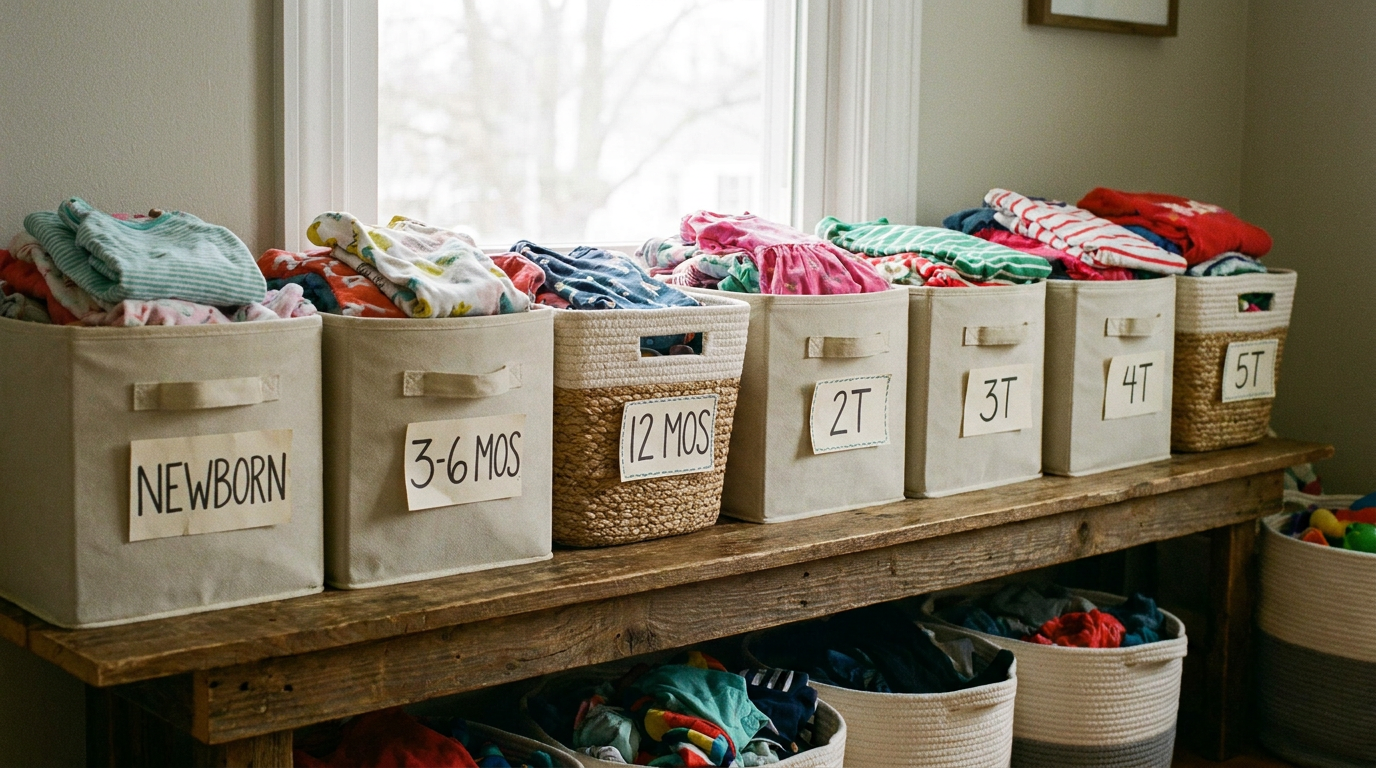
There are two bags by the door. One has been there since April. You know what’s in it — mostly. The 4T things that stopped fitting sometime around the last cold snap, plus a pair of rain boots that still fit but that nobody will wear, plus something you meant to check the size on and didn’t. Upstairs, there’s a bin labeled 3T in your own handwriting that contains at least three different sizes, because at some point the labeling system stopped keeping pace with the growing. In August, standing in the kitchen, you made a mental note to check whether last year’s winter coat still fits. It’s still a mental note. It has been a mental note for weeks, resurfacing at inconvenient hours, filed under a category of thought that has no name and no deadline and no end.
This is the part people get wrong. It isn’t the folding. Folding is fine — folding is twenty minutes and a podcast. It’s the deciding. It’s holding an ever-updating internal database of who is what size, what fits until when, what’s stained badly enough to disqualify, what’s worth passing to your sister’s kid and when her kid will actually be big enough for it, what needs replacing before the first cold morning. It is not the laundry. It is the thinking about the laundry. And the thinking never files itself away, because children keep growing, seasons keep turning, and the database needs updating again next month.
Here is what’s changed: this has a name now, and it has been studied. The mental load of kids clothes is no longer just a feeling you have at 10 p.m. with a bin open in front of you. Researchers have documented it, categorized it, and placed it inside a formal framework of household labor. That matters, because when something is unnamed, you tend to assume the problem is you — your systems, your discipline, your inability to keep a closet in order. When something is named and measured, it stops being a character flaw and becomes what it always was: a job. An unassigned, uncompensated, continuously running job.
This post is not going to end in commiseration. It’s going to end somewhere useful.

The mental load of managing children’s clothing is the continuous, largely unseen work of monitoring sizes, seasons, condition, quantity, and disposition of a child’s wardrobe. It is the tracking and the deciding, not only the doing. Recent anthropological research classifies kids’ clothing management as both cognitive and physical labor — the two operating at once, without pause.
That classification comes from Grocke-Dewey and Wanago, whose study “How do mothers conceptualize invisible work?” was published online in June 2026 in Human Organization, the journal of the Society for Applied Anthropology. The researchers set out to map what mothers actually mean when they talk about invisible work — not as a rhetorical concept, but as a discrete, sortable inventory of tasks. They then coded each task against three domains of household labor. In their own words, the framework categorizes tasks “into one or more labor domains – physical (P), cognitive (C), and/or emotional (E) – to support a more nuanced understanding of the complexity and invisibility of mothers’ household work.”
Among the tasks the study identifies, one appears with a notation worth reading twice:
“Kids’ clothing management (C, P)”
Two letters. Cognitive and physical. Both.
The paper is open access, which means you can go read it yourself — not an abstract, not a summary, the actual full text. We’d encourage it. There is something clarifying about seeing your unnamed Tuesday-night frustration rendered as a coded entry in a peer-reviewed labor taxonomy.
Now, why does the dual coding matter so much? Because most household tasks are one thing or the other. Loading the dishwasher is physical — it takes hands and minutes and produces a visible result you can point to. Remembering your niece’s birthday is cognitive — it takes no muscle at all, only the permanent background process of not forgetting. Each is tiring in its own way. Neither is tiring in both ways simultaneously.
Kids’ clothing is both, continuously, and the two halves compound rather than alternate. You cannot execute the physical work without first running the cognitive work: every garment you pick up requires a judgment before it can be sorted. Does this still fit? Will it fit in three months? Is this stain acceptable to another family, or only acceptable to me because I know it came from strawberries in June? The physical act is trivial — move item from pile A to pile B. The decision preceding it is not. Multiply that by a closet.
This is precisely why the standard advice fails. “Just do a closet purge” treats the problem as physical and finite: block off a Saturday, apply effort, achieve resolution. But a purge only clears the physical backlog. The cognitive layer regenerates immediately, because the child keeps growing and the seasons keep changing and the database you hold in your head is out of date within weeks. You didn’t fail to maintain the system. You applied a one-time solution to a continuous process — and, notably, you did the harder half of the work invisibly, where no one could see it, including you.
There’s a second finding in the paper that deserves equal weight, and it may be the most relieving idea in this entire post. The researchers didn’t just catalog tasks; they tested whether mothers agreed with one another about them, using cultural consensus analysis. They found that they did. The study concludes that the results “affirm that there is cultural consensus as to how these work tasks are conceptualized among the mothers responsible for them.”
Read that plainly: across the sample, mothers independently recognized the same body of invisible work, described in the same terms, understood the same way. This is not a set of individual women each privately struggling with organization. It is a shared, structural pattern showing up across households — which means it is a feature of how this work is distributed in general, not evidence of anything lacking in you specifically.
Prelove You was built around this exact dual-coded problem. Not around hauling — hauling is the easy half. Around the deciding. That distinction shapes everything about how the system works, and it’s the reason it isn’t structured like the alternatives most parents have already tried.
Research names the load. The next question is what it actually looks like on an ordinary Tuesday, itemized.
Kids’ clothing is cognitive labor because every physical action is preceded and surrounded by judgment calls. Does this still fit? Will it fit next season? Is this stain acceptable? Who is it for next? Is it worth listing? Is it good enough to donate? The sorting takes minutes. The deciding takes attention you never fully get back.
Think of it as a decision inventory. One seasonal changeover reads, on a to-do list, as a single line item — swap the closets. In practice, it is a stack of dozens of micro-decisions, each individually trivial and collectively exhausting. No single decision in the stack is hard. That’s what makes it so disorienting to find it draining. You can’t point to the difficult part, because there isn’t one. There’s just an enormous number of small ones, arriving in sequence, each requiring a fragment of judgment that only you have the context to supply.
Decision fatigue doesn’t announce itself. It shows up later, as a strange reluctance to open the bin at all.
Look at the shape of it. Sixteen rows, and the cognitive column is full in every single one. The physical column has gaps — four rows where there’s nothing to do at all, only something to know. Weather forecasting has no physical component. Holding the gap list has no physical component. Tracking the whole system for next cycle has no physical component. That work is real, it takes real capacity, and it leaves no trace anyone can see. Nobody walks past you while you’re mentally cross-referencing your six-year-old’s shoe size against the forecast and thinks, she’s working right now.
This is the argument the table is making, and it’s worth stating outright: the invisible half is the bigger half. When a household divides this work by what’s visible, it divides the smaller portion. The person holding the cognitive column is carrying the majority of the job in a form that cannot be observed, acknowledged, or easily handed over.
It also explains a specific and very common experience: finishing a full changeover, standing in a tidy room, and feeling wrung out in a way the visible result doesn’t seem to justify. The room looks like two hours of work. Your brain has just processed several hundred discrete judgments. Both of those things are true, and only one of them is legible to anyone else.
This maps directly onto the dual coding identified by Grocke-Dewey and Wanago — the C and the P, appearing together, exactly as the table demonstrates. The research names the pattern; the table is what the pattern looks like in your hallway on a Sunday afternoon.
One row deserves flagging before we move on, because it will return later and it’s the heaviest one on the list: end-of-life items. The pieces that are too worn to pass on and too intact to throw away. Their cognitive cost is enormous and their physical cost is nearly zero, because the decision never resolves — the item just relocates. We come back to it properly in what to do with stained kids’ clothes.
Prelove You was designed to collapse entire columns of this table rather than to help a parent move through them faster. Speed isn’t the goal. Subtraction is.
And if the work is this large, the obvious question is why it so reliably lands on one person.
It concentrates on one parent because the work is largely invisible, requires continuously held context, and has no natural handoff point. The person holding the mental database of sizes, seasons, and conditions becomes the only person who realistically can do it. Default assignment compounds from there, quietly, until it looks like a preference rather than an accident.
The mechanism here is worth understanding precisely, because it’s structural rather than moral — and the structural explanation is both fairer and more useful than the alternative.
Call it the context-holding trap. Physical labor delegates cleanly. “Please fold this basket” transfers completely in four words; the person receiving it needs no background information to succeed. Cognitive labor doesn’t work that way. To hand off “manage the spring changeover,” you’d first have to transfer the entire mental model: which bins are in the basement versus the closet, which brand runs small, which items are spoken for by a cousin, which coat has the broken zipper, what the school requires for gym, which sweater is sentimental and not to be passed on under any circumstances, and which of the four bags by the door has already been sorted.
Transferring that model takes longer than doing the task. So you do the task. Rationally, efficiently, and in a way that makes the situation permanent — because every time you do it yourself, you deepen the context, and the gap between what you know and what anyone else knows widens. The trap tightens through competence, not neglect.
This is where the cultural consensus finding from Grocke-Dewey and Wanago becomes genuinely important rather than merely interesting. If this were a personal failure — a scheduling problem, a discipline problem, a household that just hadn’t sat down and sorted out a fair split — you would expect wide variation between families. Some would have solved it. Instead, the study found agreement: mothers across the sample conceptualized the same invisible tasks in the same way, which is the signature of a shared structural pattern rather than a collection of individual shortfalls.
So let’s say the plain thing plainly. This work overwhelmingly falls to one person, and that person is usually the mother. That’s the pattern. It’s well documented, it’s consistent, and pretending otherwise would be dishonest.
And now let’s move on — because there is a version of this conversation that spirals, and it doesn’t help anyone. This is not an argument about who is failing whom at home. Most partners are not refusing to help; many are actively willing and genuinely unsure where to insert themselves into a system they can’t see. The invisibility isn’t a conspiracy. It’s the defining property of the work. That’s what “invisible labor” means.
Redistribution inside the household is one real answer, and a good one. It’s worth doing. But it has a ceiling, and the ceiling is this: splitting an unreasonable job in half produces two people doing an unreasonable job. If the underlying task load is structurally oversized — sixteen rows of judgment, regenerating every season, forever — then a fairer split is a fairer version of something that shouldn’t exist at this scale in the first place.
Prelove You‘s position is straightforward. The goal isn’t dividing an unreasonable job more evenly. It’s making the job smaller. Redistribution moves the weight; reduction removes it. One of those scales, and the other one just relocates the problem to a different pair of shoulders.
There’s a reason reduction matters more than redistribution here, and it comes down to volume. Because the load isn’t a single heavy lift — it’s a loop that never stops running.
Enough that counting misses the point. The honest frame is cycles, not totals: multiple seasonal changeovers annually, unpredictable growth spurts between them, plus school, activity, and event requirements — each triggering its own complete decision inventory. The load isn’t one big job repeated. It’s a loop with no exit.
Every organizing system a parent has ever tried assumes a finish line. The loop doesn’t have one. Here’s what a single year actually looks like when you lay it out honestly.
Then it starts again at step one.
The financial shape of this churn is visible in national data. According to the Deloitte 2026 Back-to-School Survey — fielded in late May 2026 among 1,207 parents of K-12 students — families plan to spend 22% more on clothing and accessories this year, an average of $323 per child, within a total of $557 per child overall. That overall figure is essentially flat year over year, down just $13. Clothing is the category that moved.
The reason it moved is the part that matters here. Deloitte’s back-to-school insights hub attributes the increase to families spending more on clothing “as they replace worn items and allow selective splurges.”
Replace worn items. Not upgrade, not indulge — replace. That’s the loop showing up in the national numbers. Clothing spending rises not because parents are shopping recreationally but because children’s clothing has a short, hard life and reaches the end of it on a predictable schedule. Churn isn’t a personal spending pattern. It’s structural, and it recurs on a calendar.
Which brings us to the insight underneath all seven steps. Every system parents try — the labeled bins, the seasonal capsule, the Saturday purge, the shared spreadsheet started with real optimism in March — is a one-time fix applied to a continuous loop. That’s the mismatch. The systems aren’t bad. They’re the wrong shape for the problem. A single reset cannot resolve a process that regenerates by design, any more than one deep clean permanently resolves dishes.
Prelove You is built as infrastructure that repeats on the same cycle the loop does — season after season, arriving when the outgrown pile forms rather than waiting for you to schedule a reckoning with it. Not a reset. A rhythm.
If the loop is constant, the fair question is why the familiar solutions haven’t closed it.
Because each one adds decisions rather than removing them. Peer-to-peer resale requires photographing, listing, pricing, negotiating, and shipping. Consignment requires curation and condition judgment before you’re allowed to participate. Donation requires a “good enough” call on every single item. All three leave the cognitive column of that table fully intact.
Run each model against the sixteen rows and watch what survives.
Peer-to-peer resale is the clearest case. It removes nothing cognitive and adds significantly to the physical column. You still assess fit, still judge condition, still make the sentimental call — and now you also decide whether each item’s likely sale price justifies the effort of listing it, which is a new judgment that didn’t previously exist. Then comes photographing in decent light, writing descriptions, pricing against comparable listings, responding to messages, negotiating, packaging, shipping. Resale converts unpaid cognitive labor into unpaid cognitive labor plus unpaid physical labor, and pays a small amount for the privilege. For a garment worth eleven dollars, this is not a good trade of a parent’s evening.
Consignment reduces the transactional work meaningfully — someone else handles the selling. But it front-loads the hardest cognitive step and makes it stricter. Consignment requires curation: understanding what will be accepted, pre-sorting to that standard, judging condition against someone else’s threshold. You do the discriminating work, then drive it somewhere, then handle whatever comes back rejected. The judgment call didn’t disappear. It got more demanding and acquired a deadline.
Donation drop-off is the most generous option and the most quietly taxing. It eventually removes the physical burden — the bags leave. But it preserves the single hardest judgment in the entire inventory: is this good enough? Good enough to be useful rather than a burden to someone else. That question has no clear answer, carries a faint moral charge, and must be asked item by item by item. Donation solves the storage problem while leaving the deciding problem completely untouched.
None of this is a knock on parents’ intentions, and the research is clear that intention isn’t the gap. A June 2026 study in the Journal of Fashion Marketing and Management examined mothers’ motivations for purchasing secondhand children’s clothing on peer-to-peer platforms and found economic and sustainability motivations both operating as genuine drivers, alongside a dimension the authors connect to parenting values. The sample was Finnish mothers, so it shouldn’t be read as a direct description of US households — but the finding is instructive nonetheless.
And it isolates the real problem sharply: motivation was never the missing piece. Parents already want this. They want clothes to keep circulating, they want the value recovered, they want less waste in the system. Wanting has never been the barrier. The barrier is that every available route charges an entry fee in cognitive labor from the person who already has the least of it left.

Which brings us to the heaviest item in the house.
It isn’t the good coat. The good coat is easy — somebody wants it, and you know who. It’s the shirt with the strawberry stain on the collar. The leggings pilled at the knee. The sweatshirt with the cuff worn soft and thin from two years of being pulled over one particular set of hands.
Not nice enough to pass on. Not ruined enough to throw away.
So it sits. It goes into a bag, and the bag goes into the trunk, and the trunk becomes a place you don’t look at directly. Every time you pass it, some small part of your attention registers unresolved and files it again for later. That item is the mental load in its purest form: a decision with no good answer, deferred indefinitely, then multiplied across an entire closet and several years.
And there’s a tenderness in it that’s worth naming, because it’s the real reason these pieces are so hard to move. The stain is from a specific June afternoon. The worn cuff is from a specific habit your child had at four and doesn’t have anymore. You’re not being sentimental about fabric. You’re being sentimental about a season of their life that ended without announcing itself, and throwing the garment in a trash bag feels like agreeing to something you didn’t agree to.
That is not a decision anyone should have to keep making alone in a garage.
Prelove You accepts end-of-life items. Stained, worn, past wearable life. Pieces that can’t continue as inventory are routed through upcycling and recycling channels rather than handed back to you with a verdict attached — the operational detail is spelled out in the Prelove You FAQs. The mechanism is responsible routing. But the point, the actual point, is that it removes the last judgment call. You don’t have to decide. You don’t have to look at the collar and adjudicate whether a memory qualifies as good enough. It goes in the bag with everything else.
We give this its full treatment in what to do with stained kids’ clothes.
Having ruled out the familiar answers, here’s what genuinely shrinks the load — including several things that cost nothing and require no one’s permission.
You share it by externalizing the mental model — moving sizes, seasons, and condition rules out of one person’s head and into a system both adults can see — and by eliminating whole categories of decisions rather than dividing them. Redistribution helps. Reduction helps more. The two together are what actually changes a household.
These work whether or not you ever become a member of anything.
Externalize the database. The single greatest obstacle to delegation is that the necessary information lives in one person’s memory. Get it out. A shared note, a whiteboard inside a closet door, a photo of each bin’s contents taped to its lid — the format matters far less than the fact that a second adult can access it without asking a question. This is the move that makes every other move possible. Delegation fails when the mental model can’t be transferred, and the research on invisible work is a useful frame for why: the cognitive and physical domains are distinct, and handing over the physical half without the cognitive half isn’t delegation at all. It’s supervision, with extra steps.
Set standing rules to kill repeat decisions. This is the highest-leverage action on the list, and it’s almost free. A standing rule converts hundreds of individual judgments into one decision made once. Anything with a stain goes straight in the send-in bag — no evaluation. If it doesn’t fit today, it doesn’t go back in the drawer. Two pairs of sneakers, always, no more. You are not making a rule about clothes. You are making a rule that retires an entire recurring category of thought. Every standing rule is a decision you will never have to make again, and their value compounds across seasons.
Assign the loop, not the task. “Help me sort this pile” transfers physical labor for twenty minutes and leaves the cognitive load exactly where it was — arguably worse, since now you’re also managing a helper. “Handle the spring changeover, start to finish” transfers the whole thing: the assessing, the deciding, the sourcing, the completing. Yes, it will be done differently than you’d do it. That is the cost, and it is much lower than the cost of holding it forever. Ownership of an outcome is the only handoff that actually reduces load.
Create one physical destination. A single designated bag or bin, in one permanent location, for everything outgrown. No sub-sorting, no interim staging. This ends the migration — closet to trunk to basement to somewhere — and with it the low-grade guilt of walking past a pile you haven’t dealt with. One destination also makes the standing rules executable, because there’s somewhere for the decision to go the instant it’s made.
Bring your children in. This one is underrated, and it’s the one parents consistently tell us surprised them. Kids can assess their own fit — they know better than you do which sweater is scratchy and which jeans they’ll never wear again. They can choose what they’ve outgrown. They can have a genuine say in what comes next. This is real offloading, not busywork, and the smaller benefit is the time you save. The larger benefit is what it builds in them: taste, judgment, an early sense that clothing has value and a life beyond their own closet, and the plain experience of making a real decision and living with it. Children who participate in this process stop being passive recipients of a wardrobe and start being people with a point of view about it.
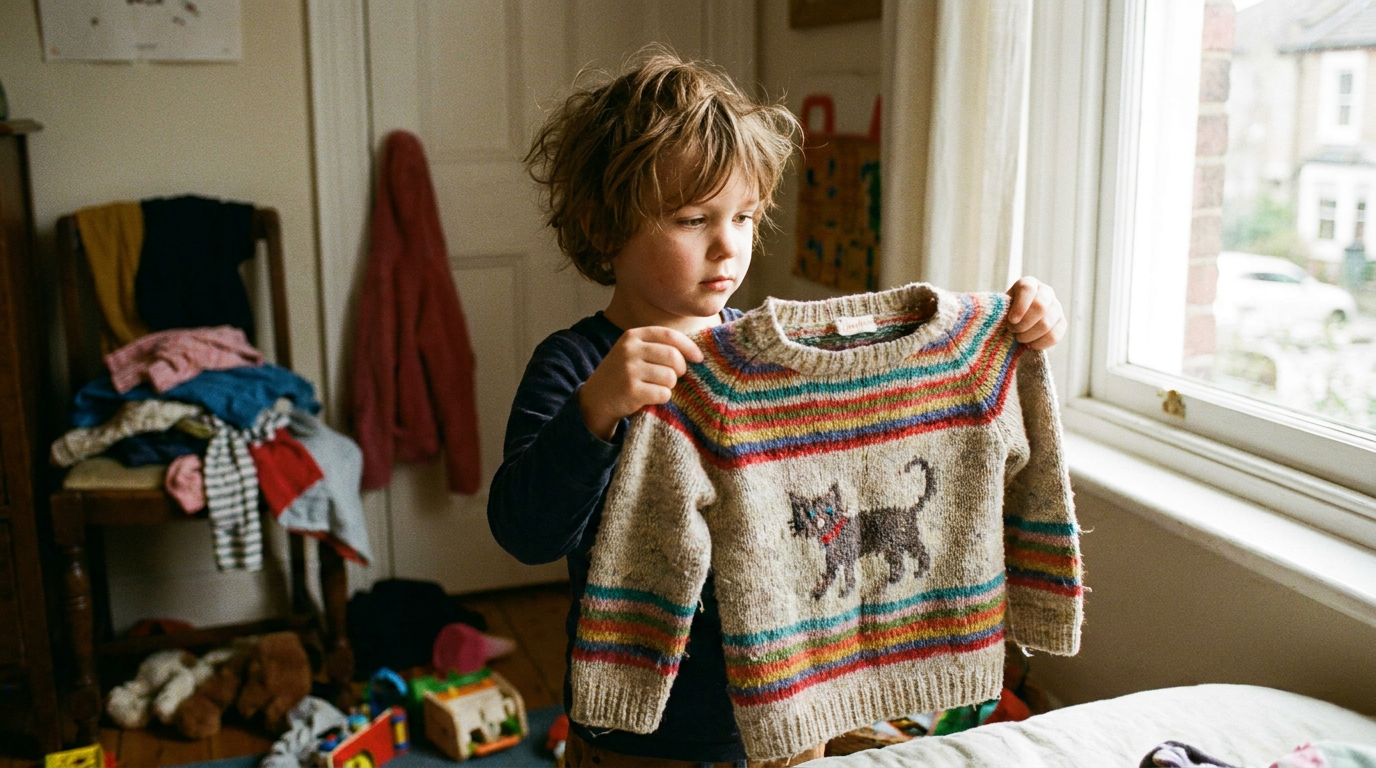
“You loved this one. Someone else is going to love it next — and you get to pick what comes after.”
Prelove You operationalizes exactly these principles, which is not a coincidence — the system was designed backward from them. One destination. No condition sorting. No listing. No “good enough” call. And the credit system gives children real decision-making power over what they wear next, which turns the whole cycle from something that happens to a family into something a family participates in together.
If you want to go deeper on the broader pattern behind all of this, we’ve gathered it under “The Invisible Load” [EDITOR: link on publish — Pillar 1 hub page, not yet built].
Those tactics shrink the load. Here’s what it looks like when the loop leaves the household entirely.
It looks like one bag, one destination, and no sorting. Families send outgrown children’s clothing and accessories to Prelove You. Prelove You sorts and grades everything that arrives. Members receive credits and shop for quality, new-to-them pieces. The decisions leave the household entirely — not redistributed, not scheduled, gone.
The category distinction, stated once and then set down: Prelove You is a premium membership ecosystem. Not resale. Not consignment. Not donation. Not a thrift platform. Those models ask you to do the cognitive work and then reward you for having done it. This one is built to absorb the cognitive work as the service itself.
Go back to the sixteen-row table and mark what disappears. Condition judgment — gone, because nothing needs to meet a standard before you send it. Resale evaluation — gone, because you never decide whether an item is worth listing. Photographing, describing, pricing, negotiating, shipping logistics — gone entirely, all of it. The donation “good enough” call — gone, because there’s no threshold to clear. The end-of-life decision, the strawberry-stain question that has been sitting unresolved in your trunk since spring — gone.
Count what’s left. Notice how much of that column was cognitive, and how much of it you were carrying without anyone including you counting it as work.
The membership tiers, plainly: Lite $35/month, Luxe $65/month, Limitless $95/month, and a $195 seasonal membership. Operational specifics — how sending in works, how grading works, how credits are applied — live in the Prelove You FAQs, where they can be read properly rather than skimmed here.
But logistics are not the whole story, and a system that treated them as the whole story would be missing what makes children’s clothing different from every other category of household object.
Clothing holds memory. It holds identity and growth and specific afternoons. The dress from the birthday where she insisted on wearing it three days running. The jacket in every photograph from that year. Parents don’t hesitate over these pieces because they’re bad at decluttering — they hesitate because handing the item to an anonymous process feels like closing a door on something that mattered, with no way to know what happened on the other side of it.
So Prelove You is building a digital library book card system: a way for parents to follow the journey of pieces they once loved. The same principle as the card in the back of a library book, where each name recorded the next person who carried the story forward. Not a tracking feature. A continuity feature. It means the send-in is never a disappearance — the thread stays visible, and the piece keeps going.
This is the part that separates a membership from a logistics service, and it’s deliberate. The experience is never anonymous, because the objects were never anonymous.
Return one last time to the research. Kids’ clothing management was coded (C, P) — cognitive and physical. Nearly every solution on offer addresses the physical half: they’ll take the bags, move the boxes, handle the shipping. Almost none of them touch the cognitive half, which the table showed is the larger one. Prelove You was built to take both. That’s the entire design brief, and it’s why the answer looks like a system rather than a service.

Kids’ clothing management is cognitive and physical labor. There is now peer-reviewed research that says so, in those words, with both letters attached.
Which means the thing you’ve been carrying was never a personal organizational failure. It wasn’t a discipline problem or a systems problem or evidence that other parents have figured out something you haven’t. It was a real job — unnamed, unassigned, running quietly in the background of every season for years, using capacity you needed elsewhere.
You can put it down now.
Prelove You was built for the whole of it. The sorting and the deciding. The good coat and the worn cuff. Including the parts that were never supposed to be anyone’s job in the first place — especially those.
Every outgrown thing held a season of their life. You were never meant to carry all of it to keep any of it.
Follow the Thread.
Start with one bag. Prelove You takes all of it — including the pieces you’ve been avoiding deciding about.

