



 Sustainability Scoop
61% of Parents Let Kids Choose. Make It Mean Something.
Your child is already picking. Here’s how to turn that input into taste, judgment, and a real understanding of what things are worth.
It’s 5:40 on a Tuesday in August. There’s a pan on the stove, a tablet propped against the fruit bowl, and a seven-year-old scrolling with the fluency of someone who has never known a world without swiping. She taps something. Then something else. The cart badge ticks up from four to five to seven. From across the kitchen, a parent glances over, registers a color, says “sure,” and turns back to the onions.
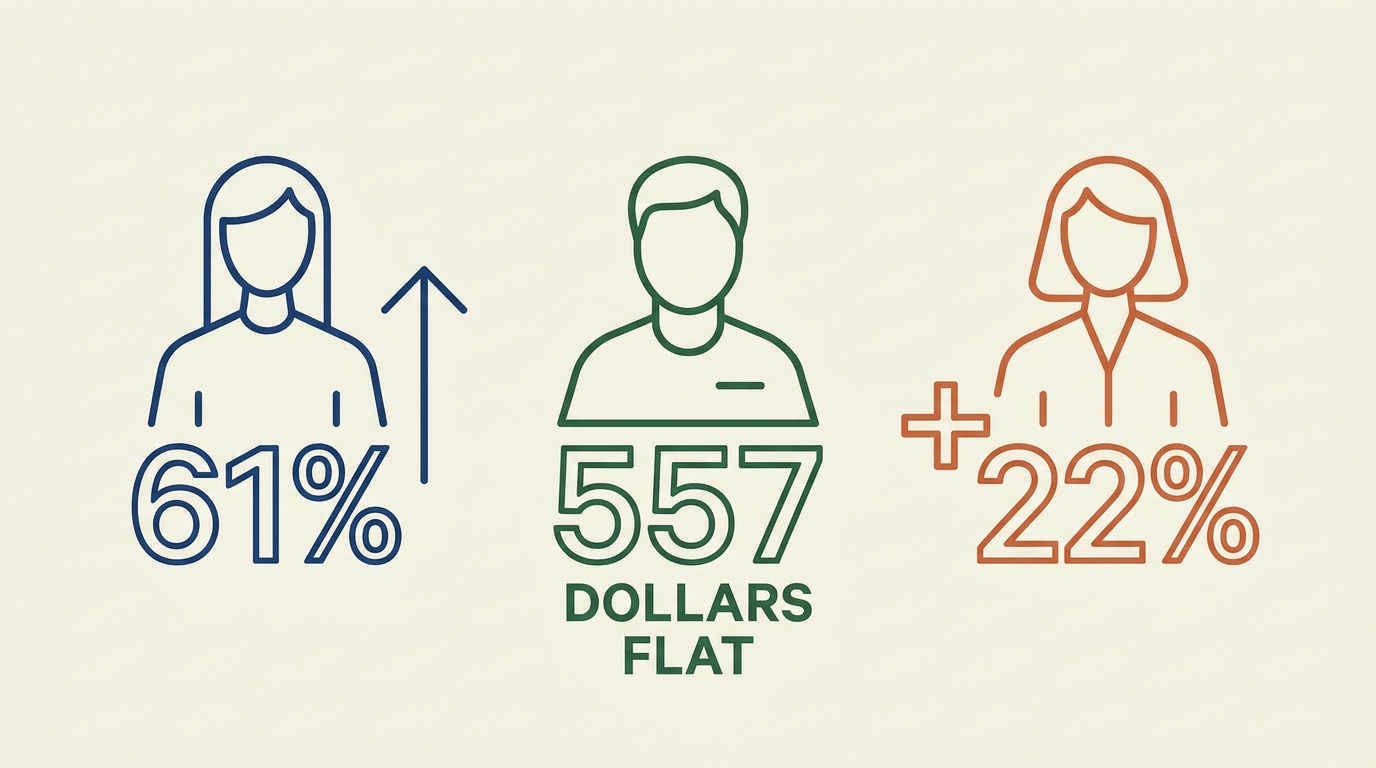
That scene is not an outlier. According to PwC’s 2026 US Consumer Poll on Back-to-School Shopping, 61% of parents let their children participate directly in online shopping — 40% give kids their own access to add items, and another 31% use linked or shared family accounts. Children aren’t influencing the cart from the sidelines anymore. They’re inside it.
Here is the part worth sitting with: that input is already happening at scale, and it is almost entirely unstructured. Unstructured input doesn’t produce better judgment. It produces a bigger pile. This piece is about the difference — and about teaching kids about clothing choices in a way that builds taste, fit awareness, and a real sense of what something is worth. You’ll get age-banded guidance and the actual words to say.
TL;DR: Most parents already let children choose. The opportunity is structure. Give a child a visible, finite budget, a small set of curated options, and language for why something works, and choice becomes judgment. Prelove You’s credit system makes that trade-off tangible, season after season.
At Prelove You, we build for children as participants with developing judgment — not as passive recipients of whatever lands in the closet. The choosing is already happening in your house. The only real question is what it’s teaching.

Start with the scale, because it reframes everything that follows. When PwC surveyed 2,080 US adults in late May 2026, it found that children are no longer pointing at things in aisles or texting links to a parent at work. They are logged in. They have credentials. In many households, they have their own access to add items to a live shopping cart — and the parent’s role has quietly shifted from decider to approver of a list someone else assembled.
The window in which this happens is narrow and intense. PwC found that 71% of families complete their back-to-school purchases between two weeks and two months before the first bell. That’s a compressed, high-stakes stretch in which a large number of decisions get made quickly, often at the end of long days, frequently on a phone. It is precisely the wrong environment for careful deliberation and precisely the environment in which most families are making these calls anyway. If you’re using that window to reset the closet from the ground up, our back-to-school closet reset walks through the sequence.
Now layer in the economics, because they explain why this matters more this year than last.
The 2026 Deloitte Back-to-School Survey — the firm’s nineteenth annual, published July 2026 and fielded in late May 2026 among 1,207 parents of K–12 students — found that expected spending per child is flat at $557. Not down. Not up. Flat.
But underneath that flat number, the composition is shifting hard. Parents plan to spend 22% more on clothing and accessories this year, while tech spending is expected to fall 16% as device upgrades get deferred. Read those two figures together and the picture sharpens considerably. The clothing increase is not a rising tide lifting the whole basket. It is a reallocation inside a fixed container. Money is being pulled out of one category and pushed into another — and it’s being pushed into the exact category where children have the most opinions, the strongest preferences, and the loudest voice.
PwC’s data confirms where that voice sits in the hierarchy. When parents were asked what shapes their final purchasing decisions, children’s preferences ranked first, cited by 58% — ahead of school supply lists and ahead of sales and promotions. Roughly a third of parents say their children specifically request name-brand or trend-driven items.
So: budgets are flat, the clothing share is climbing, and the person with the most influence over that climbing share is, in a meaningful number of households, a person who cannot yet do long division.
This is where the honest naming has to happen, and it has to happen without a single ounce of blame.
A child adding items to a cart with no visible ceiling is not making a choice. They are making a request. The distinction is everything. A choice involves giving something up. A request costs nothing to make, which is exactly why requests scale infinitely and budgets do not. When a child taps “add” for the ninth time, they haven’t exercised judgment nine times. They’ve expressed enthusiasm nine times — which is a perfectly healthy thing for a child to do and a completely useless input for a household with $557 and a September deadline.
The friction that follows is predictable. The cart gets trimmed at checkout. The child watches items disappear without understanding the logic. What they learn from that experience is not how to evaluate a garment. It’s that wanting things produces a negotiation, and that some negotiations are winnable. That’s a lesson. It’s just not the one anyone intended to teach.
None of this is a parenting failure. The 61% figure is not evidence that families have lost the plot. It’s evidence that a genuinely good instinct — include the child, respect their taste, don’t dress an eleven-year-old like a doll — has arrived faster than the structure needed to support it. The instinct is right. The scaffolding is missing.
Here is the finding that reframes the entire conversation, and it comes from Deloitte’s own data.
Deloitte identified a group it calls hyper-value seekers — parents who deploy four or more distinct cost-saving behaviors. They are, by any conventional definition, the most disciplined shoppers in the study. You would expect them to spend the least.
They spend the most. Roughly $610 per child — 14% more than everyone else.
“Value-seeking is more about selectivity than austerity.”
— 2026 Deloitte Back-to-School Survey
Read that line twice, because it is the intellectual hinge of everything that follows. The most deliberate shoppers in America are not the ones buying the cheapest things. They are the ones buying fewer, better, more considered things — and their total goes up because what they choose is worth more. Deliberation isn’t a synonym for restriction. It’s a synonym for knowing what you’re doing.
And that has a direct implication for children. Selectivity is not a personality trait or a moral position. It is a skill — comparison, prioritization, tolerating the small ache of not getting everything. Skills can be taught. Which means the question stops being should my child have input and becomes what structure turns their input into something that compounds.
What’s missing in the 61% isn’t restriction. It’s structure — a visible ceiling, a curated field, and language for why one thing beats another. Prelove You was built at exactly that seam: a finite, child-legible budget applied to a set that’s already been vetted, so a child’s autonomy can be wide without being weightless.
With the scale established and the mechanism named, it’s worth addressing the question most parents are quietly asking underneath all of it.
Yes. Children who choose their own clothes develop taste, body awareness, and confidence earlier than those who don’t. The risk isn’t letting them choose — it’s letting them choose without limits or language. Choice inside a defined, finite set builds judgment. Choice inside an infinite catalog builds appetite.
Most parents already believe the first part. The hesitation isn’t really about whether a child should have a say. It’s about what happens next — and the fear underneath it is rarely the one that gets said out loud.
The stated worry is aesthetic: the clashing patterns, the sequined leggings under the plaid skirt, the insistence on shorts in November. The actual worry runs deeper. It’s the fear of raising someone who wants continuously and values nothing. Someone for whom the new thing is thrilling for four days and invisible on the fifth. That’s not a fear about outfits. It’s a fear about character, and it deserves a straight answer rather than reassurance.
The distinction that resolves most of this anxiety is simple and rarely articulated.
Abdication is handing over a tablet and an open catalog. It looks like autonomy. It feels generous. But an unbounded field doesn’t produce a decision — it produces accumulation, because nothing is being traded against anything else. The child isn’t choosing between options; they’re collecting all of them.
Autonomy is handing over three vetted options and asking for a reason. The field is small enough to actually hold in mind. Every selection excludes the others. The child’s power is real and their choice has weight, precisely because the boundary exists.
The difference isn’t how much freedom the child gets. It’s whether the freedom has edges. A child given three good options and asked why is doing more cognitive work — and building more judgment — than a child given three hundred and asked which ones.
Let’s take the aesthetic anxiety head-on, because it deserves more respect than it usually gets.
The tulle-over-camo phase, the six-months-of-one-hoodie phase, the everything-must-be-orange phase — these are not lapses in taste. They are experiments in self-presentation, conducted by someone who is figuring out, in real time, what it feels like to be looked at. A child in a genuinely loud outfit is running a test: Is this me? Do I like how this feels? What happens when I walk into a room like this?
Taste is not transmitted. It’s developed, and it develops through trial, feedback, and a certain number of choices the child later finds mortifying. That embarrassment is itself evidence of growth — you can only cringe at your old taste if you’ve developed new taste to cringe with.
Over-correction has costs, and they show up in two directions. Children whose choices are consistently overridden tend to either stop offering opinions entirely — deferring to whoever is holding the card — or dig in hard and treat every clothing decision as a sovereignty dispute. Neither produces someone with a point of view. Both produce someone whose relationship to their own preferences is organized around a parent’s reaction rather than their own judgment.
Autonomy with edges means the edges are real and stated plainly. Four areas stay with the adult, permanently, and none of them require negotiation:
Everything outside those four is genuinely open. Color, pattern, silhouette, how many times a favorite gets worn in a week, whether stripes and florals belong together — all of it is available for the child to work out. That’s a much wider territory than most households actually grant, and naming the boundaries clearly is what makes the width feel safe rather than reckless.
This is the design principle underneath Prelove You. The inventory is curated before a child ever sees it, which means the guardrail is structural rather than interpersonal. A parent doesn’t have to police individual selections, because the field itself is already sound. That single shift — from gatekeeper to advisor — is what makes wide autonomy sustainable. It’s also the core of what we mean by raising a conscious consumer: treating children as participants with developing judgment rather than recipients of finished decisions.
Once should they choose is settled as a yes, the practical question arrives immediately — how does a child learn what a thing is actually worth?
Make cost visible and finite, then let the child feel the trade-off. Children learn value through comparison and consequence, not lecture. Give them a fixed budget, show what one item costs relative to another, and let them live with the choice. Value understood is always value experienced.
Value is not a fact you can transfer by explaining it. It’s a sensation — the specific, slightly uncomfortable feeling of choosing one thing and watching another go back. No amount of explanation substitutes for that feeling. The good news is that it can be engineered at home tonight, using four dimensions of worth that a child can genuinely grasp.
Dollars are abstract to most children under ten, and even older kids struggle to make them concrete. “Forty-two dollars” means little to someone whose economic reality is measured in weeks of allowance or trips to the corner store.
The fix is translation. Express cost in whatever unit the child reads instantly: six credits, or three weeks of allowance, or the same as two of those and a pair of socks. The number matters less than its legibility. A child who can hold the total in their head can feel it shrink.
This is precisely why Prelove You uses credits. A child can carry “I have six, this costs four” through an entire browsing session. Nobody — child or adult — carries “$180 across a flexible seasonal budget with some room depending on what’s on sale.” One is a live constraint. The other is a vague intention.
This is the dimension almost no one teaches, and it’s the one that produces the most durable judgment.
Ask a child which item in their closet they wore the most this year. Then ask why. The answers are usually revealing and almost never about price — it’s soft, it goes with everything, the pockets are good, it doesn’t itch at the neck. That’s a child articulating a value framework. Most adults never make theirs explicit.
Cost-per-wear is the underlying math, and older children can do it directly: a jacket worn a hundred times outperforms a special-occasion piece worn twice, regardless of what either cost. But the concept lands even without arithmetic. Will you actually reach for this? is a question a six-year-old can answer honestly if you ask it before the purchase rather than after.
This one is unglamorous and enormously practical.
A garment the child won’t wear has a value of zero. Not low — zero. The itchy tag, the stiff waistband, the sleeves that bunch under a coat, the fabric that makes a sensitive kid squirm by second period. These are not fussiness. They are accurate reports about whether an object will be used.
Build the check in as a standard step, before the decision, every time. Put it on. Move around. Reach up. How does it feel? Doing this consistently teaches something beyond clothing: that your own physical experience is legitimate data, worth consulting before you commit. That’s a lesson with a long runway.
The fourth dimension is where things go when they’re outgrown — and it needs to be handled with real care, because it’s the easiest place to accidentally introduce guilt.
Keep it factual. A garment has a beginning, a middle, and an end. It gets worn, it gets outgrown, it goes on. That’s the ordinary lifecycle of an object, not a moral event. “That’s too small now. Someone smaller will wear it next” is a complete sentence and a complete lesson. Nothing needs to be appended.
What this actually does is make letting go easier. A child who understands that a beloved jacket continues on somewhere has a place to put the feeling. A child who thinks it simply vanishes has nothing to do with the attachment except resist the handover. Continuity resolves the standoff that lecturing never will.
Prelove You accepts pieces at every stage, including the ones past wearing — so the afterlife conversation never turns into a conversation about whether something is good enough. There’s no moment where a child has to hear that the shirt they loved into oblivion doesn’t qualify.
One approach to kill outright, because it’s common and it backfires.
“Do you have any idea how much that cost?”
This teaches anxiety, not discernment. A child who hears price deployed as a weapon learns that money is a source of tension and that wanting things is faintly shameful. They don’t learn to evaluate. They learn to stop asking — or to ask in ways that avoid detection.
Value language should be neutral, factual, and forward-looking. Not “that’s too expensive” but “that’s four of your six — what do you want to do with the other two?” Not “you never wear the last one I bought” but “which of these do you think you’d reach for most?” Same information, entirely different lesson. One closes a conversation. The other opens a calculation.
Circle back to Deloitte’s hyper-value seekers one more time, because they validate this whole framework with real data. The most deliberate shoppers spend more, not less — Deloitte found they spend about 14% above other shoppers — because deliberation produces concentration, not contraction. Fewer things, chosen carefully, each carrying more weight.
That’s the exact instinct these four dimensions build. Not scarcity. Not going without. Selectivity — the ability to look at eight options and know which two are actually yours.
The same four dimensions apply well beyond a school-year wardrobe. They’re the identical muscles a child needs when a pile of wrapped boxes shows up in December, which is why we treat it as its own moment in teaching kids the value of things before the gift deluge.
These dimensions land very differently at four than at eleven — which brings us to timing.
Most children can choose between two options by age three, manage a small budget by six or seven, and weigh cost against wear by nine or ten. Readiness shows up as reasoning, not age alone. When a child explains why they picked something, they’re ready for more responsibility.
The instinct is to look for an age. The better signal is a behavior.
A four-year-old who says “the blue one because it has pockets” is demonstrating something a nine-year-old who shrugs and says “I dunno, that one” is not. Reasoning is the tell. When a child can attach a because to a choice — however simple, however idiosyncratic — they’ve moved from preference to justification, and justification is the foundation of everything that follows.
So read the bands below as descriptions of capability, not entitlements that unlock on a birthday.
A note on how to use this: the bands overlap, children move between them unevenly, and regression is normal. A new school, a new sibling, a growth spurt, a hard year — any of these can send a competent nine-year-old back to wanting two options laid out on the bed. That’s not a setback. It’s a child conserving decision-making capacity for something harder. Step back a band, stay there a while, and step forward again when they’re ready.
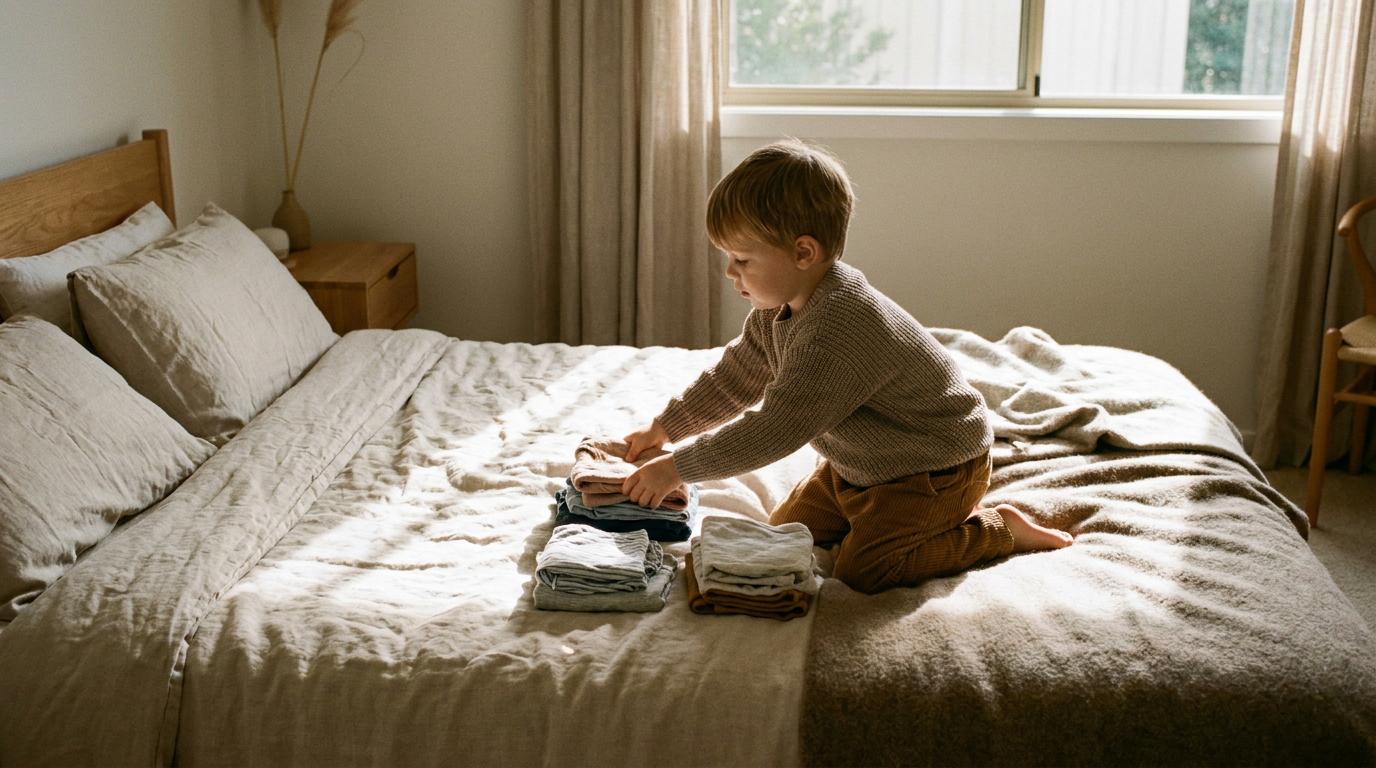
Toddler (2–4). The work here is astonishingly simple and easy to skip: demonstrate that their opinion changes an outcome. Two shirts on the bed. “Blue one or red one?” They pick, they wear it, the world proceeds. What’s being installed isn’t taste — it’s the prior belief that having a preference is worthwhile. Children who don’t get this early can be surprisingly passive about their own choices later.
Keep the field to two. Three is often too many, and an open drawer is not a choice, it’s a maze.
Early elementary (5–7). This is where the trade-off becomes teachable, and it’s the highest-leverage band in the table. A child of six can hold a small number in their head and watch it decrease. That’s all a budget requires. Six credits, a jacket that costs four, and the live question of what to do with the remaining two — that’s a complete economics lesson that takes ninety seconds.
Expect the first genuine disappointment here. That’s the point. The small ache of not getting everything is the sensation that makes value real, and it’s far better encountered at six with two credits than at sixteen with a debit card.
Older child (8–10). Cost-against-wear becomes explicit. Children this age can genuinely reason about frequency: this costs the same as those two together, but I’d wear it way more. They can also do retrospective analysis, which is where the real growth happens — looking at last year’s closet and identifying what got used versus what hung there with tags on.
Fit verification and final approval stay with the parent, but the framing shifts noticeably. You’re checking work now, not making decisions.
Pre-teen (11–13). The parent role becomes genuinely advisory, and the transition can feel abrupt if you haven’t been building toward it. A twelve-year-old can plan a season, assess construction quality with a little coaching — seams, weight, how a fabric recovers — and decide what to send on. They will also have opinions you disagree with, defended with more coherence than you’d like.
That’s the outcome, not the problem. The goal was never a child with your taste. It was a child with taste, and a reason.
The practical challenge is that most systems don’t scale across this range. A method built for a five-year-old is condescending to a twelve-year-old; a method built for a twelve-year-old is incomprehensible to a five-year-old.
The Prelove You credit system holds across all four bands without changing shape. The same mechanism that gives a five-year-old two credits and a choice between two sweaters gives a twelve-year-old a full seasonal allocation and a wardrobe to plan. The unit stays legible. The ceiling stays visible. Only the scope grows — which means the skill compounds instead of restarting every couple of years. The membership tiers are structured around exactly that continuity.
Knowing what a child can handle is one thing. Knowing what to say at 7:15 on a Tuesday morning is another entirely.
Most parents don’t lack intention. They lack language in the moment — the specific sentence that turns a standoff into a decision while dinner is burning.
What follows are twelve starting points, grouped by age band. Each has a situation, the words, and one line on why it works. Don’t recite them. Adapt them to how you actually talk, and notice that nearly all of them are questions rather than verdicts.
1. “Blue one or red one?”
Two options, no more, both already acceptable to you. This works because a toddler’s choice is only real when the field is small enough to hold in mind. Three options is often one too many; an open closet isn’t a choice at all.
2. “You picked that one. Tell me why you like it.”
Attaches language to preference. The answer will be charming and possibly nonsensical — “because it’s fast” — and that’s fine. You’re building the habit of having a reason, not evaluating the reason’s quality.
3. “That one’s too small now. Someone smaller will get to wear it next.”
Introduces afterlife as plain fact, warmly, with nothing appended. No lesson, no sigh, no commentary about how fast they’re growing. Just the next chapter, stated calmly.
4. “You have six credits. That jacket is four. What do you want to do with the other two?”
Turns the trade-off into arithmetic instead of argument. Notice the question isn’t can you afford it — it’s what happens next, which keeps the child in the driver’s seat and keeps you out of the role of obstacle.
5. “Which of these do you think you’d wear the most?”
Introduces wear-frequency as a value dimension before cost starts dominating everything. Ask it early and often enough and it becomes the child’s own first question rather than yours.
6. “Let’s check how it feels before we decide.”
Makes fit and comfort a standard step rather than an afterthought. Over time this becomes automatic — a child who reflexively checks how something feels is a child who won’t waste a season on a garment that itches.

7. “This one costs about the same as those two together. Which way do you want to go?”
Explicit comparison, with the child performing the trade-off rather than receiving it. You’ve supplied the math; the judgment is entirely theirs.
8. “What in your closet did you wear the most this year? Why do you think that is?”
The single most effective taste-building question on this list. It’s retrospective, so there’s nothing at stake and no defensiveness. Children often surprise themselves — and the answer usually predicts their next good decision.
9. “You can pick this now, but it’s most of your budget for the season. Want to think about it overnight?”
Introduces deliberation and delay as normal features of choosing rather than punishments. Sometimes they sleep on it and still want it, which is genuinely useful information. Sometimes the wanting evaporates by morning — also useful.
10. “Walk me through why this one.”
An invitation to defend a position, not a challenge to it. Tone carries everything here. Asked with real curiosity, it produces articulation. Asked with an edge, it produces a shrug and a closed door.
11. “What are you sending on this season?”
Positions them as the active manager of their own wardrobe rather than the recipient of it. This question quietly reassigns ownership, and most pre-teens rise to it faster than expected.
12. “If you had to choose three things to wear all month, what would they be?”
Strips out trend pressure and surfaces genuine aesthetic. The answer is almost always more coherent and more personal than whatever’s in the cart — and it’s a useful thing for both of you to hear out loud.
Ask more than you tell.
Every script above is a question, and that’s not stylistic. A child who explains their choice is a child forming judgment — assembling reasons, weighing factors, building the internal architecture that will still be running at twenty-five. A child receiving a verdict is a child learning compliance, which is a different skill with a much shorter useful life.
You’ll notice several scripts reference credits directly. That’s deliberate. These conversations only work when the unit is concrete — a finite, visible number the child can hold. It’s the difference between “we need to be careful” (which means nothing) and “you have two left” (which means everything). That legibility is the whole reason Prelove You runs on credits rather than dollars.
Scripts work best inside a system that reinforces them, rather than a parent supplying willpower every single time.
There’s a structural reason these conversations are harder than they used to be, and it has nothing to do with parenting.
Digital money is abstract by design. A card has no visible bottom. A tap produces the same sensation whether it’s four dollars or four hundred. Buy-now-pay-later splits a number into four smaller numbers that each feel like almost nothing. Every one of these mechanisms exists to reduce the friction of spending — which is precisely the friction a child needs in order to feel a trade-off.
You cannot teach scarcity with an instrument engineered to conceal it.
The Prelove You credit works because it restores three properties that digital money removes.
Finite. There’s a fixed number. It doesn’t flex based on how the month is going, and there’s no overdraft. When it’s gone, it’s gone until the next cycle — which is the entire point.
Visible. The balance is on screen, always, before and after every choice. A child watches six become four become one. That decreasing number is the lesson, and it does the work no lecture accomplishes.
Child-legible. A child can hold “six credits” in working memory across an entire browsing session. They cannot hold “$180 across a flexible seasonal budget, though we might have some room if the boots go on sale.” One is a live constraint. The other is atmosphere.
Here’s the mechanic that does the deepest teaching, and it’s structural rather than rhetorical.
The credits a child spends came from clothing they outgrew. Sending things on is what produces the ability to choose again.
That’s cause and effect a child can feel directly, over a timescale short enough to register. Not an abstraction about resources or a lesson about how things work in theory — a loop they personally close, twice a year, in their own bedroom. The jeans that no longer fit become the jacket they wanted. The connection is immediate and it belongs to them.
This teaches circularity as practical fact, not moral position. Nobody has to be told that objects continue on. They watch it happen, and they participate in making it happen. A child who understands the loop stops experiencing the handover as loss and starts experiencing it as a transaction they benefit from — which resolves, quietly, the standoff that most households have every single season.
How to Talk About Credits With Your Kid
“Those clothes you outgrew? They turned into credits. That means the things you loved helped you find the next thing you’ll love. You earned this choice.”
The second structural advantage is what the parent stops having to do.
Because the inventory is vetted for quality before a child ever sees it, autonomy can be genuinely wide without constant supervision. There’s no need to intercept a selection because it won’t survive three washes. The quality floor is built into the field rather than enforced at the moment of choosing.
That single design decision changes the household dynamic more than any conversational technique. The parent stops being the gatekeeper — the one who says no, the one whose approval must be secured — and becomes the advisor, the one who gets asked what do you think of this one? It’s the exact role the age-band table has been building toward, and most families can’t reach it manually, because manual gatekeeping is exhausting and never ends.
One more piece of the machinery, worth stating plainly.
Items that are stained, worn through, or past wearing are accepted and routed responsibly. There’s no quality threshold a child’s beloved shirt has to clear in order to be sent on.
This matters more than it sounds. Without it, someone in the household has to look at a garment and declare it not good enough — and if that garment is the one the child wore constantly for eighteen months, that judgment lands somewhere uncomfortable. A parent shouldn’t have to make that call, and a child shouldn’t have to hear it. Removing the threshold removes the last place where the system could accidentally introduce shame.
Every item carries a digital library book card — a record of where it’s been and where it goes next.
The function here is emotional rather than logistical. Children form real attachments to clothing; a jacket can hold a whole year of memory. The card gives that attachment somewhere to go. Letting go stops being disappearance and becomes passing on, with a name and a next chapter attached.
That’s continuity, and it’s the difference between a handover that requires negotiation and one that a child initiates themselves.
Prelove You membership comes in three monthly tiers — Lite at $35/month, Luxe at $65/month, and Limitless at $95/month — plus a seasonal membership at $195. The tier determines the size of the credit allocation. The mechanism is identical at every level.
That’s how the system works. What matters more is what it produces after a few cycles.
Systems are hard to evaluate in the moment. The honest way to judge one is to look at what’s different twelve months later — so here’s a concrete picture rather than a promise.
Your child checks fit before you ask. Not because they’ve been told to, but because they’ve internalized that a garment which doesn’t fit is a garment they won’t wear. They put it on, move around, and register the answer. It takes four seconds and it stops being a conversation.
They say “I won’t wear that” before it’s bought. This is the single largest change and the one that saves the most money. The child who once agreed to everything and then wore three items now filters at the front end. They know their own reaching-for patterns and they’re willing to state them out loud. That sentence — delivered before the purchase rather than discovered in October — is worth more than any budgeting tactic.
They have a defensible favorite. Ask why and you get a real answer: the way it hangs, the pockets, how it works with everything else they own. It might not be your taste. It’s coherent, it’s theirs, and they can articulate it. That’s a point of view.
They hand over what’s outgrown without a standoff. Because they understand where it goes, and because they know what it converts into. The seasonal handover stops being a negotiation and becomes a task — sometimes one they start on their own.
The shift on the parent’s side is quieter and, for most families, more valuable.
Less negotiating, because the ceiling is visible and non-personal. The credit balance says no, so you don’t have to — and a number is much harder to argue with than a parent, and much less emotionally expensive to lose to.
Less policing, because curation handles the quality floor. You’re not adjudicating individual items. You’re consulted.
Less mental load, which is the one nobody counts. The invisible labor of tracking what fits, what’s missing, what got worn, what’s coming next — some of that transfers. A second person in the household now holds part of the system, and holds it competently. That’s not delegation of chores. It’s a genuine redistribution of cognitive work, and it’s worth understanding why that load is so heavy in the first place.
Return to the number that opened this piece: 61% of parents let their children participate directly in the cart.
A year from now, that will almost certainly still be true in your house. The choosing isn’t going to stop, and it shouldn’t. Children’s preferences already rank as the top influence on back-to-school purchasing decisions, and that reflects something healthy — families that take their children’s taste seriously.
What changes over twelve months isn’t whether the child chooses. It’s whether the choosing is teaching anything. Same behavior, entirely different outcome, depending on whether there’s structure around it.
And the skill transfers. The child who can weigh a jacket against two shirts in August is the same child who, in December, can look at a pile of wrapped boxes and have a relationship with them that isn’t pure accumulation. Same muscle, different season.
Prelove You isn’t built as a one-time reset. It’s a repeatable household system — the same mechanism, the same unit, the same conversations, running season after season while the child’s capacity grows into it.

The number was never the issue. Children participating in what they wear is a good instinct, widely held, and worth protecting.
What’s missing is the scaffolding — the visible ceiling, the curated field, the language for why one thing works better than another. Add those three and the same behavior produces an entirely different result.
Teaching kids about clothing choices was never about restricting what they want. It’s about giving them the limits, the information, and the words to want deliberately. To hold two options and know which one is theirs. That’s not a smaller life. It’s a more considered one — and as Deloitte’s most disciplined shoppers demonstrate, considered rarely means less.
Clothing carries memory. The jacket from the year everything changed. The shirt worn until it fell apart. A child who understands what a garment is worth is learning something about their own growth — that things have chapters, that outgrowing isn’t losing, and that what they choose says something true about who they’re becoming.
How to Talk About Choosing With Your Kid
“You picked that. Not because it was the newest or the loudest, but because you knew it was right for you. That’s taste. And it’s yours.”
The scripts work on their own. They work considerably better inside a structure that makes the trade-off visible every single time, without a parent having to manufacture it.
Start with Prelove You membership. The credit system is what turns a good conversation into a repeatable one — a finite, child-legible budget applied to a curated set, season after season, scaling from a five-year-old’s two choices to a twelve-year-old’s full seasonal plan.
Stop managing the overflow. Start building the system.

