



 Sustainability Scoop
A Love Letter to the Clothes That Grew With Them
On memory, letting go, and why the clothes your child outgrew deserve more than a bag in the trunk.
This is not the grief you know how to name. It doesn’t have the shape of a loss exactly. It is something more like recognition — the sudden, quiet awareness that a stage ended while you were in the middle of living it. The winter was full. There were fevers and snowy mornings and the particular chaos of small children at breakfast. And then one day you pulled out the fleece and it didn’t fit anymore, and you put it back in the drawer, and the weeks kept coming, and now you are standing here holding a tiny thing that belongs to a version of your child who no longer exists.
Clothing is the most ordinary thing in a child’s life. And somehow, it is the most loaded. What do the clothes our children outgrow actually hold? And what happens to all of that when we let them go? These are not sentimental questions. They are real ones — with real weight, real consequences, and a real answer that most families have never been offered. This essay is about all of that. But first, let’s start at the beginning. With the shoes.
There is a reason the first pair of shoes is almost always the first piece of meaningful kids’ clothing that a parent holds onto. It is not purely sentimental, though sentiment is part of it. It is something more precise than that. The first shoes are the first garment that holds the shape of your child’s body after they are gone from it. The insole, if you press your thumb into it, still carries the ghost of a small foot. The heel is worn down at a specific angle — the exact angle of your specific child’s gait. The left one is always more scuffed than the right. You don’t know why. You never asked.
First shoes have their own mythology in parenting culture. The bronzing trend — encasing baby shoes in metal to preserve them forever — peaked decades ago but never fully disappeared. Parents still do it. Others keep the shoes in clear boxes, tissue-wrapped, in closets they rarely open. The impulse is ancient and completely understandable. We are not keeping the shoe. We are keeping the proof. Proof that those first steps happened. Proof that there was a stage, an era, a particular configuration of your family that was real and alive and went too fast.
Research confirms what parents already know intuitively: our possessions act as tangible triggers for personal memory, embedded with the emotional residue of the moments we lived in them. The objects we hold onto are rarely valuable in themselves. They are valuable because they function as anchors — ways of reaching backward into time that would otherwise become unreachable. A shoe is not a shoe. It is a Tuesday in October when she took three steps without holding on. It is the sound the velcro made every morning. It is the specific weight of her foot in your hand as you knelt down to buckle it.
This is where the idea of meaningful kids’ clothing begins — not with the dress worn to a birthday party or the costume she refused to take off for a week, but with the smallest, most unremarkable things. The shoes worn to the park. The ones that got mud in the treads. The ones that hit the pavement for the first time and changed everything.
What’s true of first shoes is true of all the firsts: the first school uniform, with its still-pristine collar. The first swimsuit of the summer, chosen with such serious deliberation at the store. The first raincoat that actually kept her dry. Each of these pieces marks an era in a way that no photograph quite captures. A photograph shows you what a moment looked like. A garment shows you what it felt like — worn-in, shaped to a body, carrying the texture of lived time inside its fibers.
This is why parents accumulate. Not because they are disorganized, and not because they don’t know intellectually that the clothes will never be worn again. But because the act of releasing them feels, somehow, like releasing the era itself. Like dismantling evidence. And most of us are not ready for that — not yet, not without something to hold in its place.
From the milestone pieces — the firsts, the markers, the documented occasions — the story of children’s clothing moves quickly toward something quieter, and in many ways more profound: the pieces that were never special at all.
They were not the ones you photographed. They were not the ones grandma gave as a gift, still in the box. They were the pajamas washed so many times the print faded — the ones he reached for every single night, the ones that somehow always ended up at the top of the pile no matter how many times you reorganized the drawer. You probably don’t remember buying them. They were just there, and then they were essential, and then one morning they were too small, and that was that.
Comfort clothes are the most emotionally loaded pieces in a child’s wardrobe precisely because they were never special. They were constant. The hoodie that went everywhere. The leggings worn until they developed a small, dignified hole at the knee that you kept meaning to mend and never did. The soft striped long-sleeve that appeared in school photos more times than you’d like to admit. These are the pieces that hold not a single memory but an entire texture of a stage — the feeling of toddler mornings, the specific weight of a sick child asleep against your shoulder, the sound of small feet padding down the hall before anyone else was awake.
There is something about a fever, and the way a child reaches for the same thing again and again when the world feels wrong. It is never the new pajamas — the ones with the characters, the ones still crisp from the packaging. It is always those pajamas. The worn ones. The soft ones. The ones that smell right. And you hold them through a long night and a higher temperature than you wanted to see, and eventually the fever breaks, and morning comes, and at some point you wash those pajamas and put them back in the drawer, and you don’t think about them again — until one day they’re too small, and you pull them out and hold them, and you remember that night exactly.
As A Year in Clothes: What Our Kids’ Closets Taught Us explores, children’s clothing tells a larger story across time — not just of occasions and milestones, but of the slow, unspectacular accumulation of ordinary days that, in retrospect, turn out to have been everything.
The Comfort Pieces
“The ones worn to softness — washed so many times the print faded. Those aren’t rags. Those are records. A record of every morning they woke up and reached for the thing that made them feel safe.”
— Prelove You
These are also the pieces parents struggle most to pass on. They are too intimate for a stranger. Too worn to seem worth anything to anyone else. Too loved to let go of without feeling that you are, somehow, betraying something. So they go in the bin in the basement. The bag in the trunk. The box under the bed that you haven’t opened in two years and that you will deal with someday, when the timing feels right, when you’re ready, when there’s a system that makes it easier than it currently is.
That difficulty — the stuckness, the deferred decision — deserves a closer look. Because it is not weakness. It is psychology.
Let’s name it clearly: the difficulty of parting with children’s clothing is real, it is psychologically grounded, and it has nothing to do with being overly sentimental or unable to move forward. If you have ever stood over a bin of outgrown clothes and felt a pang you couldn’t quite explain, you were not being irrational. You were being human.
The science behind this is well-established. Research into object attachment shows that humans — adults and children alike — develop powerful bonds with possessions that act as extensions of the self. We do not merely own our things. We imbue them with our essence. Studies have shown that when asked to imagine an item as “mine,” the brain activates the same neural regions associated with self-referential thought. Our belongings are not separate from us. In a very real sense, they are us.
This is especially true of clothing connected to caregiving. The attachment to children’s clothing is not simply nostalgia — it is an extension of parental identity. The role of caregiver is embedded in those garments. You bought them, you washed them, you dressed your child in them morning after morning, you held your child while they wore them. The garment carries the memory of your hands. Releasing it feels, at some quiet level, like releasing a piece of yourself.
Each piece of outgrown clothing also represents a version of your child that no longer exists. And that is, quietly, a kind of grief. Not the grief of loss in its most devastating form. But the specific, ordinary grief of childhood’s relentless forward motion — the way a stage ends not with a ceremony but with a Tuesday morning when suddenly nothing fits and the world has moved on and there was no pause button and no one warned you.
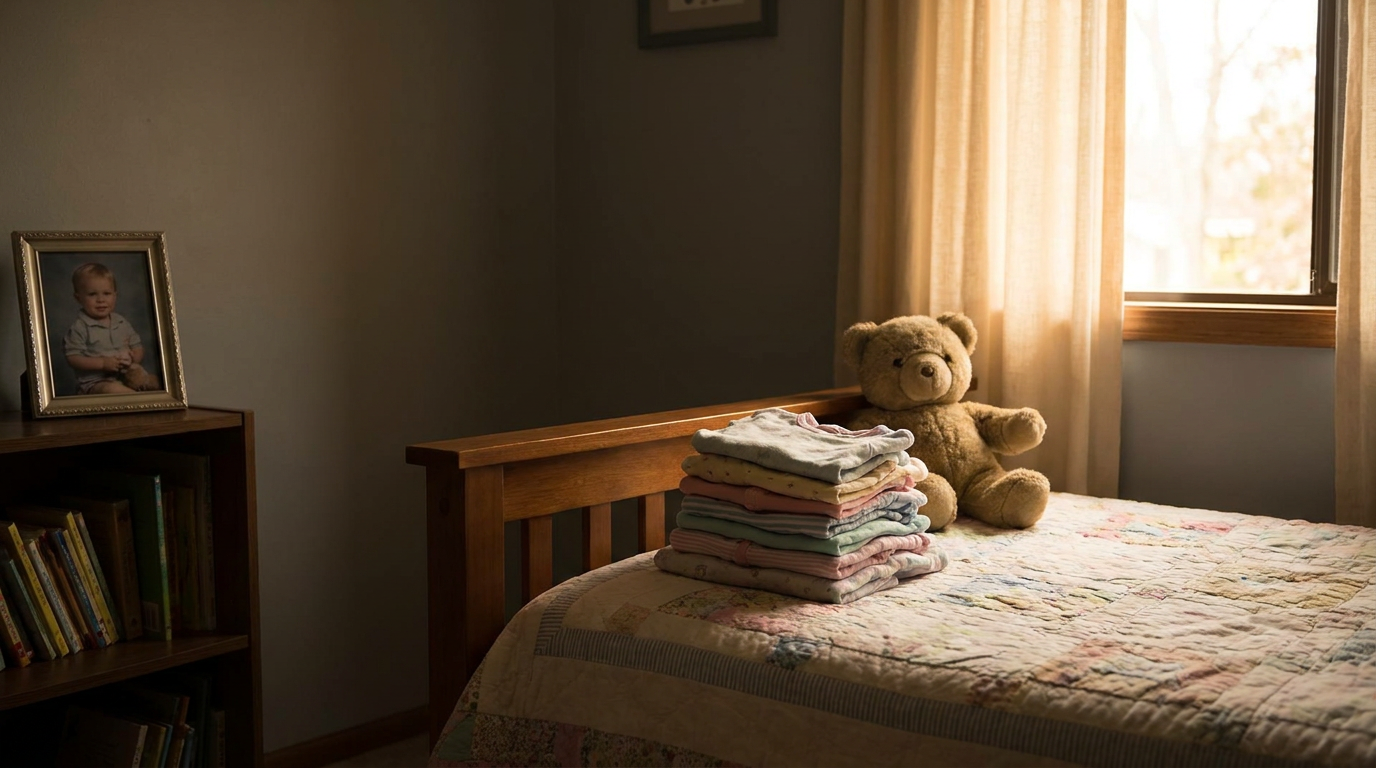
The emotions around children’s clothing memory are worth naming precisely, because they tend to blur together into a general sense of I should do something about this but I can’t quite make myself:
This last one is the critical one. Because what it reveals is that most parents are not actually looking for permission to throw the clothes away. They are looking for continuity. A way to let go that doesn’t feel like erasure. A system that honors what the clothes held — and ensures that something of that meaning travels forward, rather than disappearing into a black bag in the trunk.
The insight that matters most here: holding on and honoring are not the same thing. A box under the bed is not a memorial. It is a pause button. And the clothes inside it — slowly fading, slightly crushed, accumulating the particular atmosphere of neglect — are not being honored. They are being deferred. For more on how families are finding ways to meaningfully engage with their children’s clothing history, the Memory Makers series from Prelove Lab offers a practical companion to everything this essay explores.
The question is not whether to let go. The question is how — and whether there exists a way to do it that feels like continuation rather than conclusion. Before we get there, it is worth spending a moment in the place most families are actually living: the place of the bag in the trunk.
You know the bag. Maybe it is a canvas tote near the mudroom bench, waiting. Maybe it is a kitchen garbage bag stuffed under the stairs. Maybe it is a series of storage bins in the basement that you have told yourself, repeatedly, you will deal with when things slow down. Things have not slowed down. The bins are still there.
This is not a character flaw. It is a structural problem. Children outgrow clothing at a pace that no casual system can match. The baby seasons last months, sometimes weeks. A toddler can move through three sizes in a year. A school-age child can seem to grow overnight — pants that fit at pickup are too short by morning. The clothes accumulate faster than any reasonable family can process them, especially when processing requires decisions: Is this good enough to donate? Should I photograph it first? Can I sell it? Where do I even begin with the stained ones?
The scale of this problem, across American households, is staggering. Research compiled by Firebird Kids found that 31.4% of children’s and baby items in U.S. households are unused or no longer used — representing approximately 272.6 million items valued at $13 billion sitting idle in closets and drawers across the country. In 2021 alone, an estimated 100 million children’s items worth $4.5 billion were simply thrown away.
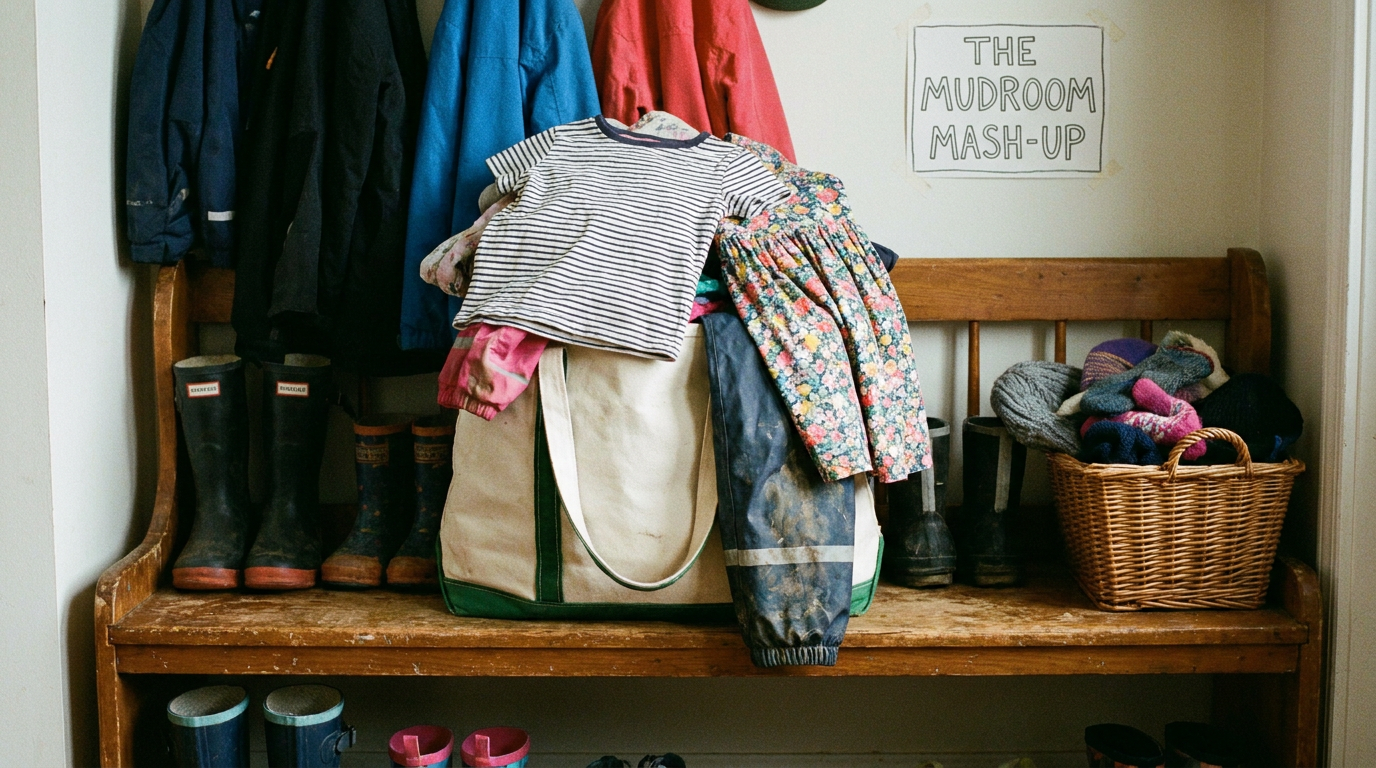
And it is not just a family problem. It is a planetary one. According to EPA data on textile waste, textiles accounted for 17 million tons of municipal solid waste in 2018 — with 11.3 million tons ultimately going to landfill. The recycling rate for all textiles sits at just 14.7%. The clothes we can’t figure out what to do with don’t disappear. They become part of that number.
But the piece that doesn’t make it into any statistic is the mental load. The invisible labor of deciding what counts as “good enough” to donate. The photographs taken and never uploaded. The listings started and abandoned. The negotiating with strangers online over a jacket that sold for four dollars after forty-five minutes of back-and-forth. This labor is real, it is exhausting, and it falls, research consistently shows, disproportionately on mothers — added to the already invisible mental load of managing a household, a family, and the emotional weight of all of it.
And then there are the stained ones. The ones with the permanent marker on the collar. The ones with the grass knees. The ones that are too worn to donate but too loved to throw away and too complicated to figure out. Most systems have no answer for those. That gap — that last, nagging, unresolved category — is often what breaks the whole thing down. The stained ones go back in the bin. The bin stays in the basement. The guilt stays with you.
The Bag in the Trunk
“You didn’t forget about it. You just didn’t have a system. Those are very different things.”
— Prelove You
For parents who want to start addressing this before the solution arrives, 5 Ways to Shrink Your Kids’ Clothing Footprint (Without the Guilt) is a practical starting point. But what most families actually need is not a tip — it is an architecture. A system that removes the friction entirely, answers the question of the stained pieces, and makes the whole process something other than a source of low-level dread.
Which brings us to the real question at the center of this essay.
Here is the assumption most parents carry, usually without examining it: that keeping is the only way to honor. That if you release the clothes — if you pass them on, donate them, send them out into the world — the memory goes with them. That the floral dress your daughter wore to her fourth birthday party becomes just a dress again, anonymous, stripped of the story that made it matter.
But what if that assumption is wrong? What if the story doesn’t end when the garment leaves your house — but continues?
Think about the dress. The one she wore on her birthday. The one you can see in every photo from that afternoon — her face lit up, frosting on her chin, the skirt already spun wide from one too many twirls. That dress carried joy. It carried her specifically, at that specific age, in that specific afternoon light. Now imagine: another child, somewhere, wearing that dress to her birthday party. The joy is not diminished. The story has not ended. It has traveled. The dress is still doing what it was made to do — holding the light of a child’s occasion — and the fact that it belongs to a different child now doesn’t erase what it held for yours.
This reframe — from holding on to letting continue — is at the philosophical center of children’s clothing memory as a living practice. It changes the question. Instead of “how do I preserve this?” the question becomes: “how do I let this keep going?”
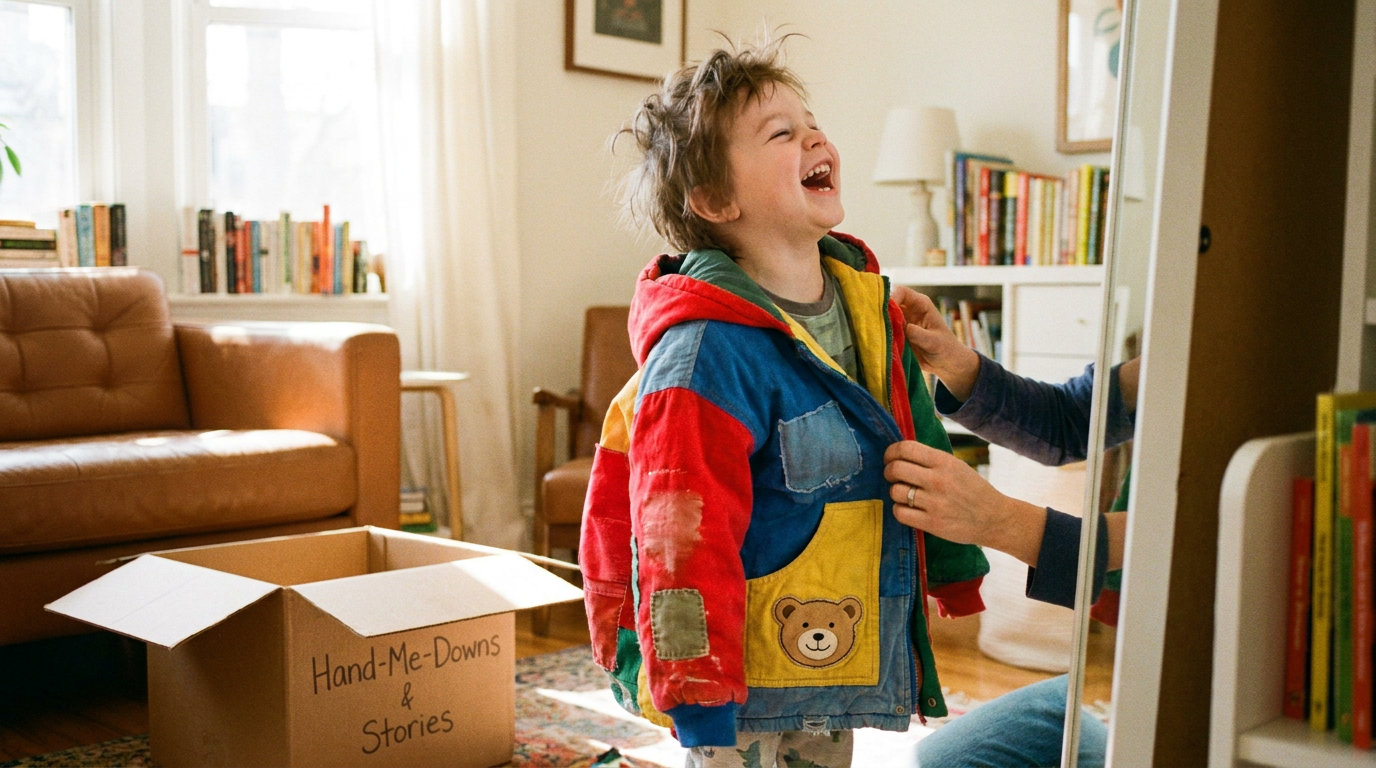
This philosophy is also deeply practical. Because what it means is that the pieces you have been unable to release — the ones sitting in the bin in the basement, the ones too worn for a traditional donation, the ones stained and scuffed and loved half to death — do not have to end their story in a landfill. The story can continue. It just needs a system capable of carrying it forward.
The Prelove You About Us page puts it simply: the mission is to give parents a smarter, more sustainable way to dress their kids. What that means in practice is a circular system where nothing has to be the end of anything. Where the birthday dress finds another birthday. Where the pajamas — even the faded, soft, worn ones that feel too intimate to pass on to a stranger — find a path forward that isn’t a landfill. For parents who want to explore a broader rethinking of how we approach children’s clothing, 5 Reasons to Rethink the ‘New Outfit’ Mentality for Kids traces the values that make this shift not just possible but deeply satisfying.
The stained pieces — the ones that feel like the last, hardest category — are handled too. Not through a workaround, but as a direct design choice: pieces that can no longer re-enter the world as wearable garments are accepted, awarded a credit, and routed responsibly through upcycling and textile recycling partners. The story doesn’t end in a bag in the trunk. It doesn’t end in a landfill. It ends — or rather, continues — in the most honest way possible.
This is what it looks like to honor a garment. Not to freeze it in time under a bed, but to release it into a system that ensures it keeps meaning something — to someone, somewhere, at another birthday party, on another ordinary morning, in another child’s reaching hands.
And when you understand how that system actually works, something shifts.
The system is called Prelove You, and it was built for exactly this — for the families who feel all of what this essay has described, and who want a way through it that doesn’t require them to become a part-time resale operation or to make impossible decisions about which stains are forgivable and which are not.
Here is how it works, in its simplest form: families send in what their kids have outgrown. Everything — the birthday dress, the faded pajamas, the grass-kneed leggings, the things that are loved into a gentle deterioration. No sorting. No photographs. No negotiations. No having to decide whether something is “good enough.” You send it in, and Prelove You takes it from there.
In return, families receive credits — a currency they can use to shop Prelove You’s curated inventory of high-quality, preloved children’s clothing. The pieces that come back into the family are chosen, not random. They are items that arrived at Prelove You from other families just like yours, assessed, curated, and made available with the care of a system that understands what these garments hold.
But the part that makes this different from every other resale or circular platform is what happens at the level of the child. Because in this system, children are not passive recipients of whatever their parents decide. They are participants. They receive credits. They make choices. They look through inventory and point at things excitedly and develop opinions about what they want to wear next. And in doing so — in being part of the process — they begin to understand something profound: that clothing has a story before it arrives in their hands, and it will have a story after it leaves. That the choices they make about what they wear are part of something larger. That caring about how things are made and where they go is not an abstraction. It is Tuesday morning, standing in front of a screen with your parent, choosing a jacket because you love it and knowing — somewhere in the background — that it has been loved before.
If you are thinking about how to bring your child into this process in a way that feels natural and joyful rather than instructional, The Confidence Cart: How to Shop With Your Kid is a beautiful companion read.
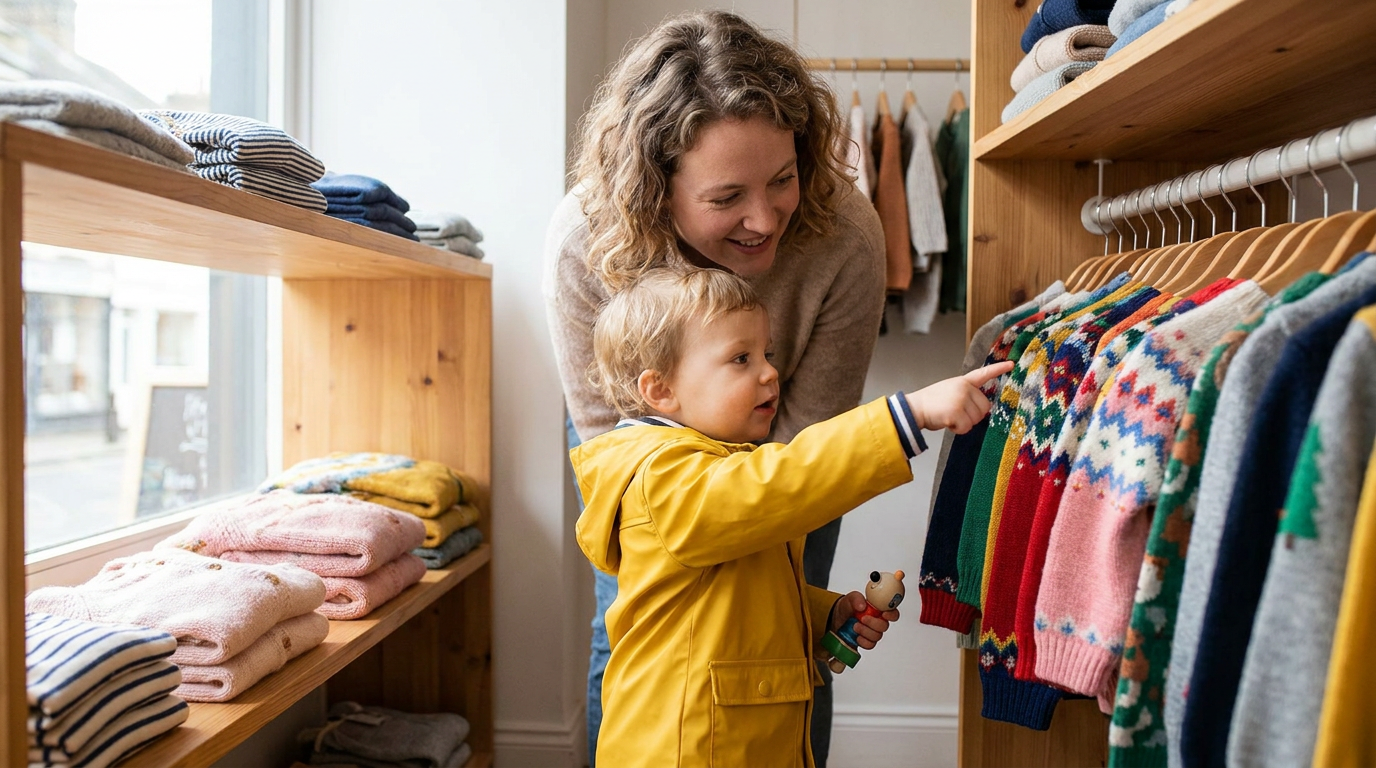
The membership is designed for real families at different points of need. Lite memberships start at $35 a month. Luxe at $65. Limitless at $95. Each tier is built around the pace and volume that actually fits a growing family — because the reality is that some seasons are quiet and some seasons are an absolute avalanche of outgrown everything, and a good system accounts for both.
And then there is the digital library book card — the thread that actually follows the garment. When you send in a piece, it doesn’t vanish. You can follow its journey. You can know that the birthday dress found another birthday. That the story continued. That what mattered about it — the joy, the occasion, the specific afternoon in which your daughter twirled until she was dizzy — didn’t disappear when the dress left your hands. It traveled.
That is the Follow the Thread philosophy made real. The thread is the garment. The thread is the memory. The thread is the story of a child growing up — and the quiet, radical belief that stories don’t have to end just because a size no longer fits.
Follow the Thread
“The clothes they outgrow are not the end of anything. They are the thread that connects who your child was to who another child is becoming. That thread deserves to keep going.”
— Prelove You
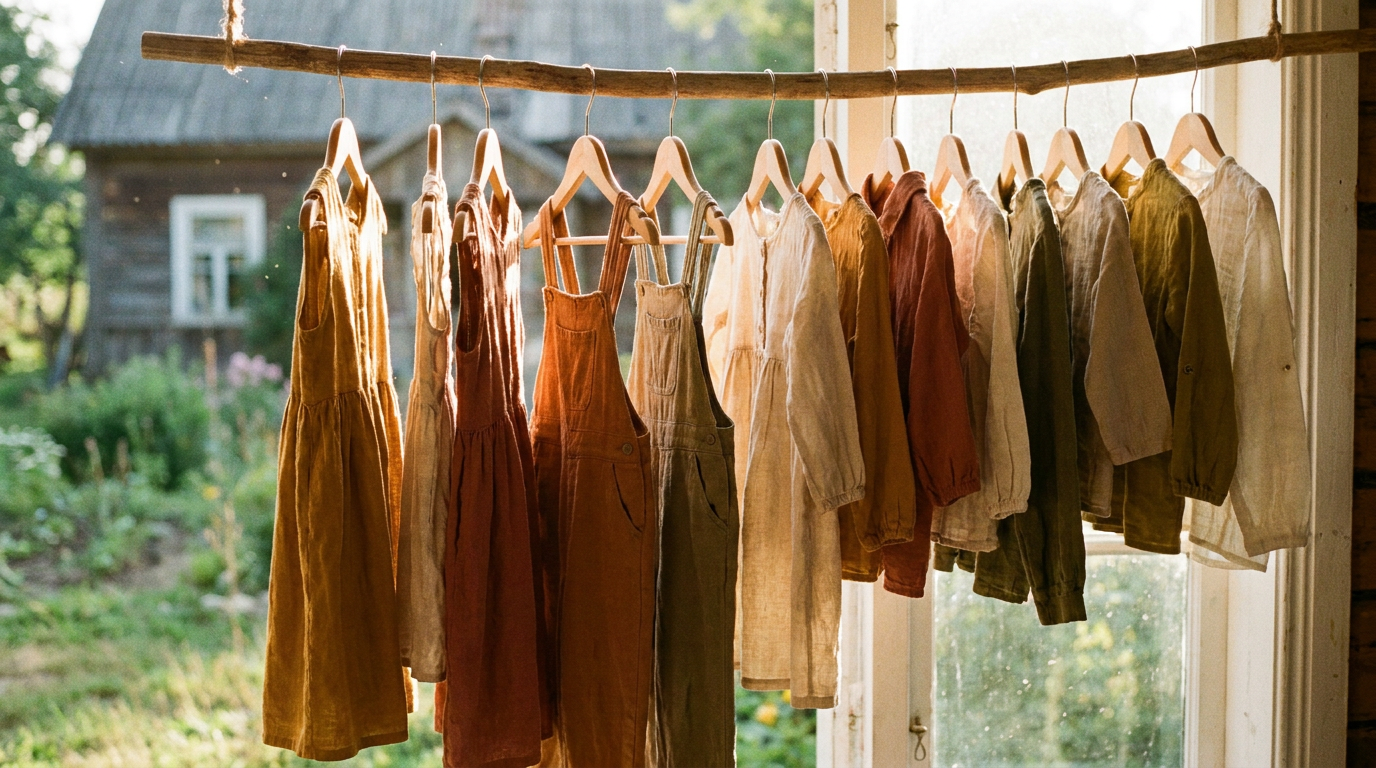
Go back to the drawer. The early summer morning. The fleece in your hands.
You know now what it holds. Not just the memory of the winter that contained it — the mornings and the ordinary chaos and the particular weight of your child at a specific age — but the proof that all of it happened. That the stage was real. That there was a version of your child who wore this, and who was loved in it, and who grew.
The clothes your children outgrow are not evidence of time lost. They are evidence of time lived. That is a different thing entirely. It is, in fact, the thing that makes them so hard to part with — and the thing that, once understood, points toward what they deserve. Not a box under the bed, growing quiet and forgotten. Not a landfill. Not guilt deferred indefinitely.
They deserve to keep going.
You carried this — the weight of it, the beauty of it, the guilt of not knowing what to do with it, the strange grief of a season that ended before you finished living in it. That weight was real. You were not being sentimental. You were being honest about something that matters. And the answer to that honesty is not to hold everything forever, and it is not to let go in a way that feels like erasure. The answer is a system that takes all of it seriously — the milestone pieces and the everyday ones, the perfect ones and the stained ones — and ensures that the story of a child growing up doesn’t end in a bag in the trunk.
It follows the thread. All the way through.
Prelove You is the household system for modern families who want ease, intention, and beauty in how they manage what their children wear. Send in what they’ve outgrown — including the stained, the worn, the ones you can’t quite let go of — and let us take it from here.
Memberships start at $35/month. See which plan fits your family → How PLY Works

