



 Sustainability Scoop
The Seasonal Wardrobe Switch, Solved for Good
A twice-a-year protocol that ends the renegotiation — what to keep, what to store, what to send, and why the bins were never the problem.
The shorts are still in the top drawer. It is the second week of September and the shorts are still in the top drawer, folded, in rotation, being pulled out on mornings when nobody has time to argue about it. The fleece is in a bin in the basement, or possibly the garage, or possibly the closet in the guest room where things go when there is no better answer. And there are two bags by the front door that have been there since August. You know what is in them. You packed them. They have simply not left.
This is the moment the seasonal kids clothing switch actually begins for most families — not with a plan, but with a mismatch you keep stepping around. And here is the part worth saying plainly, because nobody says it: you are not disorganized. You are being asked to make several hundred small decisions, twice a year, with no rule to make them by. That is not a character flaw. That is a design flaw in the task itself.
You may have already run a version of this. The back-to-school pass happened a few weeks ago. You sorted, you filled bags, you felt briefly excellent. Then the bags came back — not physically, they never left, that is the point. That is not failure. That is what happens when a task has no protocol attached to it.
So this is not a list of tips. This is one named, ordered session, run twice a year, that produces the same result every time without being reinvented.
The short version: Run the seasonal kids clothing switch twice a year, in one session. Empty the drawers completely, sort every piece into four destinations — wear now, store, send, retire — do a fast try-on pass, then seal and label what stays. Send everything else out the same week. Store only the next size, next season.
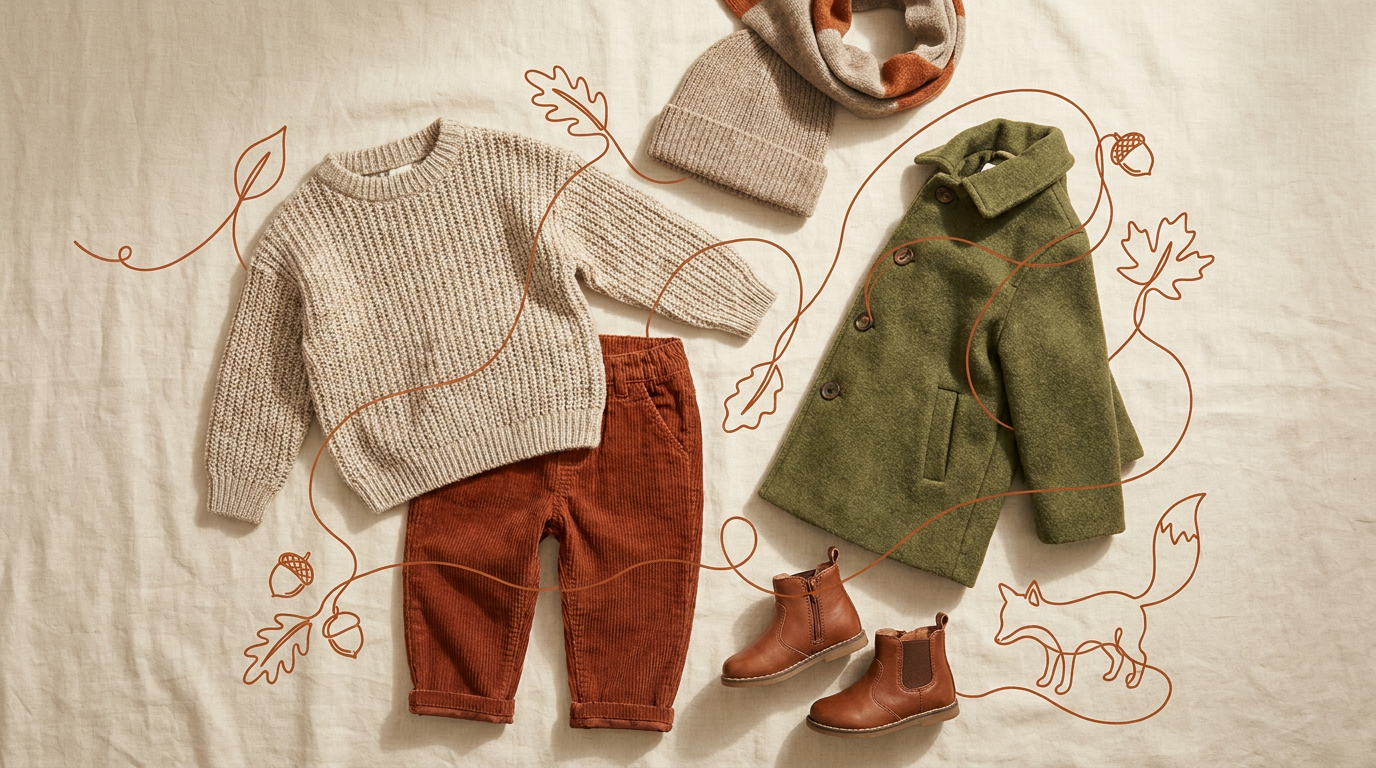
It does not break for lack of containers.
Think about what actually happens each September and each March. You start over. Not partially — completely. Whatever logic you used last time lives nowhere except in your memory of having done it, and six months is long enough that the memory has gone soft at the edges. So every single garment gets re-litigated. Does this still fit? Did she wear this? Was this the one he refused to put on, or was that the green one? Is this worth keeping for the younger one, and if so, where does it go, and will I remember it is there?
Run the arithmetic qualitatively, because you do not need a figure to feel it. Two children. A few hundred garments between them once you count socks, base layers, the pajamas that migrated into daywear, the outerwear, the shoes. Two changeovers a year. Every piece is a micro-decision, and micro-decisions are not free — they draw down the same finite attention you are using to manage everything else in the household that day. By garment ninety you are not deciding anymore. You are just moving fabric.
The exhaustion is not emotional weakness. It is arithmetic.
Which brings us to the genre problem. Search this and the internet hands you the same answer in a hundred outfits: more bins. Better labels. A color-coded system. Vacuum bags, drawer dividers, a beautiful shelving unit photographed in a house nobody appears to live in. All of it competent. All of it aimed at the wrong target.
Buying a container does not decide anything. It postpones the decision and charges you for the privilege. A storage answer to a decision problem is not a solution — it is a very tidy way of keeping the problem.
That distinction matters more than it sounds, because it explains why the organizing approach keeps producing the same September. A bin holds the undecided pile at a comfortable temperature for eighteen months. Nothing is resolved. The volume does not go down. Next spring you open it and make the decision you avoided, except now the garment is two sizes out and slightly dated, so the decision is worse and you feel worse making it.
And there is a heavier layer underneath the physical work, one that no container addresses. It is the remembering. Knowing who is in what size right now, this week. Tracking that the six-year-old has hit the top of the 5T pants but is somehow still in last year’s jacket. Holding the mental ledger of what fits, what is coming, what was outgrown between one wash and the next. This is the part nobody sees, and it does not look like labor because it does not look like anything.
Researchers have started paying serious attention to exactly this. Work by Grocke-Dewey and Wanago on how mothers conceptualize invisible work draws out a distinction that anyone who has run a seasonal switch will recognize immediately: the cognitive dimension of household labor — the anticipating, monitoring, and remembering — is experienced quite differently from the physical tasks it sits behind. Folding is visible. Knowing what needs folding, for whom, in what size, before anyone else notices, is not. If you want that thread pulled all the way through, we wrote about the mental load of kids’ clothes separately so this post can stay practical.
Here is where the practical part starts. A decision can only be made quickly if there is somewhere for the answer to go. The reason the sorting stalls is not indecision — it is that three of your four possible answers have no destination attached, so “send it on” quietly becomes “put it in a bag,” and the bag becomes furniture. Prelove You exists to remove that specific failure: a permanent destination that takes the outgrown, the barely-worn, and the genuinely finished, so the answer to where does this go is always already known before you pick the garment up.
Two passes a year, same machinery, different cadence — the fall switch and the back-to-school reset are one system, not two chores.
So much for what the switch is not. Here is what it actually is.
Rotate kids’ clothes in one session, twice a year. Empty every drawer and closet so all clothing is visible at once. Sort each piece into one of four destinations: wear now, store, send, or retire. Try on anything uncertain. Seal and label what you store. Send the rest out within the week.
That is the whole mechanism. What makes it work is not the sequence — it is the change in the question you are asking.
Most people rotate garment by garment. They pick something up and ask what do I do with this? It is an open question. It has unlimited answers. It invites memory, sentiment, hypothetical futures, and a quick mental appraisal of resale value, all in the two seconds you are holding a pair of leggings. Then they put it down and pick up the next one and do it again. Several hundred times.
Ask a different question. Ask where does this go? — and give it only four possible answers.
Precision here is the entire game, because ambiguity is what smuggles the decisions back in. If “store” quietly means anything that might be useful someday, you have not built a category — you have built a loophole. Next size, next season. If it is not next, it does not stay.
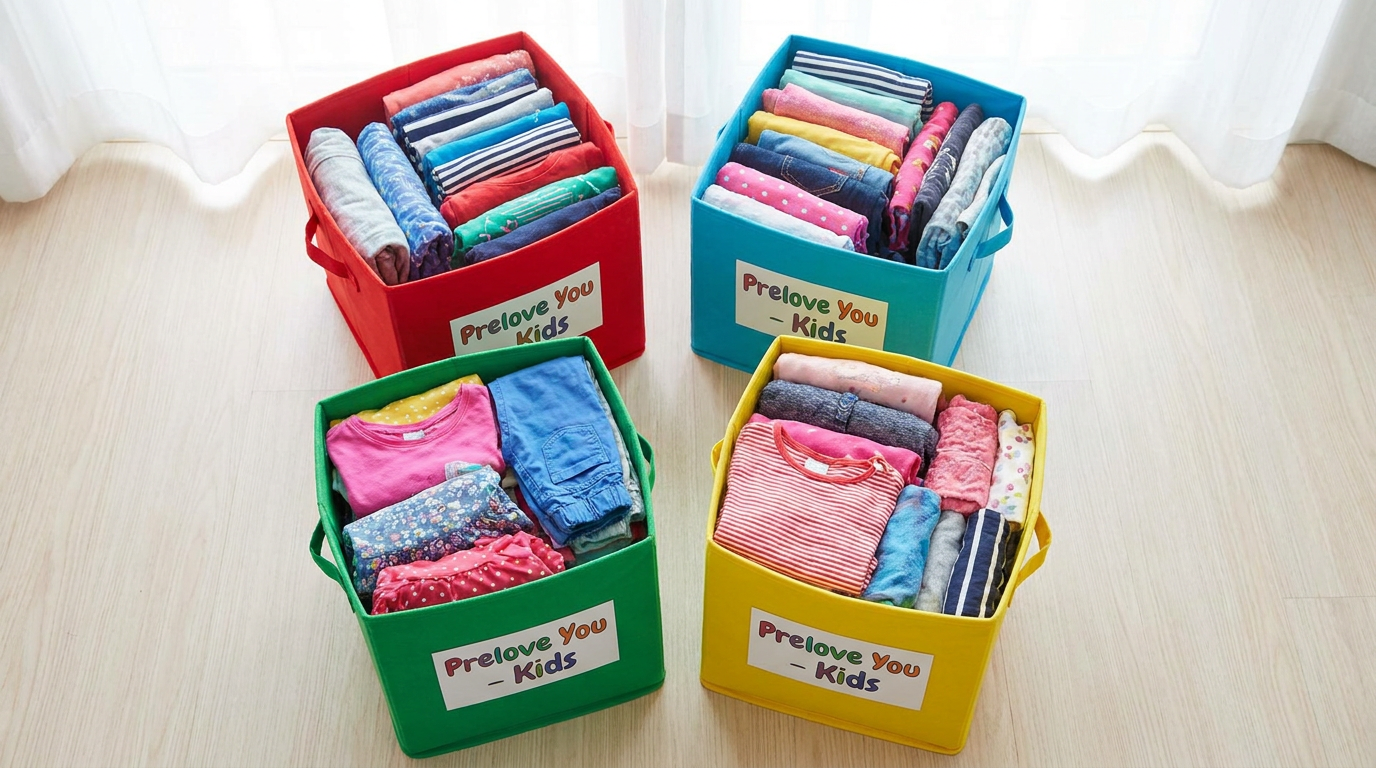
Now the mechanic that does the heaviest lifting, and the one most people miss on first read: send and retire go to the same place.
Sit with what that removes. In a conventional sort, the most expensive decision you make is not keep or go — it is is this good enough? Good enough to pass to a friend. Good enough to donate without embarrassment. Good enough that someone will actually want it, or will it just become someone else’s problem? That judgment call is slow, it is subjective, it carries a faint moral charge, and it is the single most common place a sorting session stalls out completely. You hold up a much-loved sweatshirt with a grey cuff and a small mark near the hem and you genuinely do not know which pile it belongs to, so you start a fifth pile, and the fifth pile is where the session goes to die.
Because Prelove You takes end-of-life pieces alongside wearable ones — the stained, the pilled, the worn through, the ones that have plainly finished their run — that call disappears from your day entirely. You are not grading. You are not curating. You are not deciding whether a garment has earned onward travel. You are answering one question with four options, and two of those options happen to lead to the same bag.
This is precisely what makes the seasonal kids clothing switch repeatable rather than improvisational. Improvisation requires judgment at every step, and judgment is the resource you have least of on a Sunday afternoon with two children in the room. A protocol requires judgment once, at the category level, and then it just runs.
Four destinations defined. Now the sequence that puts them to work.
Call it what it is: The Two-Season Switch. Twice a year. One session. Sixty to ninety minutes.
Set the conditions before Step 1, because the conditions are load-bearing.
This is one session, not a project spread across a weekend. A project spread across a weekend is four sessions, each of which requires re-entry, re-orientation, and a fresh act of will. Everything comes out at once — the partial approach is why the last attempt did not hold. If your child is old enough to have an opinion, they should be present for the try-on pass, though not necessarily for the whole thing. And put an empty bag or box by the door before you start. The destination exists before the sorting does. That is not a decorative detail. A sorted pile with nowhere to go reverts to an unsorted pile within seventy-two hours.
Then run it.

What makes this repeat. The protocol works because the thinking was done once, at the category level, and then encoded into the order of operations. You are not deciding about garments anymore — you decided about categories, and the sequence applies those decisions for you. Next March, you do not sit down and reconstruct a philosophy of children’s clothing. You do not relitigate whether the almost-fits jeans deserve another season. You empty, you sort, you try on, you seal, you send. Ninety minutes. The same ninety minutes as last time, producing the same result, requiring none of the same deliberation. Paired with the back-to-school reset, it becomes two scheduled runs of one continuous system rather than two annual emergencies wearing different weather.
That answers how. The next question is always when.
Switch a child’s wardrobe to fall when daytime highs sit consistently below the mid-60s Fahrenheit for about a week — typically late September to mid-October, depending on region. Do not wait for the first cold morning. Run the switch before you need the clothes, not the morning a child has nothing warm to wear.
Dates do not work. They cannot. Weather does not consult the calendar, regions diverge by six weeks or more, and children grow on a schedule known only to themselves — which is to say, entirely between one Tuesday and the next. Pick October 1st as your annual switch date and you will be either three weeks early or one cold snap late, and the year you are late is the year you remember.
Stop waiting for the right date. Watch for the trigger. A date is a guess about the future; a trigger is a fact about the present.
Two practical notes that will save you the most grief.
First, the overlap window. Do not attempt a clean same-day flip. Keep roughly two weeks of transitional pieces accessible while the changeover settles — long-sleeve tees, one light layer, one warm layer. Early fall is genuinely two seasons in one day, and a wardrobe with zero overlap manufactures its own emergency by Wednesday. The switch is a transition, not a hard cut.
Second, check outerwear and boots first. Before the drawers, before the folded stacks, before anything else. These are the pieces that fail loudest — a coat that does not close on the first cold morning is a genuine problem, not an inconvenience — and they are the hardest to source at short notice. Everyone in your climate discovers the coat problem in the same fortnight, which is exactly when the good ones vanish. Find the gap in September and you are shopping calmly. Find it in November and you are buying whatever is left in the size.
That is where the two halves of the system meet. Because sending and shopping run on the same credit balance, the outgrown fall coat and the replacement fall coat are not two separate errands with two separate decision cycles. You identify the gap during the switch, and you fill it from what has just come in in the same sitting — the Prelove You loop closing inside a single session rather than spawning a shopping trip you will schedule for a Saturday and then not take.
Timing settled. Now the pile that causes more hesitation than any other: what actually deserves to be stored.
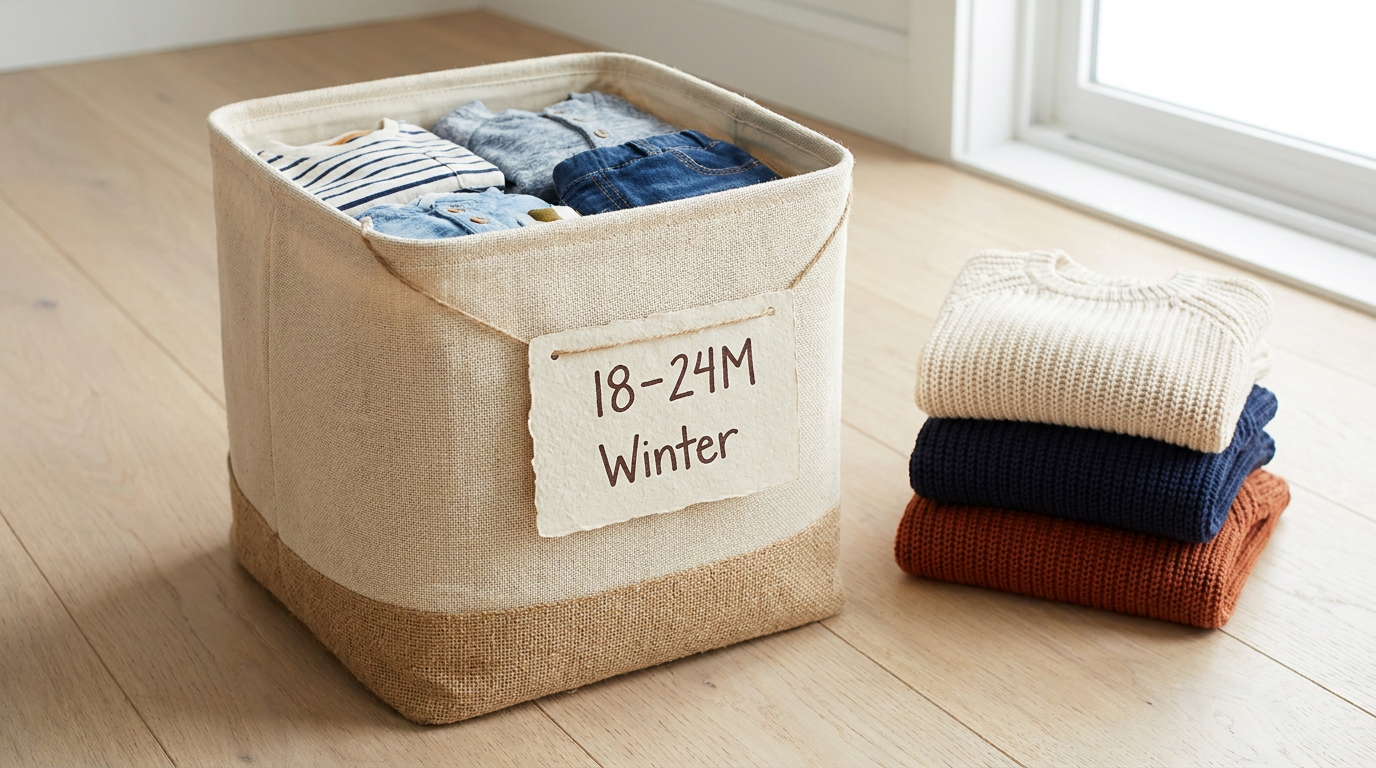
Store only what a child will realistically wear next: the next size up, in the next relevant season. Wash everything first, use breathable containers rather than sealed plastic, and label the outside with both size and season. Keep the grow-into bin small — one bin, one size. Send everything else out.
Now the position, before any mechanics, because the mechanics are useless if the premise is wrong.
Storing clothing “just in case” is deferral dressed as thrift.
It feels responsible. That is what makes it so durable as a habit. It has the texture of good household management — frugal, forward-thinking, resourceful. But look at what actually happens across the eighteen months that follow. The piece goes into a bin. It occupies space, which has a cost. It occupies a small amount of ongoing mental overhead, because some part of you is tracking that the bin exists. And then, a year and a half later, you open it and make exactly the decision you avoided making originally — except now the garment is two sizes out of relevance, has been sitting in a basement, may have a stain that set while nobody was looking, and no longer matches anything your child would choose. You did not save the decision. You paid interest on it.
The distinction that matters is between deciding to keep something and not deciding about it. Those produce identical-looking bins and completely different outcomes.
A bin with no size and no season attached to it is an archive nobody chose.
Nobody selected those items. Nobody assessed them. They simply were not decided about, and the bin absorbed them, which is what bins are for. That is why the label is not an organizing flourish — it is proof that a decision occurred. “18–24M / Winter” on the outside of a container means someone determined that these specific pieces have a specific near-term use. An unlabeled bin is a record of avoidance in a nice container.
With the position established, the rule set. This is the part worth screenshotting.
A few rows deserve elaboration.
Outerwear earns its storage. A good winter coat one size up is a genuinely sound thing to keep, because the cost of replacing it is high and the window in which you need it is narrow and non-negotiable. Snow gear likewise. This is the category where “store” is a real decision rather than a deferred one.
Occasion pieces almost never survive contact with the next occasion. The wedding outfit, the holiday velvet, the good shoes worn twice. The instinct to store these is powerful and it is almost always wrong — occasions are specific, and a piece chosen for one rarely fits the season, size, and mood of the next. Send them while someone else’s occasion is still ahead of them.
Two sizes ahead is not planning, it is speculation. The storage window is long enough that condition degrades, style dates, and your child’s own taste changes entirely. Elastic relaxes whether or not anyone is wearing the garment. Printed graphics crack in storage. Factor that honestly into what deserves the space.
Now the mechanics, told straight. What survives storage: clean natural fibers, in breathable containers, kept off concrete and out of damp. What does not survive: anything stored dirty, because invisible residue oxidizes and sets into permanent discoloration over months — the shirt goes in looking fine and comes out with a yellow shadow at the collar. Anything sealed in plastic long-term, which traps moisture against fiber. Anything in cardboard in a basement. And regardless of your technique, elastic and printed graphics degrade on their own timeline. That is not a storage failure; it is materials science, and it should make you more selective, not more diligent. If the stain question is the one snagging you — and for most families it is the single biggest source of hesitation in the whole pile — we wrote a separate piece on exactly that.
Finally, the constraint that makes all of this hold: keep the grow-into bin small. One bin per child.
The limit is not a hardship. The limit is the feature. A cap you set in advance is a decision you never have to make again, because the bin makes it for you — if it does not fit, it goes. Without a cap, every borderline piece triggers a fresh individual judgment, and you are right back to garment-by-garment deliberation. With a cap, you are simply ranking against a fixed space, which is a faster and far less taxing cognitive task. One bin. One size. Full is full.
And the reason you can afford to be this decisive is that the alternative to storing is not the trash, and it is not a guilt-tinged drop-off where you quietly hope the sorting volunteer is kind about the mark on the sleeve. It is credits, and a destination that accepts everything — including the retire pile. Prelove You takes the pieces that have finished as readily as the pieces that have not, which is precisely what makes “send it” a low-cost answer instead of a small moral event. If you want the specifics before you commit, the FAQs cover what can be sent in.
The table resolves most of the pile. It does not resolve all of it.
Every switch produces a small pile that refuses the four destinations.
You know it when you reach it, because the pace changes. You have been moving quickly, and then you are not moving at all. It is the going-home outfit, impossibly small, that you have moved between four different drawers over five years. It is the dress from the third birthday — the one in all the photographs, the one she wore until it stopped closing and then wore anyway. It is the sweater worn through at both elbows.
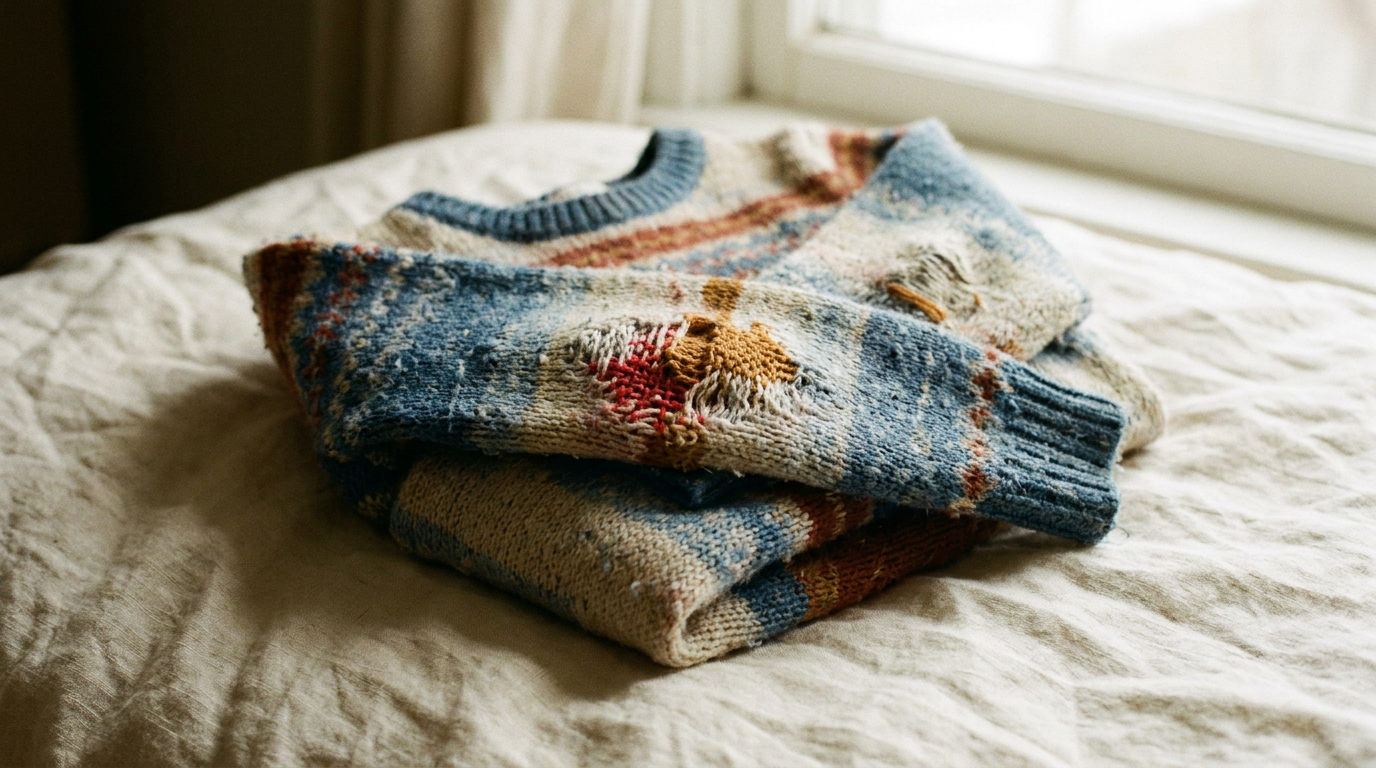
That sweater deserves a moment, because it is the piece the whole category turns on. It is worn through because it was worn constantly. That is the entire explanation. It was chosen, over and over, on ordinary mornings, by a person who does not yet articulate why they like things but knows with total certainty which sleeve feels right. The damage is not evidence of neglect. It is a record of preference.
Wear is evidence, not damage. The most worn pieces are the most loved pieces, and reading them as failures of care gets the story exactly backwards. If you want to know what your child actually likes — not what they said they liked in the store, not what you hoped they would like — look at what has gone soft at the cuffs. That is real information about their taste, and it is worth having on hand the next time you are choosing something new.
So keep some of them. Genuinely. The permission here is not “keep nothing” — the permission is to keep deliberately. A small number of pieces, chosen on purpose, stored separately from the rotation bins so they never re-enter the sorting question. Three things in a box on a high shelf is a keepsake collection. Forty things in a bin in the basement is the archive nobody chose, and it is the reason next spring’s session will be slower than it needs to be. The problem was never keeping meaningful things. The problem is keeping everything, because nothing was ever actually selected.
Then there is the other resistant group: the genuinely finished. Stained past treating, worn through, elastic gone, the mark that did not come out and never will. These pieces generate a particular and quite specific paralysis, because the available options both feel wrong. Throwing them away feels wasteful. Passing them on feels like handing someone a chore. So they go back in a drawer, or into a bag that stays by the door, and the session ends without ending.
This is the friction Prelove You was built to remove. End-of-life pieces come in alongside everything else and get routed responsibly, which means the question is this good enough? never has to be asked or answered. It is difficult to overstate how much that one absent decision changes the character of the session. It is the difference between a sort that finishes and a sort that stalls at the last pile.
A note in reverse, while you have condition on your mind. Once you have spent an hour assessing wear on your own children’s clothes, you will find you have become unexpectedly sharp about it — and the next time you shop secondhand, you will want the same clarity applied in the other direction. What does honest wear look like versus a piece that has quietly given up? Which fabrics show age early and which hide it? That is its own guide, and it is coming.
One more thing worth knowing about, briefly. We are building a digital library book card — a way of following a piece onward after it leaves you, so that sending is a continuation rather than a disappearance. It is a small idea with a disproportionate effect on how the send pile feels. The sweater does not vanish. It goes somewhere, to someone, and you get to know that.
If the emotional weight of all this is heavier than you expected, that is not unusual, and it is genuinely well documented. The clothes are not just clothes, and pretending otherwise is what makes the task feel strange to be tired by.
From what the switch surfaces, to what the switch builds.
The measure of this protocol is not today’s session. It is March.
March is when you find out whether you built a system or just had a productive afternoon. If you sit down in March and start reasoning from first principles again — squinting at a pair of jeans, weighing the case for keeping them, wondering whether the bin in the basement has anything in the right size — then you did the work but you did not keep it. If instead you empty, sort, try on, seal, and send, and the whole thing takes ninety minutes and requires no philosophy whatsoever, then the decisions from today are still holding. They were made once. They are still doing their job.
Which leaves the most underused opportunity in this entire category: your child.
The switch session is the only moment all year when a child sees their whole wardrobe at once. Not a drawer. Not what is clean. Everything, laid out, at the same time. That is a genuinely rare vantage point, and it is wasted if they are in another room while it happens. Bring them in. Ask what they reach for and what they never touch. Ask what is missing, and listen to the answer even when it is “more pockets.” A child who has seen their full wardrobe once a year develops an actual relationship with it, rather than experiencing clothing as something that simply appears in drawers.
Credits are what turn that from a conversation into a decision with real stakes. When a child understands that the things they have outgrown come back as the ability to choose new things — and that they get to make some of those choices — they are learning value, taste, and consequence at the same time, in a context small enough to be safe. Spend it all on one loud jacket and discover you now need socks. That is a genuinely useful lesson, and it costs nothing to learn at seven. The mechanics of how the credit loop works are simple enough to explain to a child in about a minute, which is the point.
Read membership as infrastructure rather than as a purchase. Sending and shopping running on one balance means the switch produces its own resupply — the outgrown funds the incoming, in the same session, without a separate errand or a separate decision cycle. That is the structural difference between a household that manages clothing overflow continuously and one that runs a system twice a year and otherwise does not think about it.
The tiers are plain: Lite at $35/month, Luxe at $65/month, Limitless at $95/month. There is also a seasonal membership at $195, and for the reader who has made it this far — someone who intends to run this exactly twice a year and would like the destination to exist on both of those days — that is the honest fit. It is aligned to the cadence this entire post describes. No hard sell; it is simply the option that matches the behavior.
And so the thread closes where it started. Those two bags by the front door were never evidence of a storage failure. You had bags. You had bins. You had, if we are being frank, more organizational equipment than the situation strictly required. What you did not have was a permanent destination — somewhere the answer could go the moment it was decided. Once the destination is fixed and always available, the sorting stops being a negotiation and becomes something the household simply runs. Twice a year. The same way. Every year.
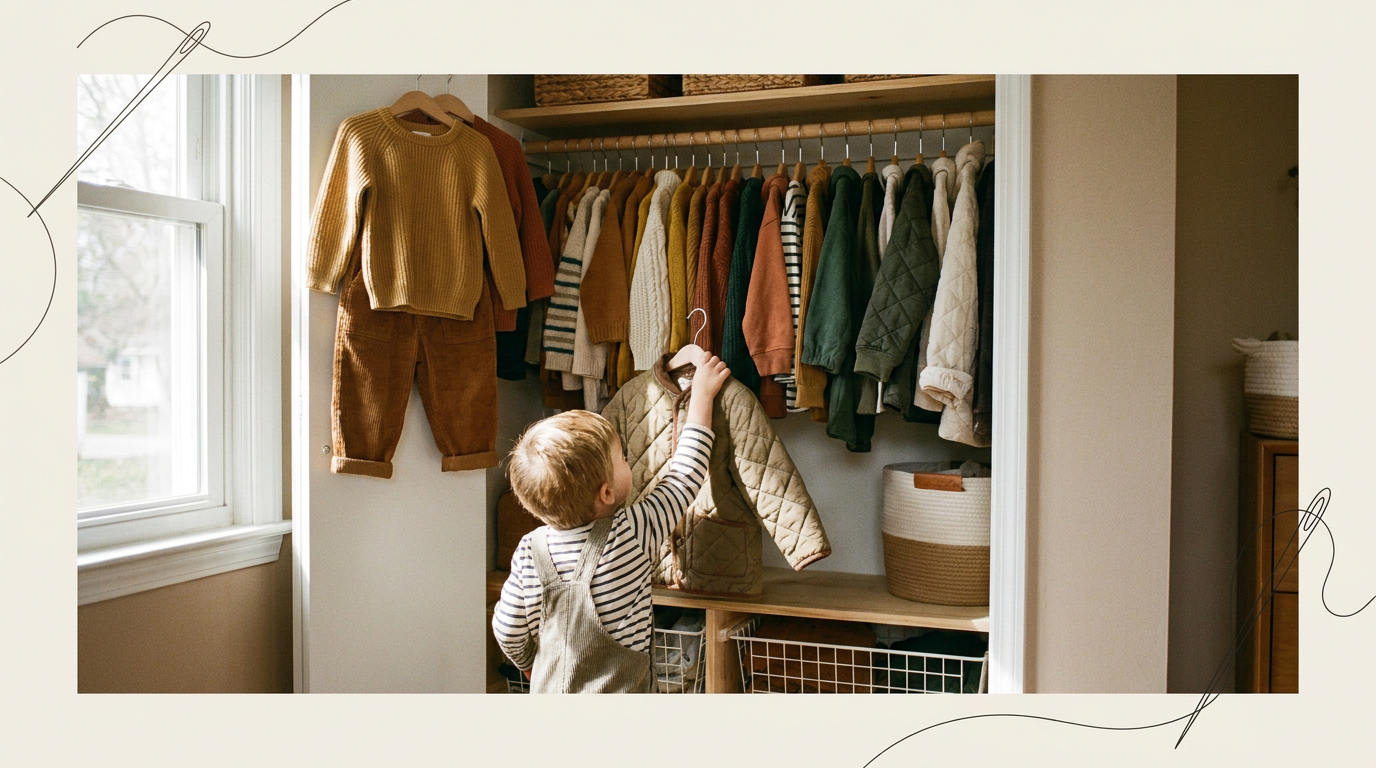
It was never a storage problem. It was a decision problem — and decisions only have to be made once if you encode them into a sequence.
That is The Two-Season Switch: empty, sort by destination, try on, seal and label, send. Sixty to ninety minutes, twice a year.
Two positions are worth carrying with you. Store only what comes next — the next size, the next season, one bin, labeled on the outside. And let everything else leave the house the same week, including the pieces that are finished, because the judgment call about whether something is good enough is the most expensive decision in the process and you no longer have to make it.
Next March, you run it. You do not rebuild it.
How to Talk About the Switch With Your Kid
“Twice a year we take everything out and look at all of it together — and you get to say what you love and what you’re done with. The stuff you’ve grown out of goes to another kid who’s just the right size for it now. They’re going to love it exactly like you did.”
If you take one action before the fall switch, make it this one: have the destination in place before the day you run it. The send step is the step that decides whether the whole protocol repeats, and it only works if there is somewhere for the bag to go on the afternoon you fill it.
Start a membership before you run your switch. The seasonal membership at $195 is built for the family running this twice a year and nothing in between; Lite ($35/month), Luxe ($65/month), and Limitless ($95/month) are there if you would rather it run continuously.
Not ready to join? See what’s new in and start with the coat.
