



 Sustainability Scoop
The Invisible Labor of Kids’ Clothing (And the System That Finally Takes It Off Your Plate)
You’re not disorganized. You’re carrying a job nobody gave you a title for — and it’s time to put it down.
There’s a bag in the trunk of your car. It’s been there for three months, maybe four. You know exactly what’s in it — the 18-month onesies your youngest has outgrown, the fleece jacket with the small stain near the collar, the pajamas with the worn-out feet. You put it there with good intentions on a Sunday afternoon when you finally tackled the dresser. You told yourself you’d deal with it that week. Drop it somewhere. Figure it out. And then Tuesday happened, and Thursday happened, and now it’s just… there. A quiet weight in the back of your car that you stop seeing, the way you stop seeing anything you’ve learned to live around.
The bag is not the problem. The bag is the symptom.
What it represents is something harder to name — the hours of mental work that preceded it. The noticing that the sleeves were too short. The pulling everything out to assess. The impossible triage of sell, donate, save, trash. The guilt over the too-stained ones, the indecision over the sentimental ones, the logistics of actually getting rid of the rest. Nobody asked you to do this. Nobody will notice when it’s done. It simply falls to you, like so much of what keeps a household running — silently, invisibly, endlessly.
This blog is not about how to organize a closet or build a better donation habit. It’s about naming what you’ve actually been carrying, understanding why it’s genuinely hard, and offering you something real: a system that was designed for exactly this.
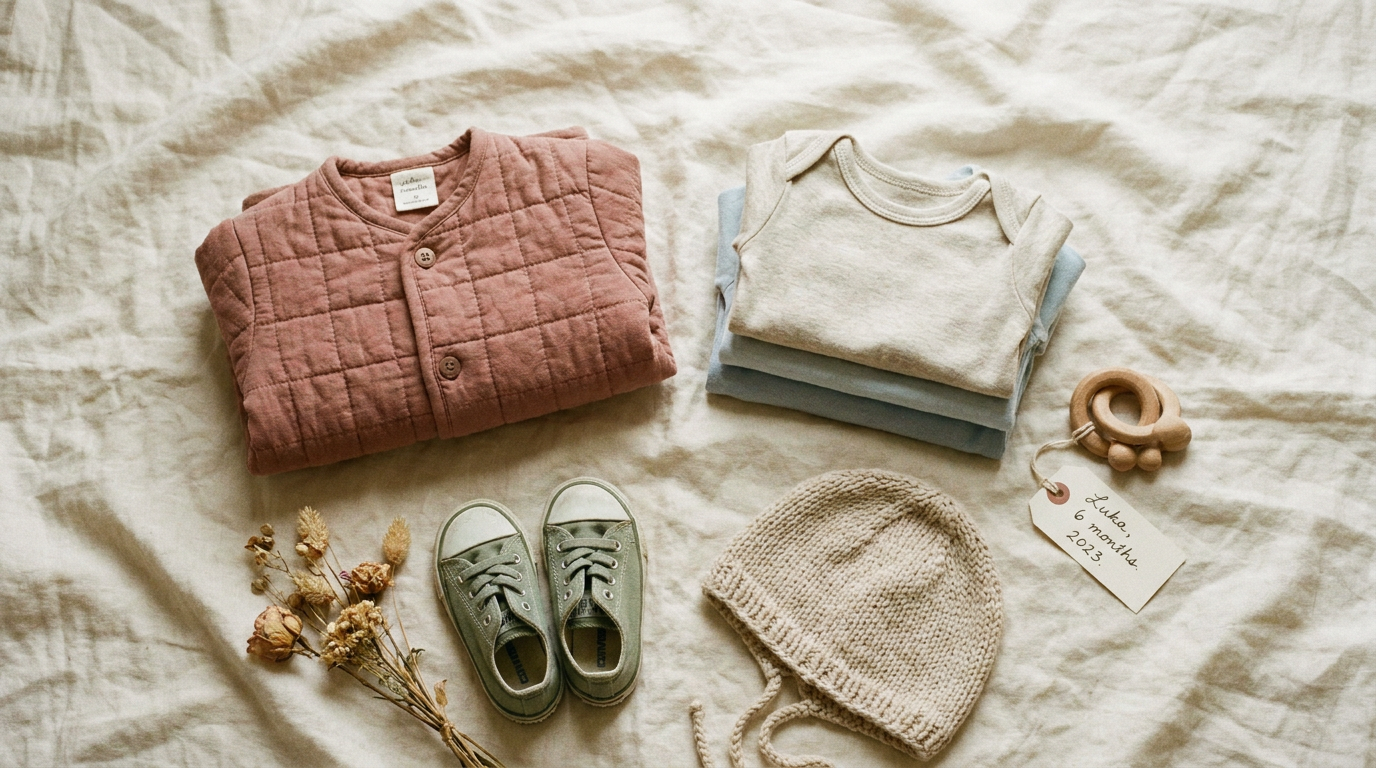
Most conversations about parenting labor focus on what you can see: the cooking, the carpooling, the laundry that multiplies overnight. But the research tells a different story — one about the layer of work underneath all of that, the constant cognitive hum of managing, anticipating, planning, and remembering that keeps a family running even when no one is doing anything visibly productive.
This is what researchers call the “mental load,” or more precisely, cognitive household labor. It’s the work of knowing what needs to happen before it needs to happen. It’s remembering that the doctor’s appointment needs to be scheduled three weeks before the school physical deadline. It’s tracking which child has outgrown which shoe size. It’s holding the family’s entire operational logic in your head, all the time, without being asked and without being thanked — because the expectation is simply that it will be done.
A 2024 study published in Psychology Today, drawing on University of Bath research of 3,000 U.S. parents, put hard numbers to what many parents have felt but struggled to articulate. On average, mothers handle 71 percent of household mental load tasks — while fathers manage just 29 percent. The disparity becomes even more pronounced when looking specifically at daily, repetitive responsibilities: mothers carry 79 percent of those ongoing duties, the kind that have no finish line and no off switch.
What makes this finding particularly striking is the perception gap it reveals. Fathers in the study frequently overestimated their contributions to household cognitive labor, believing the division to be far more equal than their partners reported. This is not about bad intentions — it’s about the nature of invisible work. When labor doesn’t produce a visible, finished product, it becomes easy to discount. The mental load doesn’t leave dishes in the sink or laundry on the floor. It lives in someone’s mind, and the person carrying it often has no way to put it down at the end of the day.
“The work isn’t in the doing. It’s in the knowing what needs to be done, and never being allowed to forget it.”
The consequences of carrying this load disproportionately are not abstract. Peer-reviewed research published in Springer (2024) links sustained cognitive household labor directly to increased rates of depression, chronic stress, burnout, and compromised relationship functioning in women. From a neuroscience perspective, this makes sense: the prefrontal cortex — the region of the brain responsible for executive function, planning, and decision-making — is under constant activation when you’re perpetually managing household logistics. Chronic strain on this region degrades the very cognitive resources that the work demands. You become worse at making decisions precisely because you are always making decisions. You become more emotionally exhausted precisely because there is no emotional off-ramp.
The career implications compound the personal ones. Gallup research shows that working mothers are twice as likely as fathers to contemplate reducing their hours or leaving the workforce entirely because of parenting responsibilities. The mental load doesn’t stay neatly inside the home — it bleeds into professional life, into sleep, into the quiet moments that no longer feel quiet.
This is not a personal failing. It is a structural problem. And naming it as such is the first, necessary step toward something better.
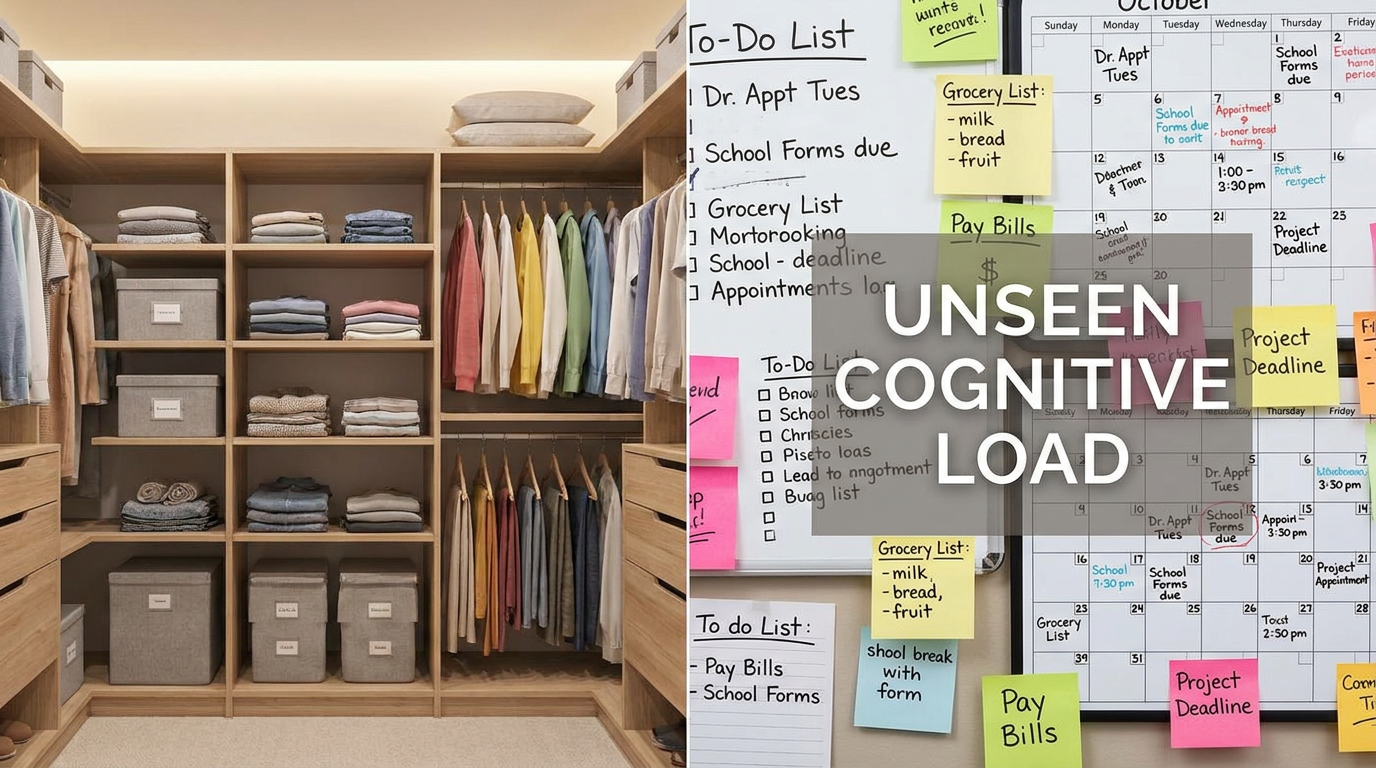
Understanding the mental load in its full scope is essential — but to really feel the weight of it, you have to zoom in. Because within the vast landscape of cognitive household labor, there is one task so relentless, so gendered, and so utterly unacknowledged that it deserves its own conversation entirely.
Ask a parent what they did last Thursday afternoon, and they might mention a meeting, a school pickup, a dinner that didn’t quite come together. What they likely won’t mention — because it doesn’t feel like something worth reporting — is the three hours they spent going through their children’s closets. Pulling out everything. Assessing it. Deciding what still fits, what doesn’t, what’s too stained to donate, what’s too sentimental to part with, what needs to go somewhere but where exactly remains unresolved. Three hours of concentrated cognitive work that will leave no trace in anyone’s memory except theirs.
Managing kids’ clothing is one of the most invisible — and uniquely relentless — forms of parenting labor. Children outgrow clothes at a pace that is genuinely biological: every three to six months in the infant and toddler years, seasonally in the years that follow. There is no slowdown. No plateau. No moment when the wardrobe simply stabilizes and you can rest. The minute you’ve sorted through the 18-month pile, the 2T pile is already quietly becoming irrelevant. The cycle is built into the nature of childhood itself.
But the labor is not just in the sorting. It’s in everything that surrounds it. It’s in noticing when the jeans are getting short before anyone complains about them. It’s in anticipating that the winter coats won’t fit next year and factoring that into a budget three months early. It’s in managing the incoming hand-me-downs from a cousin — sizing, assessing condition, integrating what works and quietly disposing of what doesn’t without offending anyone. It’s in the drawer full of fitting pajamas that your child opens every morning without a second thought, not knowing that it required someone’s quiet, sustained effort to make it that way.
As Romper reported in a March 2025 piece on the invisible and emotional labor of kids’ clothing, this is “the most invisible of all the invisible labor and it’s happening all the time.” The piece captures with precision the specific texture of this work: the bag of too-small 2T winter clothes that rode in the back of a minivan for six months before finally making it to a donation bin. The pajama drawer so overfull it barely closes, but you don’t dare clear it because these all still fit and that is a minor miracle. The piles on the dining room table of new dresses from a well-meaning relative that need to be sized, tagged, washed, and found a home for — before dinner.
What makes managing kids’ clothes so particularly exhausting as a form of cognitive labor is the decision fatigue it generates. Every single piece of clothing that exits a child’s wardrobe requires a judgment call, and there are no easy answers:
There is no clean exit. Every option has a friction cost. And unlike so many other household tasks — cooking dinner, running a load of laundry — managing kids’ clothing has no completion state. There is no moment when it is done. Another growth spurt is always coming. Another season is always six weeks away. And no one — no partner, no system, no well-intentioned Pinterest board — has ever adequately solved for this.
The Clothing Pile That Never Ends
“You didn’t let the pile grow. The pile grew because your kids did — and the system you had wasn’t built for that. That’s not a failure. That’s a design problem.”
The logistical weight of managing kids’ clothing is exhausting enough on its own. But it’s only half the story — because these are not just clothes.
There is a particular kind of grief that no one prepares you for in parenting. It doesn’t arrive at milestones — not at first steps or first words, where the celebration is loud enough to hold the bittersweetness in check. It arrives quietly, in a folded pile of clothing. In a tiny fleece jacket that still smells faintly of the child who wore it every single day one winter until it was so worn it could barely be called a jacket anymore. In the dress she spun in. In the pajamas he absolutely refused to take off for two weeks running, the ones with the small rocket ships and the left knee gone slightly threadbare.
These are not neutral objects. They are timestamps. They are the physical evidence that a child was small, that they grew, that time moved — and that it always moves forward.
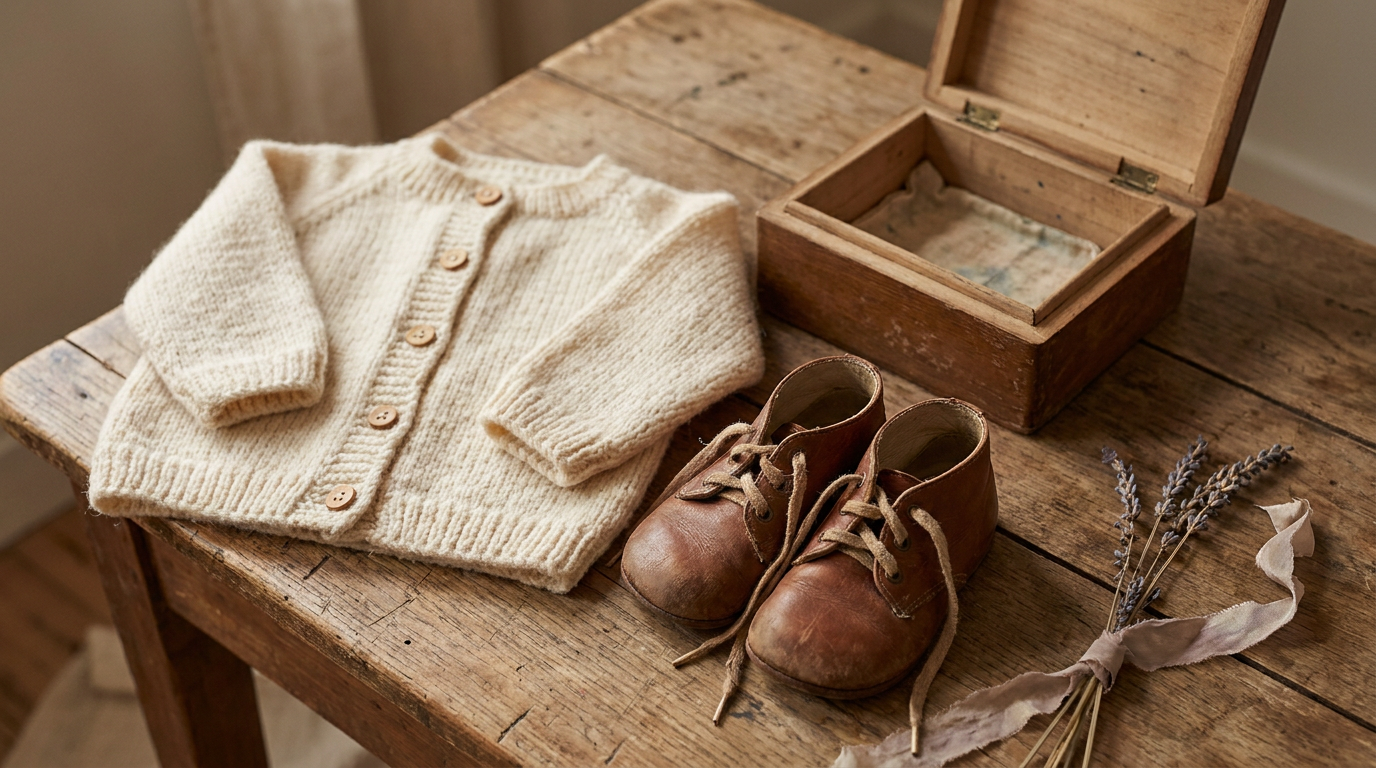
Children’s clothing holds memory in a way that very few objects do. The first Halloween costume — worn not just on Halloween but on every regular Tuesday for three months afterward, because that is the kind of commitment children bring to things they love. The polo shirt from the first day of kindergarten, which you photographed from four angles and texted to grandparents. The bunny outfit you bought while pregnant, when you were still dreaming about who this person would be, worn exactly once before they grew out of it. Getting rid of any of these things feels, in some undeniable way, like letting go of the moment itself.
This is not sentimentality for sentimentality’s sake. It’s a genuine psychological reality. Clothing holds episodic memory — it’s tactile, sensory, specific. You don’t remember a vague month. You remember the yellow raincoat. And when you’re asked to put the yellow raincoat in a bag and release it to an unknown destination, you are being asked to let go of something that felt, however irrationally, like it was keeping the memory alive.
The guilt operates in both directions, which is what makes it so difficult to resolve. Keeping everything feels impossible — closets and storage bins overflow, the weight of accumulation becomes its own kind of burden. But getting rid of things triggers a specific shame: the sense that you are erasing something, or that your love for that moment wasn’t careful enough to preserve it. There is no right answer inside this tension. There is only the next bag that needs to go somewhere, and the feeling that wherever it goes, something is lost.
This is why so many parents find themselves holding onto the tiniest first-day-of-school outfit long past any practical use. It’s not clutter. It’s continuity. And any solution to the problem of outgrown children’s clothing that doesn’t account for this emotional dimension will always feel inadequate, no matter how efficient it is.
At Prelove You, clothing is understood as the literal common thread — the thing that holds memory, identity, and the story of a child’s growth. That understanding shapes every part of how the system was built. Because when letting go of something feels personal, the answer can’t be purely logistical. It has to be human.
What the Clothes Remember
“The tiny jacket they wore on the first cold day of fall. The pajamas they refused to take off for two weeks. The dress they spun in. These aren’t just clothes. They’re timestamps. And you deserve a system that honors that.”
Understanding why this is hard — both logistically and emotionally — is necessary. But it raises an obvious question: if this problem is so real and so universal, why hasn’t any existing solution actually solved it?
Families are not passive in the face of the outgrown-clothing problem. They try things. They donate, they sell, they consign, they organize, they hand things down, they build elaborate systems on Sunday afternoons that are supposed to finally get this under control. And then, a growth spurt later, the pile is back. The bag is in the trunk again. The bins are overflowing.
This is not a failure of effort or intention. It’s a failure of design. Each of the available options addresses a symptom — getting clothes out of the house — without addressing the underlying system problem: that managing kids’ clothing is a continuous, repeating cycle that demands continuous, repeating decisions. And every current solution adds decisions rather than removing them.
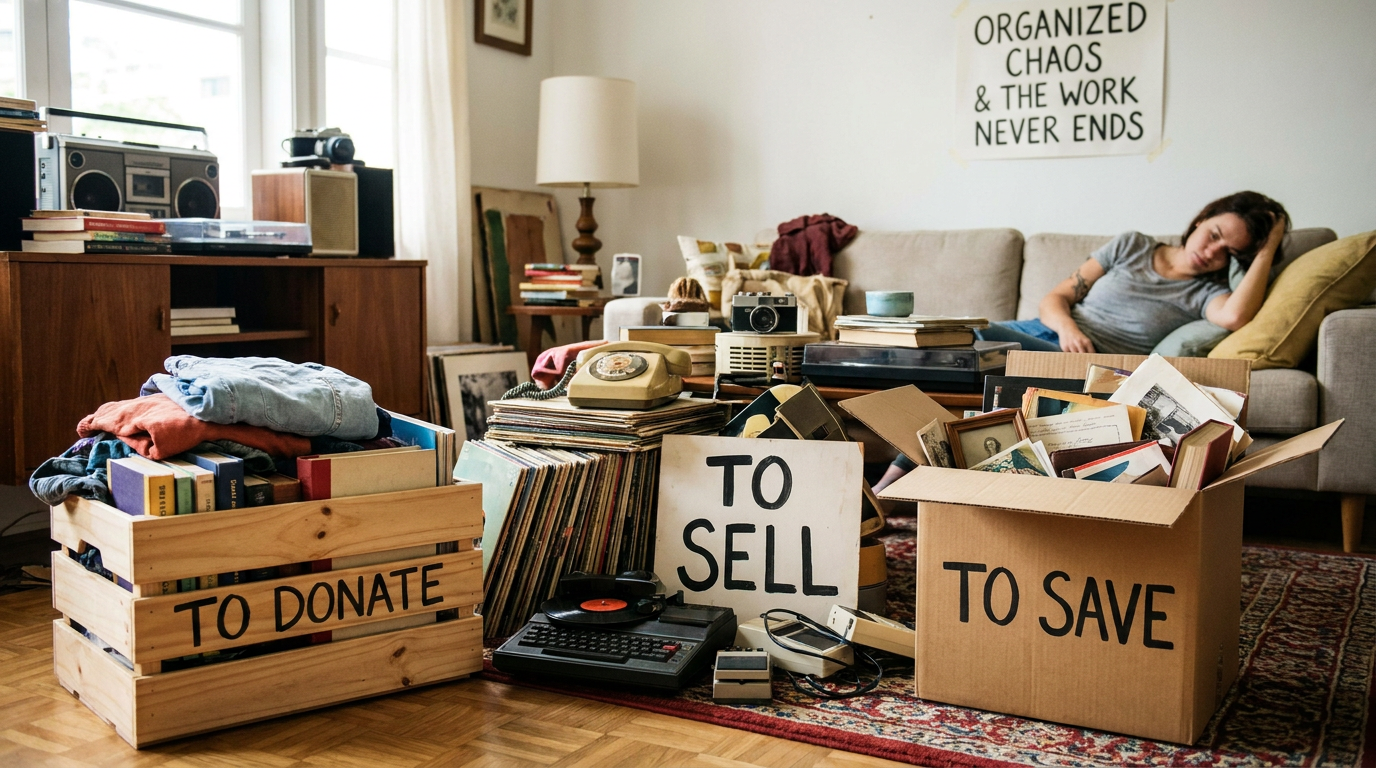
Consider what each option actually asks of you:
Donation sounds simple until you try to do it. First, you have to sort — because most donation centers have condition requirements, and sending in genuinely worn or stained items often means they end up in landfill anyway after the charity rejects them. Then there’s the decision about where — which organization, which drop-off location, which hours they’re open. Then there’s the guilt when you show up with a bag of clothes that are too worn to be useful to anyone and wonder if you’ve just created someone else’s problem. Donation removes the item, eventually, if the stars align. It does not remove the cognitive work that precedes the removal.
Resale platforms — Poshmark, Facebook Marketplace, Mercari — introduce an entirely second job into an already crowded schedule. For every item you want to sell, you need to photograph it (ideally in good light, styled to show size), write a listing, respond to inquiries, negotiate, ship, and then follow up when a buyer goes quiet. The return on this investment, for a pair of outgrown baby jeans, might be four dollars. The time cost of generating that four dollars is genuinely not worth it for most families — and yet the alternative feels like leaving money on the table, which is its own kind of mental load.
Consignment shops occupy a middle ground that ends up excluding the families who most need relief. Consignment requires items to be in near-sellable condition, which immediately disqualifies the most-worn, most-loved, most characteristically childlike pieces — the ones with the grass stains and the worn knees and the paint smears that prove they were actually used. Parents still have to sort, transport, wait for evaluation, and return for items that didn’t sell. For children’s clothing specifically, the volume and frequency of need makes this model structurally inadequate.
DIY organization systems — the labeled bins, the vacuum-sealed bags, the size-sorted plastic containers — solve a storage problem but not a cycle problem. They look extraordinary in a freshly organized closet. They work until the next growth spurt, at which point the entire system needs to be rebuilt. The container labeled “3T” needs to be replaced by one labeled “4T.” The bins multiply. The method that felt like a solution becomes another thing to maintain. As the Prelove You blog explores, the volume of kids’ clothing is itself part of the problem — and no amount of better storage addresses the fundamental footprint issue.
Hand-me-down networks, well-intentioned as they are, frequently add more inventory to manage rather than less. Incoming bags of clothes arrive in the wrong sizes, the wrong seasons, conditions that vary wildly. Someone has to sort through them, decide what’s usable, find storage for what isn’t yet the right size, and diplomatically handle the items that simply don’t work. It shifts the cognitive labor rather than reducing it.
The answer families keep searching for is one that treats this as what it actually is: not a one-time decluttering project but a recurring household system problem. What they find, instead, are individual transactions and temporary fixes. None of the existing options were designed for the full cycle. None of them take the decision-making off the parent. They simply reroute it.
This is perhaps the most common dead-end in the entire cycle. The stained, the worn-through, the beloved-but-past-their-prime pieces represent a significant portion of any family’s outgrown clothing — and traditional options fail them entirely. They can’t be donated. They’re not worth selling. And putting them in the trash carries a genuine environmental guilt that compounds the emotional one. Families end up keeping them in limbo — in bags, in bins, in trunks — simply because there is no dignified exit.
The solution to a system problem isn’t a better workaround. It’s a system.
When Prelove You was built, the starting point wasn’t “how do we move more secondhand clothing?” It was: what does a family actually need? The answer was a household system — one that repeats, that handles the full spectrum of what families have (not just the best pieces), and that removes decisions rather than adding them.
Prelove You is a membership-based children’s clothing system. Not a donation drop-off. Not a resale app. Not a consignment service. A system — designed to replace the seasonal chaos of managing outgrown kids’ clothes with a single, repeating process that works every time.
Here’s how it works at its simplest: you send in your outgrown pieces. You earn credits. You shop for quality preloved children’s clothing for whatever comes next. No sorting for condition. No photographing. No negotiating. No judgment calls about whether something is good enough to deserve being passed on.
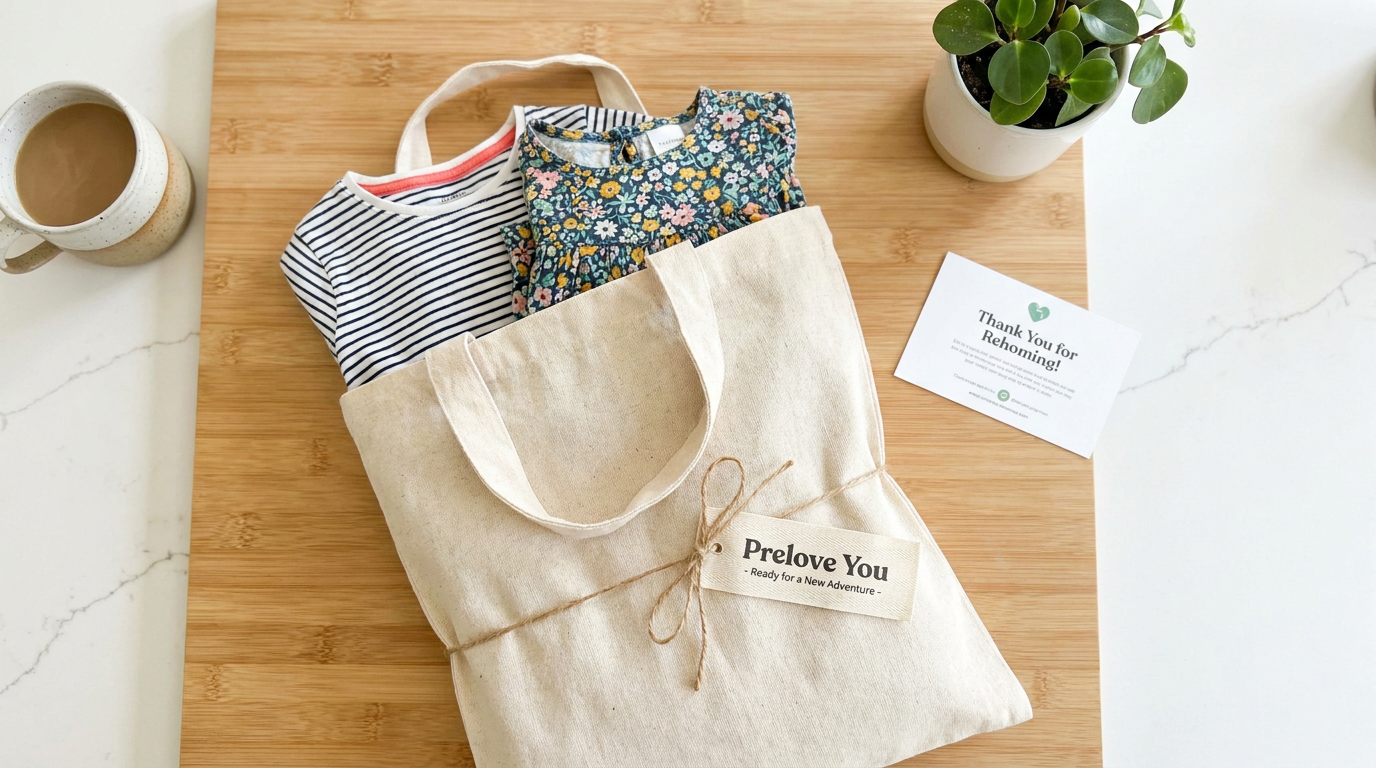
That last part matters more than it might initially seem. The single greatest barrier to getting outgrown clothing out of the house is the condition judgment — the moment where you hold up a pair of jeans with grass-stained knees and have to decide whether they’re good enough to go somewhere, and where, and what happens if they’re not. Prelove You eliminates that barrier entirely.
Every piece you send in earns credits. Items in excellent condition earn more. Items that are worn, stained, or past their wearable life still earn one credit — and rather than ending up in a landfill, they’re routed through textile recycling partners who give them a next chapter as something new. The last excuse for keeping the bag in the trunk disappears. Every piece has somewhere to go.
The answer is a system that doesn’t require you to make the same decisions over and over again. Prelove You membership means that when clothes are outgrown, you already know what happens next. The decision has been made. You bag it, you send it, you earn credits, you shop. Season after season. The process doesn’t change as your children grow — it simply continues. That’s the architecture of a real system: not one that works once, but one that works every time.
Membership tiers — Lite ($35/month), Luxe ($65/month), Limitless ($95/month), and a Seasonal option ($195) — are designed to match the pace at which different families cycle through clothing. See how credits are earned and how the full model works before choosing the tier that fits your family’s rhythm.
The PLY digital library book card system adds a dimension that no other option offers: traceability. Parents who want to know where their children’s clothing goes — who gets the yellow raincoat, where the pajamas land — can follow the journey of their pieces. Letting go doesn’t have to feel anonymous. The story of the clothing doesn’t have to end.
From a Prelove You Member
“The bag of outgrown clothes used to just sit in my trunk for months. Now I know exactly where it’s going — and I come back with credits to shop for whatever comes next.”
— Jill, mom of Quinn + Cameron
The emotional outcome of using PLY is difficult to quantify but easy to feel. The bags stop sitting in the trunk. The guilt — about stained pieces, about sentimental ones, about the environmental weight of it all — dissolves. The drawer is manageable because the outflow has somewhere to go. And somewhere in that relief, there’s a little space returned to you. Space that used to be occupied by a decision you kept putting off.
For families managing the full cognitive load of parenting, that space is not a small thing.
One of the most overlooked dimensions of children’s clothing is the child’s own relationship to it. We spend a great deal of time managing clothing for our kids — buying it, sorting it, replacing it — without much thought for what it might mean to involve them in the process. Prelove You’s credit system changes that dynamic in a way that has real, lasting value.
When children can earn credits by sending in their outgrown clothes, something shifts. The clothing cycle stops being something that happens to them and becomes something they participate in. They understand — in a concrete, tangible way — that what they’ve grown out of has value. That it can become something. That they have a say in what comes next.
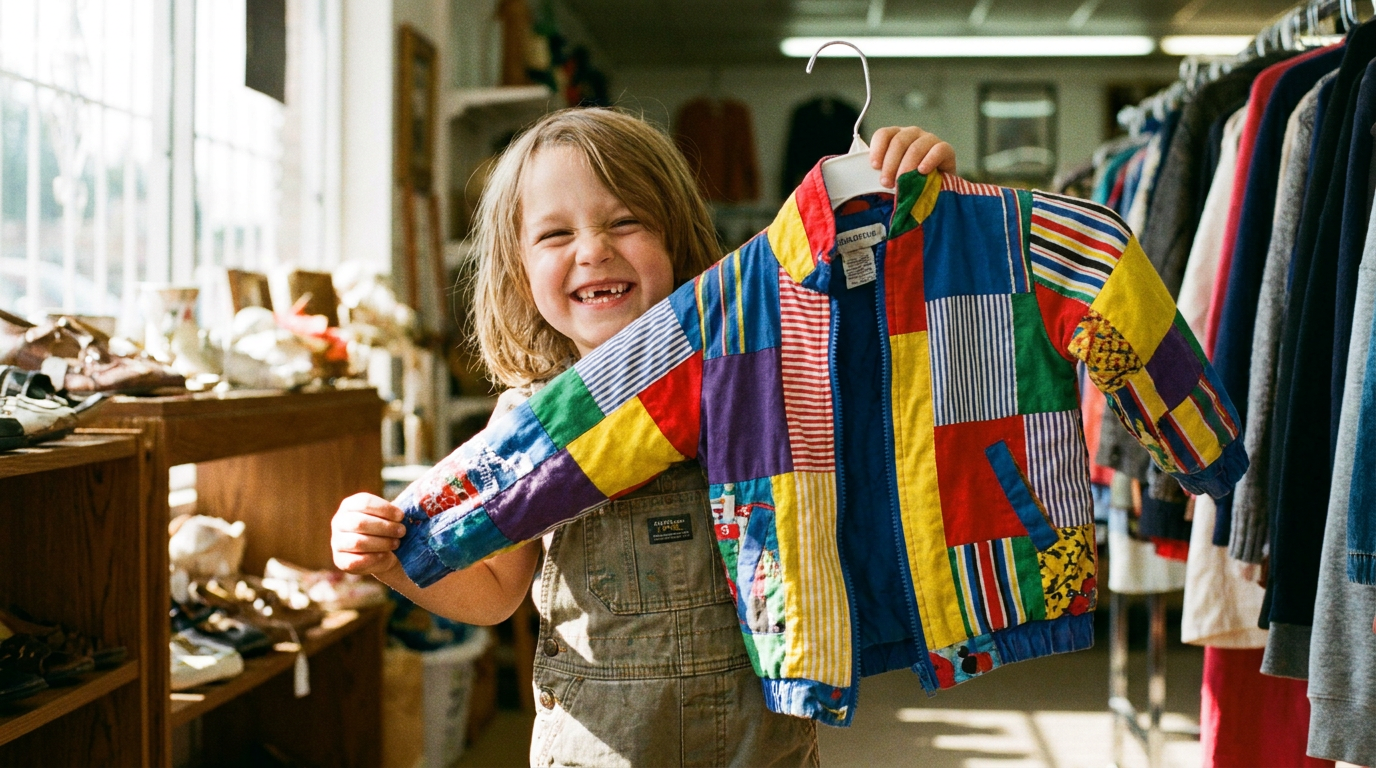
This is not a small pedagogical point. Children who have a genuine role in choices about what they wear — who shop with their own credits, who select the pieces that appeal to them — develop confidence in their own taste and preferences in ways that matter. The difference between wearing clothes that were simply placed in your drawer and wearing something you chose for yourself, with credits you earned, is the difference between being dressed and having a point of view.
The lifecycle of clothing also becomes visible and meaningful to them. Something they loved — the jacket they wore until it was genuinely too small, the swimsuit from last summer — doesn’t simply disappear into a donation bag headed for an unknown destination. It goes somewhere. To a kid who will wear it just as much. The story continues. Children who understand this are learning something quietly important about the value of things, about circular thinking, about the life that objects have beyond their original owner.
The hand-me-down conversation changes, too. Instead of receiving someone else’s leftovers — which can carry its own complicated emotional weight for children who are old enough to notice — kids who use PLY are participating in a cycle they understand and chose to be part of. The dynamic around hand-me-downs is complex in many families, and what PLY offers is a reframe: not charity, not someone else’s cast-offs, but a curated selection of quality preloved pieces that the child helped earn the right to choose.
For the Kids
“When you send in the clothes you’ve outgrown, they don’t disappear. They go somewhere new — to a kid who’ll wear them just as much as you did. And the credits you earn? Those are yours to spend on whatever comes next.”
There is a lightness to this section of the PLY experience that the rest of the blog earns the right to arrive at. After the weight of the mental load, the logistics, the emotional complexity — there’s this: a child holding up a jacket with genuine delight, knowing they chose it. A simple moment that the system made possible.
The system works for parents. It works for kids. And it works season after season — because it was designed for the full reality of family life, not a single flash of decluttering inspiration.
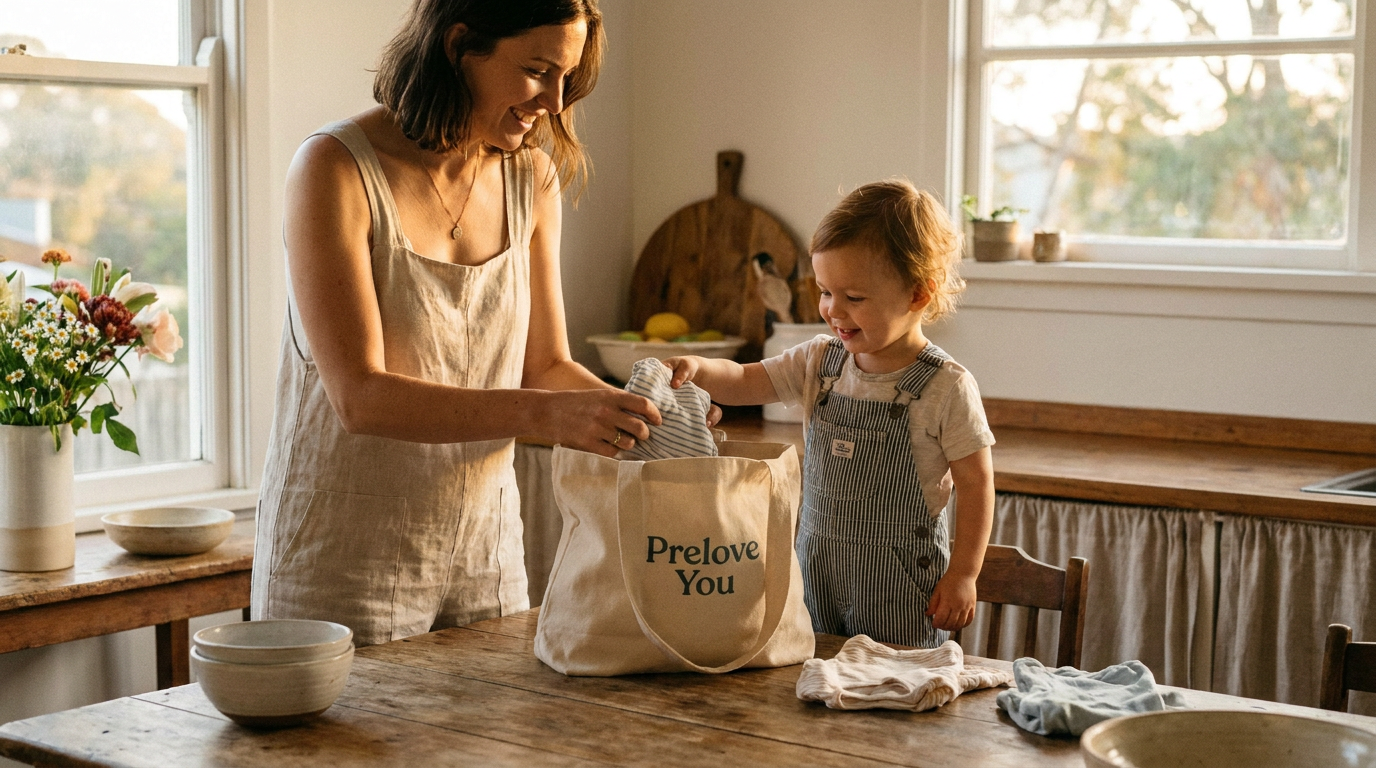
By the time you’ve read this far, something may have already shifted. Not because the information is new — you’ve felt all of this before, in some wordless, persistent way — but because someone finally said it out loud. You now have language for the weight you’ve been carrying. You know that it has a name — the mental load — and that it is not a reflection of your capacity or your care. You know that managing kids’ clothing is one of its most relentless and least recognized expressions. And you know that the systems you’ve tried haven’t worked because they were never designed to work. Not for this. Not for the full cycle, the full spectrum, the full emotional complexity of what it means to watch a child grow out of everything, season after season, year after year.
The gap in the market was not a failure of innovation. It was a failure of empathy — a failure to see this particular labor clearly enough to build something that actually addressed it. That is what Prelove You was designed to correct. Not to add another step to an already impossible process, but to replace the process entirely with something that repeats, that removes the decisions that have been grinding you down, and that gives the clothing — and the memories woven into it — somewhere worthy to go.
You are not disorganized. You are not failing at something simple. You are carrying a job that no one gave you a title for, in a domain that no one built a real system for. That changes now.
Follow the Thread.
The bag in the trunk has been waiting long enough.
Prelove You is the household system that finally gives it somewhere to go — and gives you something back in return. Credits to shop with. Space in your home. Space in your head. And the quiet satisfaction of knowing that the clothes your children loved are on their way to someone who will love them just as much.
Not sure yet? See exactly how PLY works — the credits, the process, the recycling promise, all of it. Or spend some time with The Prelove You Post, where we write about the real experience of raising children, managing the mental load, and building a home that works for your actual life.
When you’re ready, we’ll be here.

