



 Sustainability Scoop
How to Make a Difference to Children Through What They Wear
Clothing isn’t just fabric. This July — and every day — it’s one of the most powerful ways adults shape the lives of children.
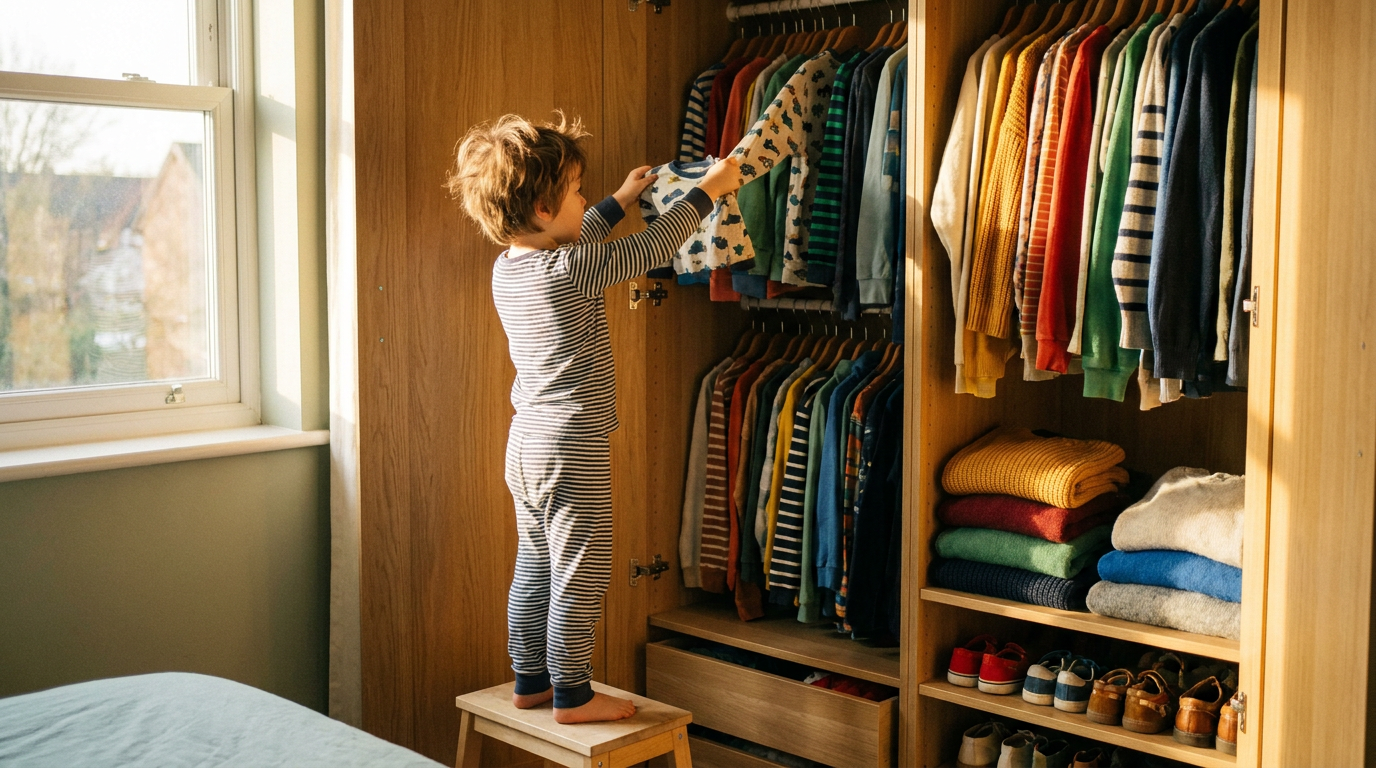
Now think about the child who doesn’t have that. The child who pulls on the same worn-out pair of jeans again because there isn’t another option. Who notices, at some level they can’t yet name, that their clothes signal something they don’t want the world to see. That child is in every school, every neighborhood — and the distance between those two children’s experiences of getting dressed in the morning is larger than most of us have ever stopped to consider.
July is National Make a Difference to Children Month, a full-month observance dedicated to asking a deceptively simple question: what does it actually mean to show up for a child in a lasting, meaningful way? The usual answers involve time, mentorship, education. All important. But there’s another answer that’s been sitting in plain sight — one that repeats every morning, every season, every year of a child’s life. Clothing.
This is not a post about charity. It’s not a fundraising pitch or a guilt trip about donation bins. It’s about the systems that quietly shape how children experience their own lives — and what it looks like to build better ones. In the sections that follow, we’ll cover why clothing matters more to child development than most parents have been told, what quality access to children’s clothing actually means, the invisible labor that falls on families managing the cycle of kids’ wardrobes, and what a smarter approach looks like from the inside out. The thread running through all of it is simple: the way we manage what children wear is one of the most tangible, repeatable, and underestimated acts of care available to us.
National Make a Difference to Children Month was founded in 2006 by Kim Ratz, a child advocate with a conviction that tends to get overlooked in conversations about scale: that one person making a meaningful difference in one child’s life is enough. Enough to shift a trajectory. Enough to matter. Ratz wasn’t interested in grand institutional programs alone — he was interested in the quiet choices that compound. The decision to pay attention. The decision to show up. The decision to ask what a child actually needs, and then do something about it.
That framing matters for this conversation, because what we’re talking about here is not a sweeping systemic fix. It’s a household decision. A seasonal habit. A way of thinking about the objects that move through a child’s life and what they communicate along the way.
Most conversations about making a difference to children center on the obvious pillars: education, safety, emotional support, mentorship. These are real and important. But clothing rarely makes the list — and that’s the gap this post is here to address. Because clothing is not peripheral to a child’s wellbeing. According to Catie’s Closet, a children’s clothing nonprofit that has served hundreds of thousands of students across the United States, clothing sits at the very base of Maslow’s Hierarchy of Needs — a foundational physiological requirement that must be met before a child can meaningfully access safety, belonging, esteem, or self-actualization. When it isn’t met — when clothes don’t fit, aren’t appropriate for the season, are visibly worn beyond their usefulness — children cannot fully climb that hierarchy. They get stuck at the bottom. And everything else suffers.
This is what makes July such a useful prompt. Not as a campaign hook. Not as an opportunity for performative generosity. But as a genuine moment to slow down and ask: is the system I’ve built around my children’s clothing actually working for them? Is it working for the children in my community? Is it honoring the weight of what clothing actually does in a child’s life?
“Clothing is the literal common thread — it holds memory, identity, and the story of a child’s growth. We built a system that honors that.”
— Prelove You
The observance runs the full length of July — thirty-one days of invitation to think differently about what it means to be present for a child. And the argument this post is making is a specific one: among the most tangible, repeatable ways to make a difference to children is to think carefully about the system that clothes them. Not just whether they have clothes. But who chose them. How they fit. What happens when they’re outgrown. And whether the whole process has any dignity or beauty in it at all.
The good news is that this is an area where the gap between where most families are and where they could be is not a matter of resources. It’s a matter of attention. And this month, attention is exactly what’s on the table.
From the philosophical groundwork, it’s worth moving into the science — because the case for clothing as a genuine developmental tool is not anecdotal. It’s documented, studied, and more compelling than most people realize.
Here’s what the research actually says: clothing is not just what children put on their bodies in the morning. It is, in a very real and measurable sense, part of how they experience being themselves. The science behind this is not new, but it remains underknown — and that gap in awareness has real consequences for how families, schools, and communities think about what children wear.
Research consistently shows that children who feel comfortable and confident in what they wear are more likely to engage fully in school, form friendships more easily, attempt new challenges, and participate more actively in their own lives. This isn’t a matter of vanity. It’s a matter of how psychological safety works. When a child feels at ease in their body — when what they’re wearing fits, feels right, and in some way reflects who they are — they have more cognitive and emotional bandwidth available for everything else. Learning. Connecting. Growing.
Catie’s Closet, whose work puts them in direct daily contact with the realities of children’s clothing access, puts it plainly: “Clothing is the most visible sign of poverty. It shares a secret with the rest of the world our students may try to hide.” When children wear clothes that don’t fit, that are seasonally wrong, that are visibly worn or stained in ways they know other children notice — they are carrying a weight that has nothing to do with the clothes themselves. It has to do with what those clothes communicate about them to their peers, their teachers, and the world they’re trying to navigate. That weight sits on top of everything else they’re trying to do.
There’s a psychological framework that helps explain the mechanism here: the concept of enclothed cognition. Studied extensively in adult populations and increasingly in developmental contexts, enclothed cognition describes the way that what we wear influences how we think, feel, and behave — not just how others perceive us. A child who puts on something they love, something that fits, something that in some small way feels like a choice, is not having a shallow aesthetic experience. They are, in a very real sense, putting on a version of themselves that is more capable of facing the day. The first-day-of-school outfit isn’t just a photo opportunity. For many children, it’s armor.
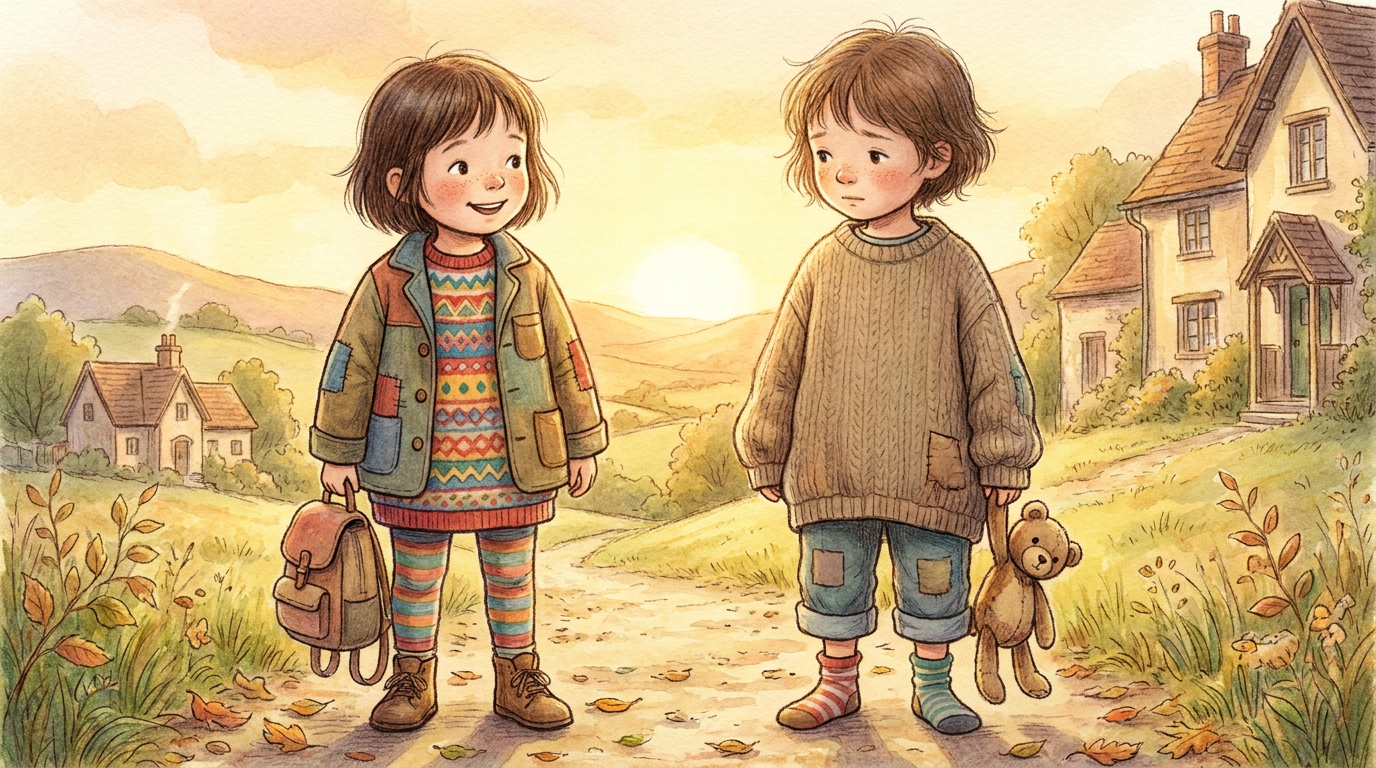
The data on access makes this more urgent, not less. In the United States, 1 in 6 children live in poverty — meaning that for a significant share of children across every community in this country, access to appropriate, fitting, seasonally correct clothing is genuinely limited. These children are not a distant abstraction. They are in the same classrooms, on the same teams, in the same neighborhoods as children who have every piece they need. And the difference between those two experiences is felt every single day, in ways that compound quietly and invisibly over years.
For families with resources, this reframe carries a different kind of weight. The question is not just whether your children have clothes. It’s whether the system for managing those clothes — the cycle of buying, outgrowing, donating, replacing, repeating — gives your children real agency, beauty, and dignity. Whether the pieces you’re sourcing for them are chosen with care. Whether they’re being taught, through the way clothing moves through your household, that their things have value. That they have value.
When children have genuine input into what they wear — when they are participants in the process rather than recipients of it — their confidence, engagement, and sense of self shifts in measurable ways. The research on this is consistent and worth taking seriously. Clothing is not a soft topic. It is a developmental one.
Understanding why clothing matters is the foundation. The next question is an equally important one: what does quality access to children’s clothing actually look like — and why does the standard model fall so short?
There’s a version of the children’s clothing problem that sounds easy to solve: just make sure kids have enough clothes. But access is not a binary. It is a spectrum that includes fit, quality, durability, choice, and the quiet dignity that comes from wearing something that was chosen with care. The volume-first approach to solving this problem has been tried. It has not worked as well as advertised.
Fast fashion’s central promise — that clothing can be made cheaply, quickly, and in abundance — has created an illusion of plenty that is, on closer inspection, one of the most wasteful systems modern families participate in. Children’s clothing is the extreme edge of this problem. Kids grow fast. A piece worn three times is outgrown. Six months of use, if that, and then what? According to data from the Ellen MacArthur Foundation cited in Sustainable Business Magazine, garments are now used 36% less often than they were just fifteen years ago. Children’s clothing is the sharpest expression of that trend.
The downstream consequence of this is staggering. According to Earth.org, 92 million tonnes of textile waste are produced globally every year — the equivalent of a rubbish truck full of clothes discarded every second. If current patterns hold, that number is expected to climb to 134 million tonnes by 2030. A meaningful portion of that waste is children’s clothing: small garments, cheaply made, worn briefly, and then routed — through donation bins or household trash cans — out of circulation entirely.
This is the part of the story that doesn’t get told in conversations about access. The volume-first model doesn’t just fail children by producing disposable clothing — it fails them by training them to see their things as disposable. A child who cycles through cheap, interchangeable pieces learns, at some level, that their belongings don’t hold value. That things come and go without meaning. That the cycle is neutral, inevitable, nothing to pay attention to.
Quality children’s clothing inverts this entirely. A piece made from durable materials, designed with longevity in mind — a well-constructed knit sweater, a pair of jeans with reinforced knees, a coat that could genuinely last three winters — holds up through multiple wearers. It retains value in circular markets. It teaches children that their possessions are worth caring for, that the things they love can be treated with respect and passed forward with integrity.
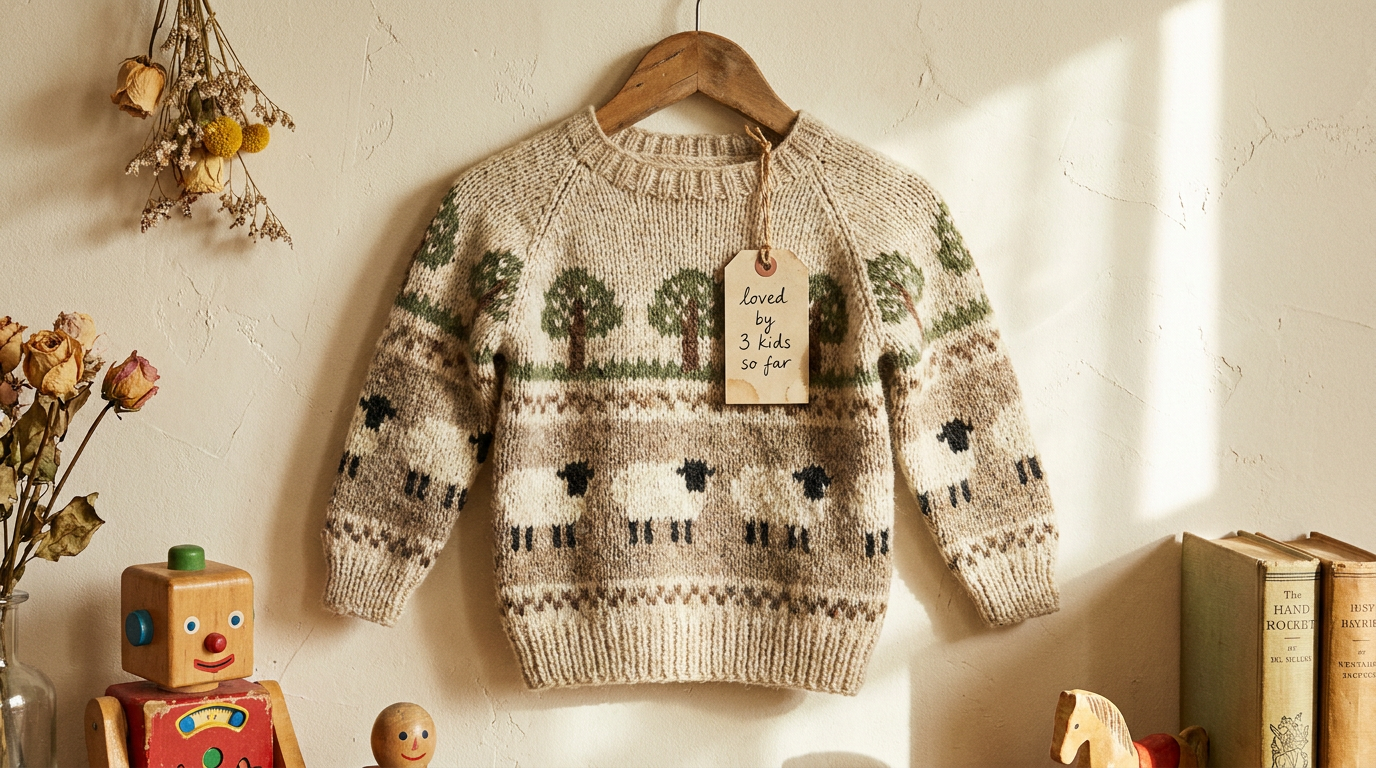
This is the argument for circular, quality-first thinking over donation bins: not just as an environmental stance, but as a values alignment. When a well-made piece is outgrown and re-enters circulation rather than the landfill, the child who receives it next gets something with real value. Not charity. Not a castoff. A piece with a story — something that was cared for, that lasted, that was sent forward with intention.
The families who have figured this out tend to share a few things in common. They buy less. They choose better. They take the long view on what a piece is worth — not just in dollars, but in wears, in seasons, in how many children it can serve across its life. They understand that a $40 sweater that lasts five years and outfits three kids is not an extravagance. It’s a system.
For families still running the old model — cheap, plentiful, disposable — this month is a reasonable time to ask whether that system is actually serving the children at its center. And whether there’s a better way.
There is. But before we can get to what that better system looks like, it’s worth naming the invisible labor that currently holds the old one together — the unremarked, exhausting work that falls on parents every single season, with no real infrastructure to support it.
There is a bag. You know the one. It’s been sitting in the trunk of your car — or in the corner of the laundry room, or on the shelf in the garage — for longer than you want to admit. It contains outgrown clothes. Mostly good ones. A few things you’re not sure about. One piece with a stain you can’t decide whether crosses the line. The bag has been meaning to go somewhere for weeks. Maybe months. It is, as Prelove You’s blog describes it, not clutter. It is a decision tree. Every item in it represents a decision that hasn’t happened yet.
This is the invisible labor of managing a child’s wardrobe. And it is genuinely, relentlessly invisible — to conversations about parenting, to conversations about household labor, and almost entirely to conversations about what it means to make a difference to children through clothing. The decisions involved in managing a child’s wardrobe across a single year include: tracking what fits and what doesn’t, sorting through outgrown pieces, deciding what is good enough to donate versus what is too worn, listing things for resale, photographing items, messaging buyers, negotiating prices, packaging, shipping, and then turning around and doing all of that in reverse to find what’s needed for the next season. And then starting again.
Research on the mental load — the cognitive work of managing household systems — consistently shows that this labor is disproportionately carried by mothers. But the impact on children is rarely discussed in this context. When the system for managing clothing is broken or absent, children feel it downstream: disorganized drawers full of pieces that don’t fit, last-minute scrambles before school picture day, outgrown things worn too long because the replacement hasn’t happened yet, donated items that were actually just landfill with extra steps.
The traditional solutions to this problem don’t solve the problem. They relocate it. Donation bins ask parents to sort, assess, transport, and hope — and offer no visibility into where anything ends up. Facebook Marketplace and similar platforms require an entire second job: photograph every item, write descriptions, set prices, field messages, negotiate, ship, repeat. Consignment stores have their own intake requirements, their own rejection criteria, their own friction. All of these models transfer the product without removing the labor.
“The bag of outgrown clothes used to just sit in my trunk for months. Now I know exactly where it’s going — and I come back with credits to shop for whatever comes next.”
— Jill, mom of Quinn + Cameron
Seasonal transitions are the most acute pressure point in this system. The seasonal wardrobe switch — pulling out last year’s pieces, assessing what still fits, figuring out what’s needed, sourcing it — is something most families muscle through twice a year with no real infrastructure behind it. It is exhausting not because the individual decisions are hard, but because there are so many of them, they come all at once, and there is nowhere to put the things that need to go.
The question this month invites — and the question that sits underneath all of the developmental science and quality arguments in this post — is: what would it mean to make a real difference for the children in your life by removing the friction from the system that clothes them? Not by adding more stuff. Not by making another trip to the bin. But by building something that actually repeats, season after season, without the labor piling up in between?
That question has an answer. And it looks nothing like what most families are currently doing.
The problem with donation bins is not generosity. The generosity is real. The problem is that donation bins are the end of a system that was never designed with the child at its center. Clothes go in. They may or may not get sorted. They may or may not be accepted. The parent has no idea where anything ends up. And the child who receives something from that system — if they receive anything at all — gets what was left. Whatever was good enough to pass the sort. Whatever happened to match their size. No story. No agency. No sense that what they’re wearing was chosen for them.
Prelove You was built as a direct response to this. Not as an improvement on the donation model — as a replacement for it.
Here’s how it works. Families with a Prelove You membership send in their children’s outgrown clothing. Every piece, regardless of condition, earns credits. Items are graded on type, designer, condition, material composition, and cleanliness — and credits are assigned accordingly. Those credits go back to the family, who can then shop the platform’s curated inventory of quality, new-to-them children’s pieces. No sorting required. No decision about whether a piece is “good enough.” No rejection. No guilt.
That last point deserves emphasis, because it’s the one that changes everything for most parents: Prelove You accepts end-of-life pieces. The things that are too stained to feel good about donating, too worn to sell, too far gone for any of the existing options — those pieces don’t have to go in the trash. They go to Prelove You, earn 1 credit, and get routed through responsible textile recycling partners. Every piece has a next chapter. The decision tree in the trunk of the car collapses into a single action: bag it and send it in.
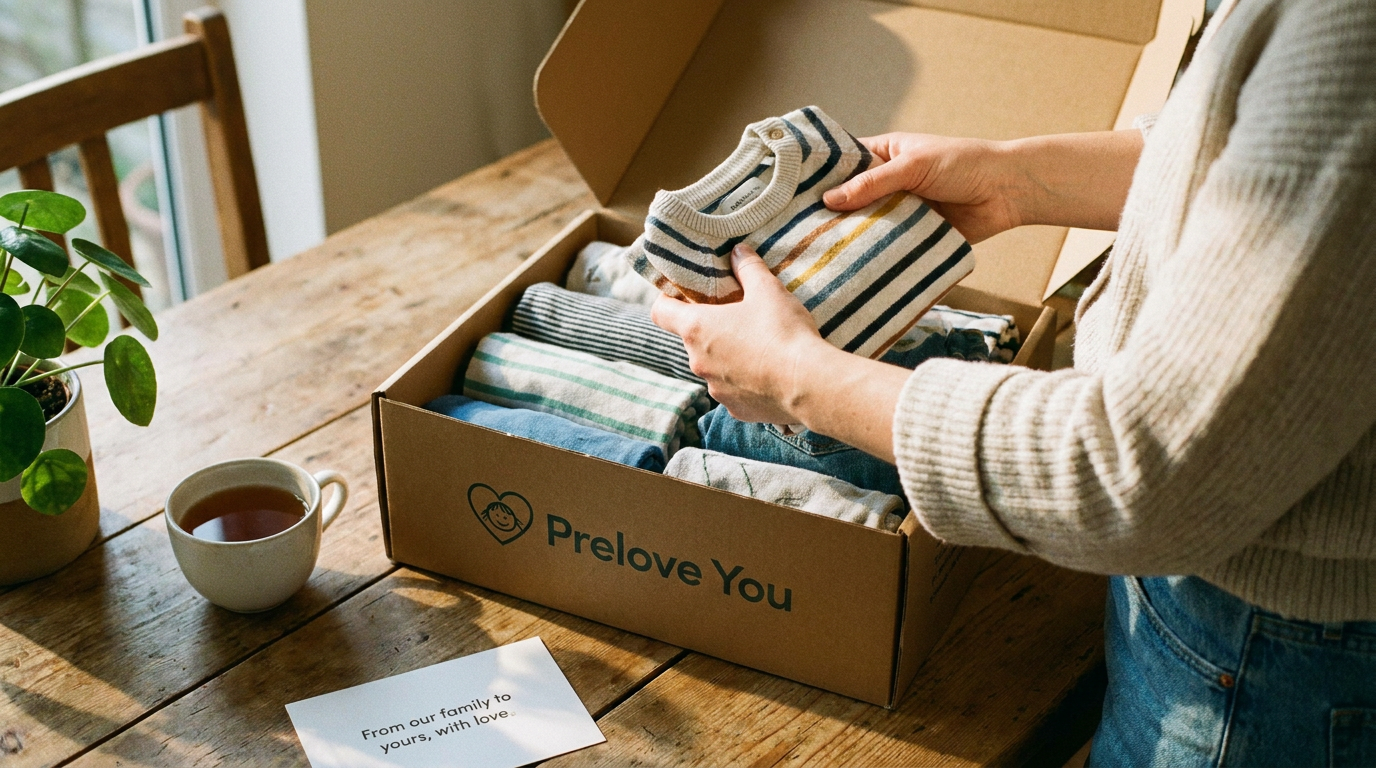
This is not a donation model. The distinction matters enormously. A family that sends in their children’s outgrown clothing is not giving anything away. They are participating in a credit-based circular system. The value of what they send is returned to them in the form of credits they can spend on quality pieces for their children. A child who shops for their next season’s wardrobe using credits earned from their last season’s outgrown clothes is not receiving charity. They are participating in a system that recognizes the value of what they had, and turns it into something new.
For families looking for a meaningful kids’ clothing alternative to the donation model — one that removes the guilt, the friction, and the labor — this is it. Membership tiers are designed to fit different household rhythms: Lite ($35/month), Luxe ($65/month), and Limitless ($95/month), with seasonal and gifting memberships also available. Learn how PLY works here, or explore what to do with children’s outgrown clothes through the Prelove You blog.
The platform is also building a digital tracking system — a kind of library card for clothing — that allows parents to follow the journey of the pieces they send in. So the experience never feels anonymous or disconnected. The story continues. The thread holds.
What this system does for parents is significant: it replaces a broken, labor-intensive, guilt-producing cycle with one that repeats smoothly, rewards participation, and routes everything responsibly. But the most meaningful part of what Prelove You does is not what it does for parents. It’s what it does for the children at the center of it.
One of the least-discussed but most transformative elements of the Prelove You model is this: children are not passive recipients. They are active participants. And that shift — from recipient to participant — is where the developmental impact of the platform becomes most clear and most aligned with the research on child wellbeing.
When a family sends in their outgrown pieces, they earn credits. Children can be part of deciding how those credits are spent. They browse. They choose. They weigh options, develop taste, learn what they love and why. They understand — in a way that is concrete, not abstract — that what they had held value. That value was passed forward. And it came back to them in a form they got to shape. This is a lesson that most children’s relationships with clothing never teach them.
Think about what this is actually practicing:
Compare this to the standard alternative: a child is told their old clothes were donated, new clothes appear from a store, and the cycle is completely invisible to them. There is no story. No agency. No lesson. Just stuff appearing and stuff disappearing, meaninglessly, season after season.
Research on children and clothing choice consistently finds that when children participate in selecting what they wear — when they have genuine input, genuine agency — their confidence, engagement, and sense of self increases in measurable ways. The act of choosing is not trivial. It is formative. It teaches children that their preferences matter, that their taste is real, that they have a say in how they move through the world. These are not small things. They are foundational.
For families navigating children who resist hand-me-downs or second-hand pieces, this is also the key distinction: the difference between a hand-me-down a child has no say in and a piece a child actively chose using credits they understand they earned is enormous. One feels like it was chosen for them by circumstances they didn’t control. The other feels like something they picked because they wanted it. That distinction lives entirely in the structure of the system — not in the quality of the piece itself.
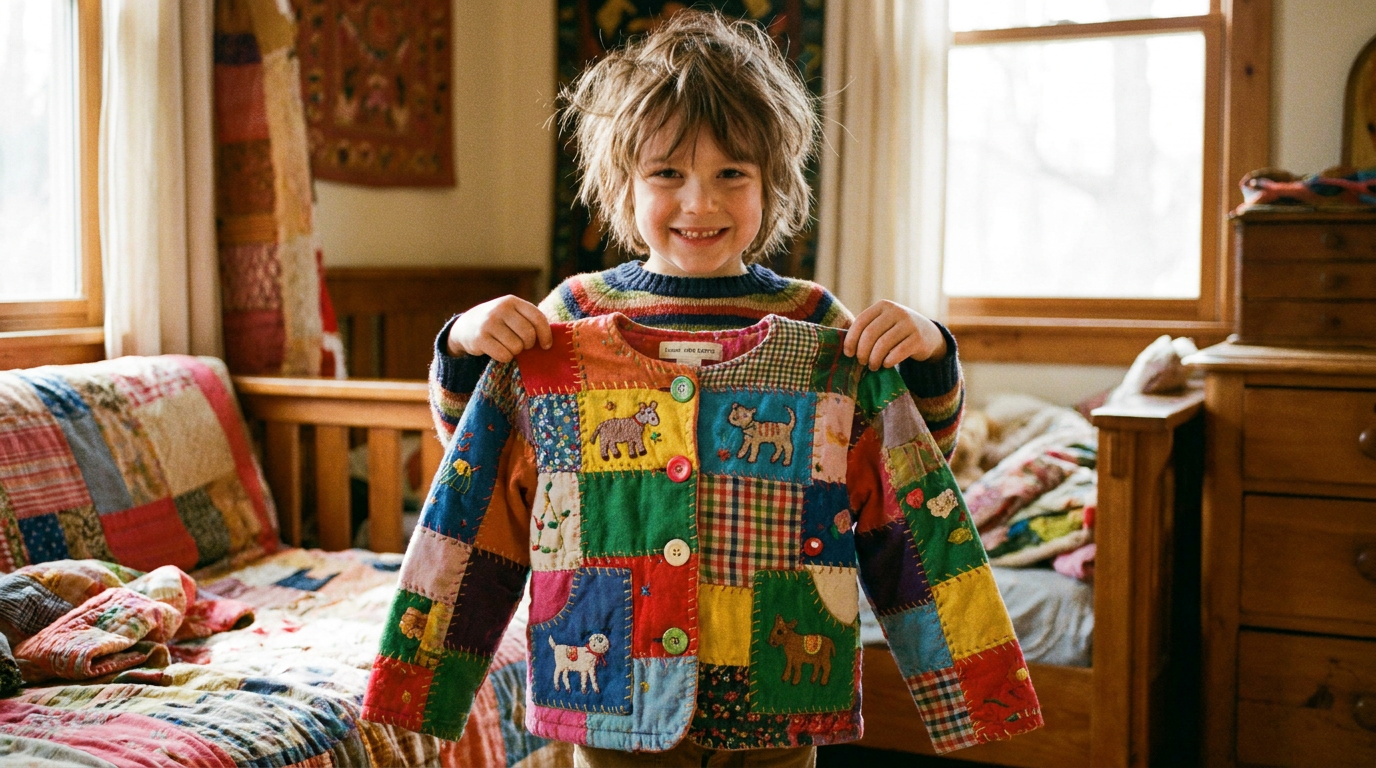
“Remember that one thing you wore again and again this year? That’s because it made you feel amazing. Clothes that feel good help us feel brave, comfy, and confident — aka the best style recipe ever.”
— Prelove You
For the families in your life that you want to show up for this July — families who could use a better system, not a one-time gesture — a Prelove You gifting membership is one of the most genuinely values-aligned ways to make a difference to children through what they wear. It gives a family not just access to quality children’s clothing, but a system their child can actively participate in. Season after season. Not once. Repeatedly.
The developmental case has been made. The quality case has been made. The labor case has been made. What’s left is the practical: what can you actually do, starting now, to make a difference to the children in your life through the lens of what they wear?
National Make a Difference to Children Month is a prompt, not a prescription. It asks adults to choose — intentionally, this month — at least one thing they can do to show up for a child in a lasting way. What follows is not a checklist. It’s a short list of things that actually work, offered in the spirit of a knowledgeable friend giving you the honest version instead of the feel-good one.
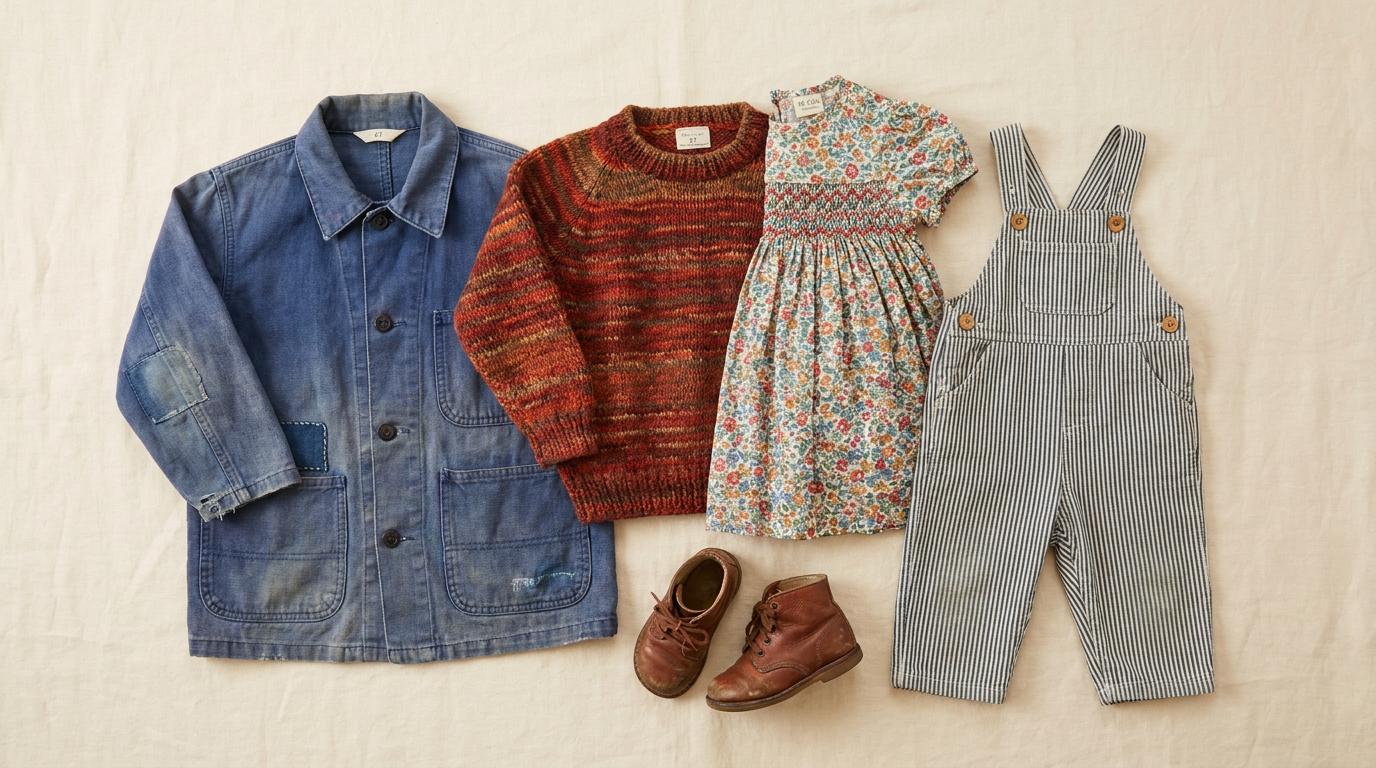
1. Audit what your children actually wear — and let them lead.
Pull everything out. Do it together. Ask your children what they love — not what fits, not what’s practical, but what they actually reach for and why. What makes them feel like themselves? What has been sitting unworn in the drawer for a reason? Start there. The exercise itself is valuable: it teaches children that their opinion about their own wardrobe matters, and it gives you real information about what to keep, what to release, and what gaps actually exist versus what gaps you imagined.
2. Stop letting the bag sit in the trunk.
If there’s a bag of outgrown clothes waiting for a decision anywhere in your home or car, make this the month you give it a destination. Not “eventually.” Now. Whether that’s a family in your network who can use the pieces directly, a local resource you trust, or a Prelove You membership that accepts everything — including the stained and the worn-out — make the call. The bag is not clutter. It’s a deferred decision, and decisions don’t improve with age.
3. Choose quality over volume this season.
When it’s time to add pieces to your children’s wardrobes, resist the pull of volume and invest in quality instead. Buy fewer things. Choose materials that last, construction that holds up, pieces that could realistically be worn by more than one child. A well-made piece that lives through two children has half the footprint and twice the story. And it teaches something quietly powerful: that the things we own are worth caring for.
4. Give children genuine agency in what they wear.
This one costs nothing and is immediately available to every parent reading this. Let them choose. Let them make what you consider wrong choices — the mismatched patterns, the formal shoes with the casual outfit, the beloved jacket worn for the fifteenth day in a row. Style is identity in development. The confidence that comes from being allowed to dress yourself — really dress yourself, with real input and real stakes — is foundational. It is not a small thing. It is the kind of thing that compounds quietly into a child who knows their own mind.
5. Consider a gifting membership for a family you want to show up for.
For the family in your life who could use a better system — not a one-time donation, not a gift card to a fast fashion retailer, but a real, repeatable solution — a Prelove You gifting membership is worth considering. It gives a family the structure to manage their children’s wardrobe with intention: sending in what’s outgrown, earning credits, shopping quality pieces their children actually choose. It’s one of the most values-aligned ways to make a difference to children through what they wear — and it keeps making a difference, season after season, long after the gesture is forgotten. See how PLY works →
Come back to the child heading out the door. The outfit they chose. The way they moved through the threshold differently because of it — or didn’t, because the choice wasn’t available to them, because the system that should have been there wasn’t.
What this month’s observance is really asking is not a complicated question. It’s asking adults to notice. To pay attention to the things we have decided are too small to think carefully about. Clothing is one of those things. It has been treated as a logistical problem — something to manage, to sort, to donate, to replace — rather than what it actually is: a daily, repeatable, season-by-season opportunity to communicate something to a child about their own worth.
The system you build around your children’s clothing is not incidental. It is instructional. It teaches children whether their things have value or are disposable. Whether their preferences matter or are accommodated when convenient. Whether the cycle of outgrowing and acquiring is something they participate in or something that simply happens to them.
This July, and in every month that follows, the children in your life are wearing the story of how you thought about them. The clothes they put on in the morning are part of how they understand themselves, their place in the world, what they deserve.
Build a good system. Not because it’s July. Because they’re always watching, always learning, always growing into whoever the world is telling them they are — and you are one of the loudest voices in that conversation.
Prelove You is the household system for modern families — a membership that takes the outgrown, the stained, and the loved-to-worn, and turns them into credits to shop for quality, new-to-them pieces. No sorting. No guilt. No bag sitting in the trunk.
Prelove You gifting memberships are available for the families you want to show up for this July — and every season after.

