



 Sustainability Scoop
What Circular Fashion Actually Means for Families (No Jargon, No Guilt)
The plain-language guide to circular clothing for everyday parents — and why your kids’ outgrown wardrobe is the best place to start.
That bag — and the vague guilt it carries — is exactly where this conversation about circular fashion for families begins. Not with a lecture. Not with a carbon footprint calculator. Not with a TED Talk on “closed-loop textile systems.” Just with that bag, and the question every parent eventually asks: there has to be a better way to handle this.
There is. And it’s simpler than the language around it suggests. By the time you finish reading this, “circular fashion” won’t sound like a sustainability conference keynote. It’ll sound like something you’re already doing — and something you can do a whole lot better with the right system. This guide will explain what sustainable kids clothing and circular fashion actually mean in plain language, why children’s clothing is the single most obvious place to start, and what it looks like when the whole thing becomes a seamless household habit.
No guilt. No jargon. Just clarity.
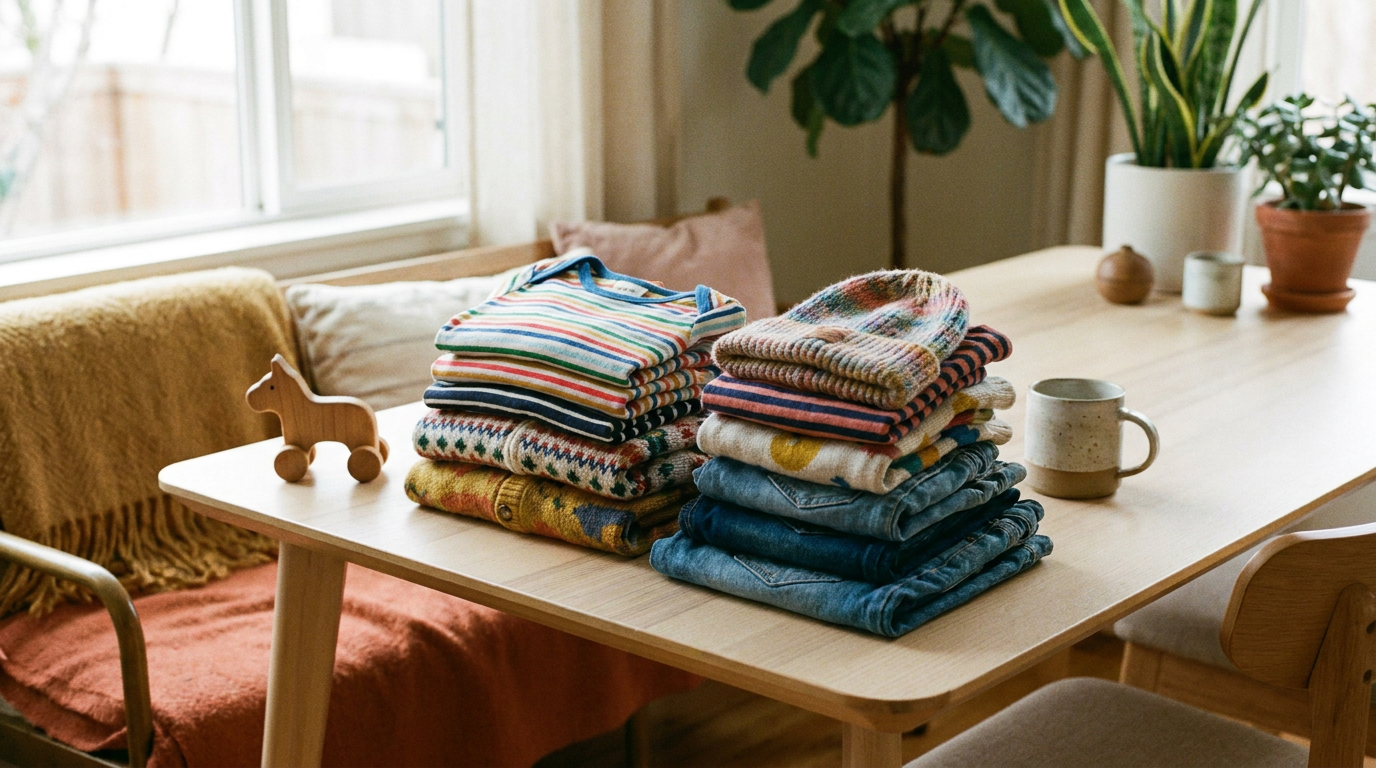
Let’s start with an honest admission: the language of sustainability has a real problem. Terms like “circularity,” “closed-loop systems,” “end-of-life routing,” and “regenerative supply chains” are accurate descriptions of important ideas — but they’re also the kind of phrases that make most people’s eyes glaze over within seconds. They sound like something for policy wonks and industry insiders, not for parents trying to get three kids out the door by 8am.
The irony is that the concept behind all of that terminology is genuinely simple. So simple, in fact, that most parents have already been participating in it — without ever calling it circular fashion — for most of their lives.
Think about it. Have you ever passed a bag of clothes to a neighbor whose kids are a size behind yours? Sent a box of outgrown onesies to a cousin expecting her first baby? Picked up a barely-worn jacket at a school clothing swap? Scored a gently loved pair of boots at a consignment sale? Congratulations. You’ve been practicing circular fashion. You just weren’t using the vocabulary.
The concept is fundamentally this: instead of clothing traveling the route of store → child → trash, it travels a longer, smarter path. It goes from store → child → another child → another child — and keeps going, through as many families and as many seasons as the garment has life in it. Only at the very end, when a piece genuinely cannot be worn anymore by anyone, does it get responsibly recycled or repurposed. The goal is to keep clothing in use — circulating, being loved, being worn — for as long as possible.
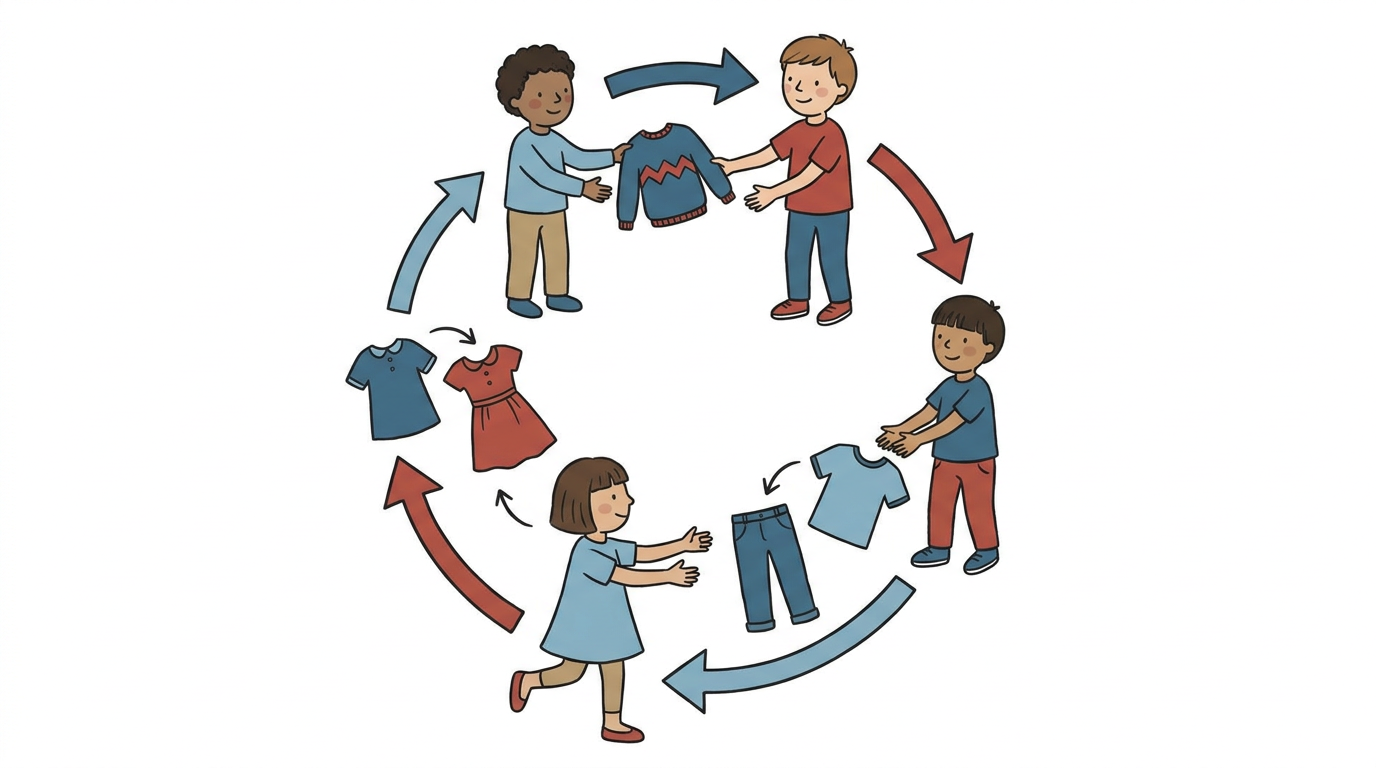
The fashion industry has made this harder than it needs to be. For decades, the dominant business model has been built on getting you to buy more, more often — not on designing clothing meant to outlast one owner. And the language of “sustainability” that’s grown up around this problem hasn’t always helped, either. It’s been co-opted, overcomplicated, and turned into a marketing category rather than a practical framework. Which is exactly why it feels inaccessible to the people who could benefit from it most.
You don’t need to understand the full supply chain to participate in something that works. You don’t need to be a sustainability expert. You just need a clear picture of what the circular loop looks like — and a system that makes it easy to join. That’s what Prelove You was built around: a platform designed to make the circular loop effortless for families, one outgrown piece at a time.
Now that we’ve deflated the jargon, let’s actually define circular fashion — in the plainest terms possible.
At its core, what is circular fashion? Here’s the clearest definition you’ll find, stripped of everything unnecessary.
The traditional fashion model is linear. Raw materials get extracted, turned into fabric, stitched into garments, shipped to stores, purchased by consumers, worn for a while, and then — in the vast majority of cases — thrown away. It has a beginning. It has a wasteful, resource-squandering end. And in between, it moves in only one direction: forward, toward a landfill.
Circular fashion breaks that straight line into a loop. In a truly circular system, clothing is designed, purchased, used, passed on to another person, repaired if needed, used again, and passed on again. This continues until the garment has genuinely reached the end of its wearable life — and even then, rather than going to landfill, it gets recycled into new material or responsibly composted. The objective isn’t perfection. It’s extension. Every additional season a garment is worn by someone who needs it counts as a win.
“Every second, the equivalent of a garbage truck of clothes is burned or buried in landfill. Consumers miss out on approximately $460 billion in value every year by discarding clothes that could still be worn. The system isn’t broken — it was never designed to close the loop.”
That statistic is worth sitting with for a moment. A garbage truck of clothing. Every single second. Not every day. Every second. And $460 billion in value — real, tangible value that exists in those garments, that people paid real money for — disappearing into the ground every year because we haven’t built the systems to route clothing somewhere better when we’re done with it.
It gets sharper. According to research cited by sources including BCG, less than 1% of clothing material is currently recycled into new garments. Not because the technology doesn’t exist — it does, and it’s growing. But because the infrastructure, the habits, and the systems haven’t caught up with the scale of the problem. The fashion industry accounts for somewhere between 2 and 8% of global carbon emissions, depending on how you account for the full supply chain — and the vast majority of the waste that drives those numbers comes not from manufacturing alone, but from what happens to clothing after it leaves the store.
It’s worth briefly clarifying a few related terms you’ll encounter:
Each of these fits into the circular picture at a different stage. The important thing isn’t mastering the taxonomy — it’s understanding the direction of travel: keep clothing in use, for as long as possible, for as many people as possible, and handle the rest responsibly.
If those numbers feel abstract, that’s fair. So let’s bring it home to the place where circular fashion matters most for families: the children’s closet.
Here’s the thing about children’s clothing that every parent knows viscerally, even if they’ve never framed it this way: kids don’t wear out their clothes. They outgrow them. That distinction matters enormously.
A toddler can move through two, sometimes three clothing sizes in a single year. The 12-month onesie gets worn for eight weeks. The size 3T jeans fit perfectly in September and are too short by January. The shoes that were bought in the fall are already tight by spring. This isn’t slow, gradual wear-and-tear waste — this is growth waste. The garment did absolutely nothing wrong. It just got outgrown by a body that refused to stop developing on a convenient timeline.
The pace of this is relentless. And the financial reality of it compounds quickly. Parents who do the math often discover they’re cycling through multiple full wardrobes a year per child — spending hundreds, sometimes thousands of dollars on clothing that will be perfectly wearable when they set it aside. The child’s body changed. The clothes didn’t.
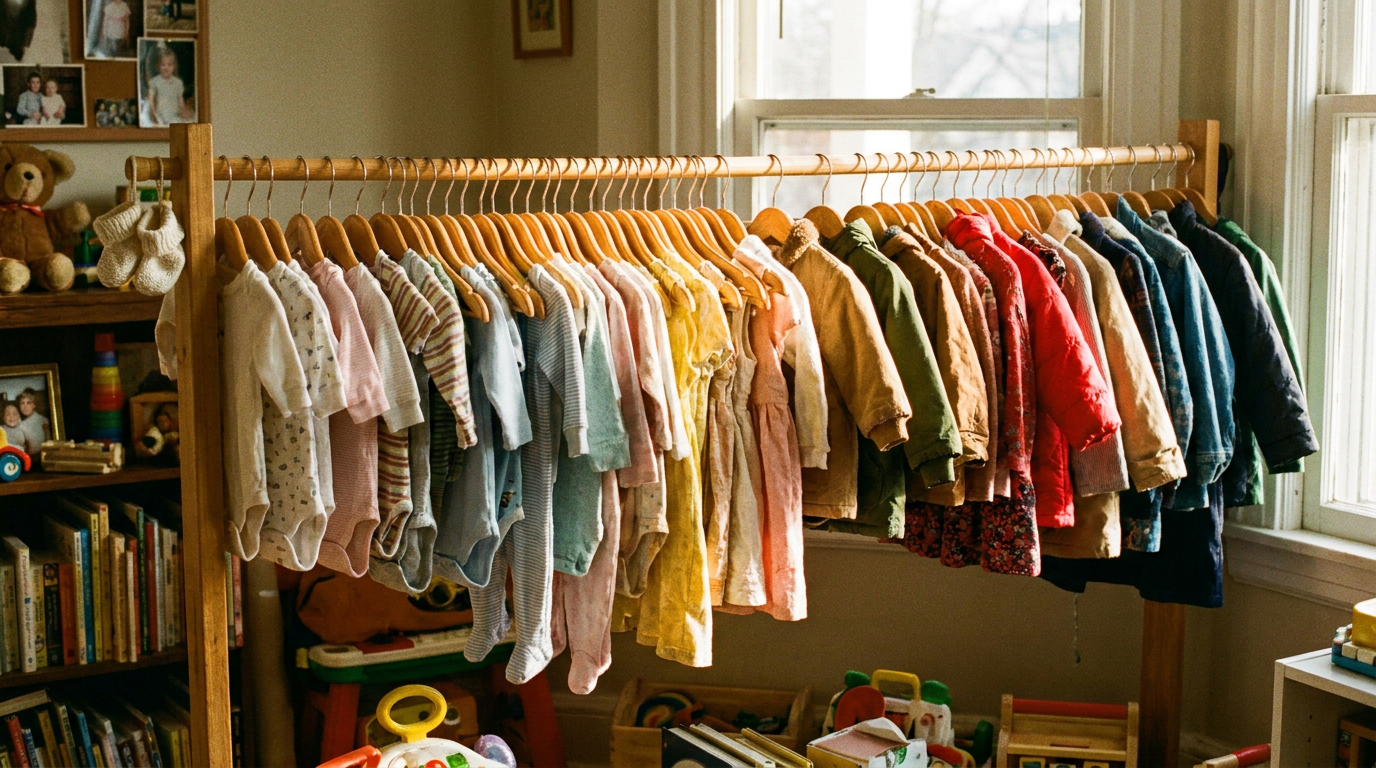
The scale of this problem isn’t a private family frustration — it’s a documented crisis. According to a 2026 report published by GlobeNewsWire, approximately 812.6 million pieces of children’s clothing are discarded to landfill in Europe alone every year. That’s 2.2 million pieces of children’s clothing, every single day, in Europe alone. The US figure, proportionally, is similarly staggering. The same report found that 42% of parents have children’s clothing items with the price tags still attached — bought, never worn, and eventually discarded — and that 54% have thrown away or repurposed clothes that were never worn at all.
The cruel irony of children’s clothing waste isn’t that the garments are worn out. It’s that they’re not. They’re often in excellent, near-new condition. A size 18-month sleepsuit that was worn for six weeks looks almost identical to the day it was bought. But without a clear system for where it goes next, it ends up in a bin bag headed for landfill — taking decades to decompose if it’s made from synthetic fibers, which most children’s clothing is. Polyester — a petroleum-based plastic fiber — accounts for roughly 54–57% of all fibers used in global apparel production. In landfill, it doesn’t biodegrade. It fragments. It leaches microplastics. It compounds its environmental impact year after year.
National Geographic notes that the average piece of clothing is worn far fewer times than it was designed to sustain — and children’s clothing, given its growth-driven obsolescence, is the most dramatic illustration of this gap. A pair of children’s jeans might have 50 or 60 wears left in them when a child outgrows them. In the linear model, those 50 wears just disappear into a landfill.
This is exactly why children’s clothing is the most logical entry point for circular fashion in family life. The problem is obvious. The solution is obvious. The clothing is in good condition. The math works. And the need — the relentless, season-after-season, growth-driven need for new sizes — creates a natural rhythm that a circular system can plug directly into.
So the problem is clear and the logic is obvious. But what does circular fashion actually look like when it’s working in a real family’s life?
Circular fashion for families isn’t an ideology. It isn’t a grand gesture. It isn’t something you do once for Earth Day and feel good about. It’s a system — a repeatable, quiet, practical rhythm that handles the outgrown clothing problem without adding more labor to the already impossible mental load of raising children.
And the best systems are the ones you barely notice running.
What does it actually look like in practice? It looks like having a dedicated bag or bin somewhere in your home — in the closet, in the mudroom, behind the bedroom door — where outgrown items go the moment you notice they no longer fit. Not a pile of decisions. Not a sorting project waiting to happen. Just a drop. The jacket that’s too small in the shoulders goes in the bag. The shoes that are suddenly tight go in the bag. The jeans that hit mid-shin go in the bag. No deliberating. No guilt. Just a clean, consistent action.
It looks like that bag going somewhere, on a predictable schedule, and something coming back in return. Credits. Access to beautiful, carefully selected pre-loved pieces that someone else’s child has already worn and loved — pieces that are now ready for yours. No starting from zero every season. No spending $40 on a pair of jeans you already know will fit for ten weeks. A steady, self-sustaining loop that keeps pace with the speed at which your children grow.
“I used to feel guilty every time I saw that pile of outgrown clothes. Now I just bag it and send it in. My daughter picks out what comes next with her credits. The whole thing actually works.”
— Kristen, mom of Mikayla
That quote isn’t aspirational marketing. It’s a description of what a working circular system actually feels like from the inside. The guilt lifts because the problem is handled. The child becomes a participant rather than a bystander. And the household has a rhythm — bag in, credits earned, new pieces out — that repeats season after season without requiring willpower or free time.
This is the model Prelove You was built to deliver. As a membership platform, it functions as exactly this kind of household system: send in what your children have outgrown, earn credits based on the type, brand, condition, and sustainability of each piece, and use those credits to shop for high-quality, inspected pre-loved pieces for whatever size comes next. The send-in process is designed to be frictionless — no sorting required, no guessing about what’s acceptable. You pack a bag. It goes. Credits arrive. You shop.
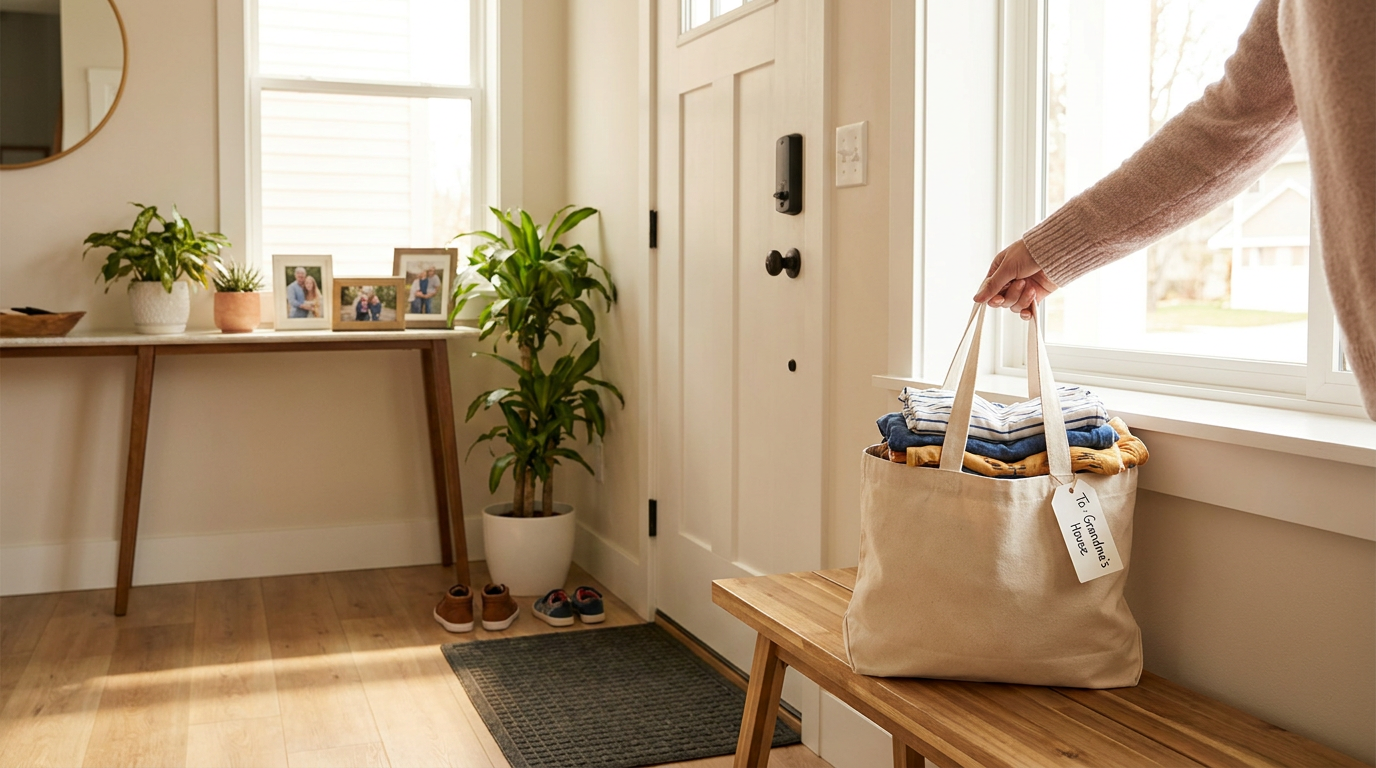
Circular fashion isn’t an identity. You don’t need to describe yourself a particular way or align with a particular movement to participate in it. It’s a behavior. And the best behaviors are the ones that become automatic — the ones woven so seamlessly into the rhythm of family life that you stop thinking of them as choices and start thinking of them as just how things work at our house.
That shift is worth chasing. Because it turns the relentless pace of children’s growth from a source of frustration and waste into something that just… runs.
But circular fashion isn’t only logistical. There’s something emotional happening when clothing moves from one child to the next — and it’s worth naming.
Children’s clothing is never just fabric. Every parent knows this, even if they’ve never said it out loud.
The tiny sleepsuit from the first week home from the hospital. The swimsuit from the summer vacation where everything felt perfect. The sweater they wore in every single photo from that one year when their hair did that thing. The dress-up costume they refused to take off for three weeks straight. The school uniform, worn to shreds, that somehow still hangs in the back of the closet two years after they moved on.
We hold onto these things — or struggle to let them go — not because we’re sentimental hoarders, but because children’s clothing carries weight that fabric alone shouldn’t be able to carry. It holds time. It marks phases. It is, in a quiet, physical way, proof that those moments happened. That your child was once exactly this small. That this particular version of them existed, briefly and completely.
The act of setting aside a piece of outgrown clothing can feel, unexpectedly, like letting go of something more than a garment. It’s the acknowledgment that a phase has passed. That the child who wore this is not quite the same child who stands before you now. That time moves in only one direction, and it moves faster than anyone warned you.
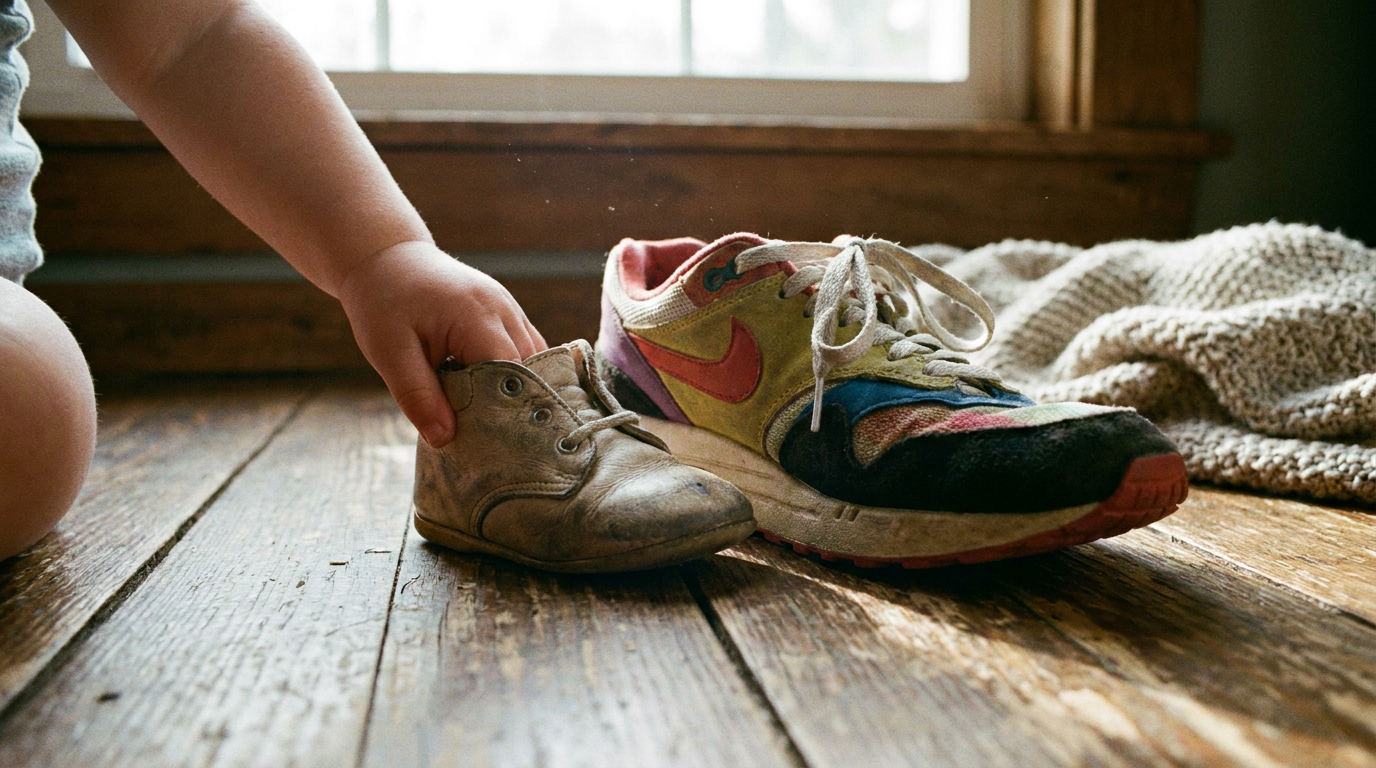
Circular fashion — done well — honors that weight. It doesn’t treat a beloved piece as a unit of inventory to be processed and priced. It treats it as something with a story that continues. The idea that another family will love that piece, that another child will make their own memories in that swimsuit or that sweater, reframes the act of letting go. It isn’t loss. It’s continuity. The garment’s story isn’t ending. It’s entering a new chapter — one your child no longer needs, but that another child is ready to begin.
“Every piece of clothing a child wears holds something — a first day, a growth spurt, a phase they’ll never be in again. We built a system that honors that, and makes sure it doesn’t end in a landfill.”
— Rebecca Bahmani, Founder of Prelove You
This is the founding philosophy at the heart of Prelove You: that clothing is the literal common thread. It holds memory. It holds identity. It holds the physical record of a child’s growth. A system that treats it accordingly — with care, with attention, with the understanding that it matters — is a fundamentally different experience than dropping an anonymous bag at a donation bin and wondering, vaguely, where it goes.
Children themselves can be part of this story in powerful ways. When kids understand that the jacket they’ve outgrown is going to another child who will love it, the act of letting go becomes meaningful rather than just practical. National Geographic’s guidance on talking to kids about fashion waste underscores this: children are remarkably capable of engaging with ideas about care, continuity, and responsibility when those ideas are made concrete and personal. “Your jacket is going to help a child who needs one just like it” is a story a four-year-old can hold.
The emotional dimension of circular fashion isn’t a soft add-on to the practical case. It is the practical case, for many families. Because the reason the bag sits in the trunk for three months isn’t logistics — it’s that letting go is hard, and the alternatives feel anonymous and unsatisfying. A system that makes letting go feel meaningful changes that. It removes the barrier that isn’t about time or effort, but about the invisible weight that children’s clothing carries.
And then there’s the question every parent eventually asks, standing over a pile of the less-lucky pieces: what do you do with the things that can’t be passed on?
Let’s talk about the stained onesie. The beloved pair of leggings with both knees worn through. The shoes that were genuinely, gloriously loved to death. The knitwear that got a little too cozy with the washing machine and came out a full size smaller. Every family has a version of this pile — the pieces that are too worn, too stained, or too damaged to pass on to another child. And for most parents, this pile is the last remaining source of clothing guilt.
Traditional resale and consignment platforms reject these pieces. Which makes sense from a business perspective — but it leaves parents with yet another unresolved decision. The piece didn’t make the cut. Now what? It goes back into the bag. The bag goes back to the mudroom. The guilt compounds. Eventually, reluctantly, it goes in the trash.
This is the gap that a truly circular system has to close — and it’s also the gap that most resale platforms never do.
True circular fashion accounts for end-of-life. A garment that can no longer be worn doesn’t have to go to landfill. It can be upcycled into new material, shredded into insulation or padding, repurposed into something entirely different, or processed through textile recycling programs that break it down into reusable fiber. The technology and infrastructure for this is growing — and critically, it means that a stained shirt or a stretched-out pair of leggings still has value. It just looks different from the value of a wearable garment.
The challenge has never been the technology. It’s been the systems — or the lack of them — that make it easy for families to access those pathways without doing a research project every time they have a damaged piece to dispose of.
According to BCG research, 80% of discarded clothing ends up in landfills or incinerators, while less than 1% is recycled into new textile fibers. That’s not a technology failure — it’s a systems failure.
The Prelove You approach closes this loop in a specific and honest way. Every piece sent in is assessed and graded. If it meets wear-again criteria, it earns full credits and gets re-homed to a new family. If it doesn’t — if it’s genuinely at the end of its wearable life — it still earns 1 credit, and it gets routed responsibly through Prelove You’s nonprofit textile recycling partner, Green Tree Textile Recycling, where it becomes something new. Not landfill. Not an anonymous mystery. Something new.
This matters enormously for the psychology of participation. One of the biggest invisible barriers to circular fashion isn’t laziness or indifference — it’s the cognitive friction of decisions. Parents who want to do the right thing don’t participate in circular systems not because they don’t care, but because the sorting, the deciding, the researching, and the executing are all additional mental labor on top of an already overwhelming load. A system that says “send everything, we’ll handle the rest” removes that friction entirely.
Here’s what the pathway looks like in practice:
No guilt. No extra decisions. No bags sitting in the mudroom because you can’t figure out what to do with the hard stuff.
This is what distinguishes a true circular system from a resale platform: it closes the loop on everything, not just the pretty things. And it’s the final piece of the puzzle that makes the whole system viable as a long-term household habit.
So what does it look like when all of this — the definition, the emotion, the practicality, and the end-of-life plan — comes together into something that actually runs?
A behavior only becomes a habit when it’s easier to do than not to do. That’s the real test of any system: does it reduce friction, or does it add to the pile of things to manage? Does it make life lighter, or does it add another layer of decisions to an already crowded mental load?
The difference between “I mean to donate those clothes” and “those clothes are already handled” is not willpower. It’s not free time. It’s not values. It’s a system. A clear, repeatable, frictionless system that makes the right action the default action — the thing that just happens, because that’s how things work in your house.
What does a working circular fashion system look like for a family? It looks like four things:
This is exactly what the Prelove You membership system delivers. It’s not a donation platform. It’s not a resale marketplace where you do all the work. It’s a membership built around the specific rhythm of family life — the relentless pace of children’s growth, the emotional weight of their clothing, and the practical need for a system that runs without requiring constant attention.
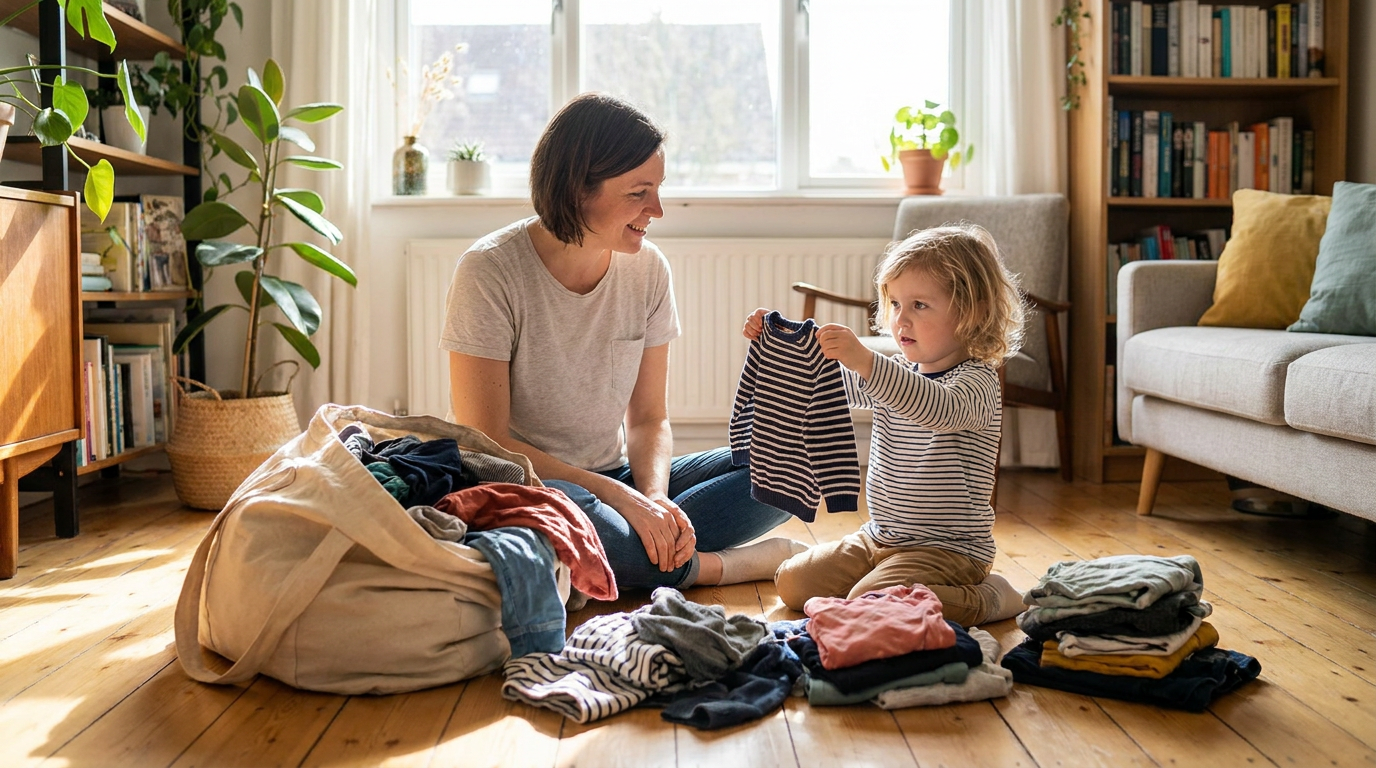
Children are an important part of this system — not bystanders, but active participants. When kids understand that the credits earned from sending in outgrown pieces are what let them choose something new, the loop becomes legible and exciting. They’re not just accepting secondhand clothing. They’re participating in a system of exchange, of value, of responsibility. A child who grows up understanding that their clothing has a life before them and a life after them — and that both of those matter — carries that understanding forward in ways that extend well beyond the closet.
The shift this creates in a household isn’t dramatic. It’s quiet. The bag fills up. It goes out. Credits arrive. You browse. Something arrives that fits perfectly, that’s been inspected and loved, that costs a fraction of the retail alternative. You put it in the closet, and the cycle begins again. Season after season. Size after size. Growth spurt after growth spurt.
And at some point — somewhere between the first send-in and the third or fourth — it stops feeling like a sustainable practice and starts feeling like just the way you handle children’s clothing. Which is exactly what it should be. Not an activist choice. Not a sacrifice. Just a smarter, more intentional, more human way to manage the relentless reality of raising children who insist on growing.
The fashion industry’s linear model was never designed to close the loop. But families can — and more families are building exactly this kind of system, right now, without waiting for the industry to catch up.
Follow the thread. Every piece your child loves has a life before them and a life after them. A system that honors that isn’t a burden — it’s a better way to live.
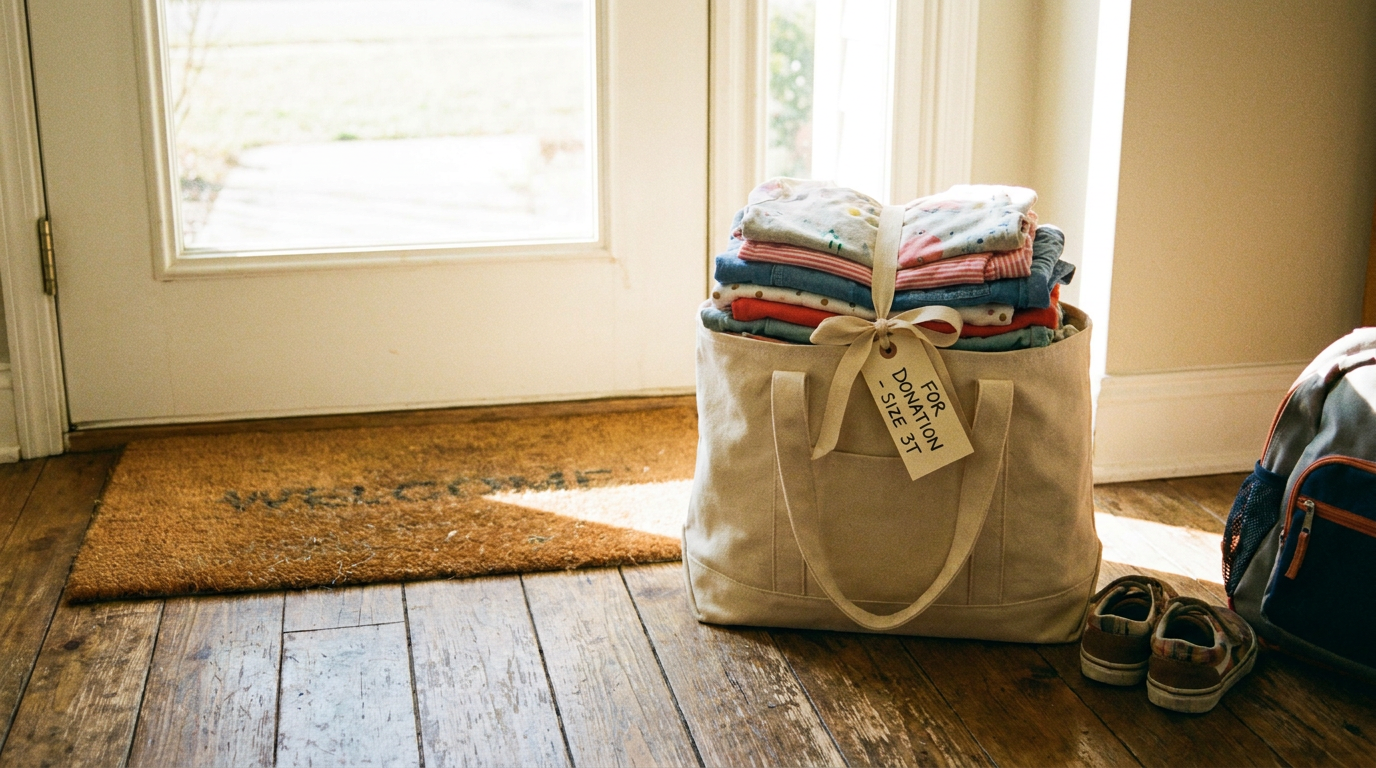
Circular fashion, for families, comes down to something beautifully simple: kids outgrow everything, and those things deserve somewhere better to go than a landfill.
You don’t need the vocabulary. You don’t need to understand the full supply chain, the policy frameworks, or the lifecycle analysis of synthetic fibers. You don’t need to feel guilty about the bags that sat in the mudroom for three months. You just need a system — a clear, repeatable, frictionless system that handles the outgrown clothing problem as naturally as any other household routine.
The clothes your child loved are not disposable objects. They are a thread that connects them to who they were — and to another child, somewhere, who is ready for exactly that sweater, that jacket, that pair of boots that still has so much life in them. That thread is worth following. The system that makes it easy to follow is already here.
Prelove You is the membership platform that makes circular fashion effortless for families — send in what your kids have outgrown, earn credits, and shop for high-quality, beautiful pre-loved pieces without the sorting, the guilt, or the bags in the trunk. Every piece that can be worn again is re-homed with care. Every piece that can’t is routed responsibly, so nothing ends in a landfill.
Already curious about how it works? See the full system here.

