



 Sustainability Scoop
The Credit System: Why Letting Kids “Earn” Their New Clothes Changes Everything
When children have real skin in the clothing cycle — sending in what they’ve outgrown, earning credits, and choosing what comes next — something shifts. This is what that shift actually looks like.
There’s a particular kind of quiet that happens after a closet clear-out. You’ve sorted the too-small jeans, the jacket with the broken zipper that somehow never made it to a donation bag, the dress that was worn exactly once. You’ve done the responsible thing — filled the bag, tied it off, moved on. But somewhere in that process, your child notices that the sweater they wore every single day last autumn is gone. They didn’t know it was going. Nobody asked.
That moment — small, ordinary, easily overlooked — is actually the beginning of a missed conversation about value.
Most children move through clothing the way they move through time: passively. Things appear, things disappear, and very rarely is a child invited to be part of that process. It’s understandable. Parents are busy. Sorting outgrown clothes is a logistics problem, not a teachable moment — or at least, that’s how it tends to feel. But the kids clothing credit system at the heart of Prelove You was built on a different premise entirely: that the moment a child hands something over is one of the richest learning opportunities available to a parent. That clothing — the most physical, personal, tangible category of stuff in a child’s life — is one of the best tools we have for teaching what value actually means.
This post is about that idea. About what changes when children become participants instead of bystanders. And about what a credit system, practiced seasonally, actually builds in a child — long after the bag is sealed and sent.
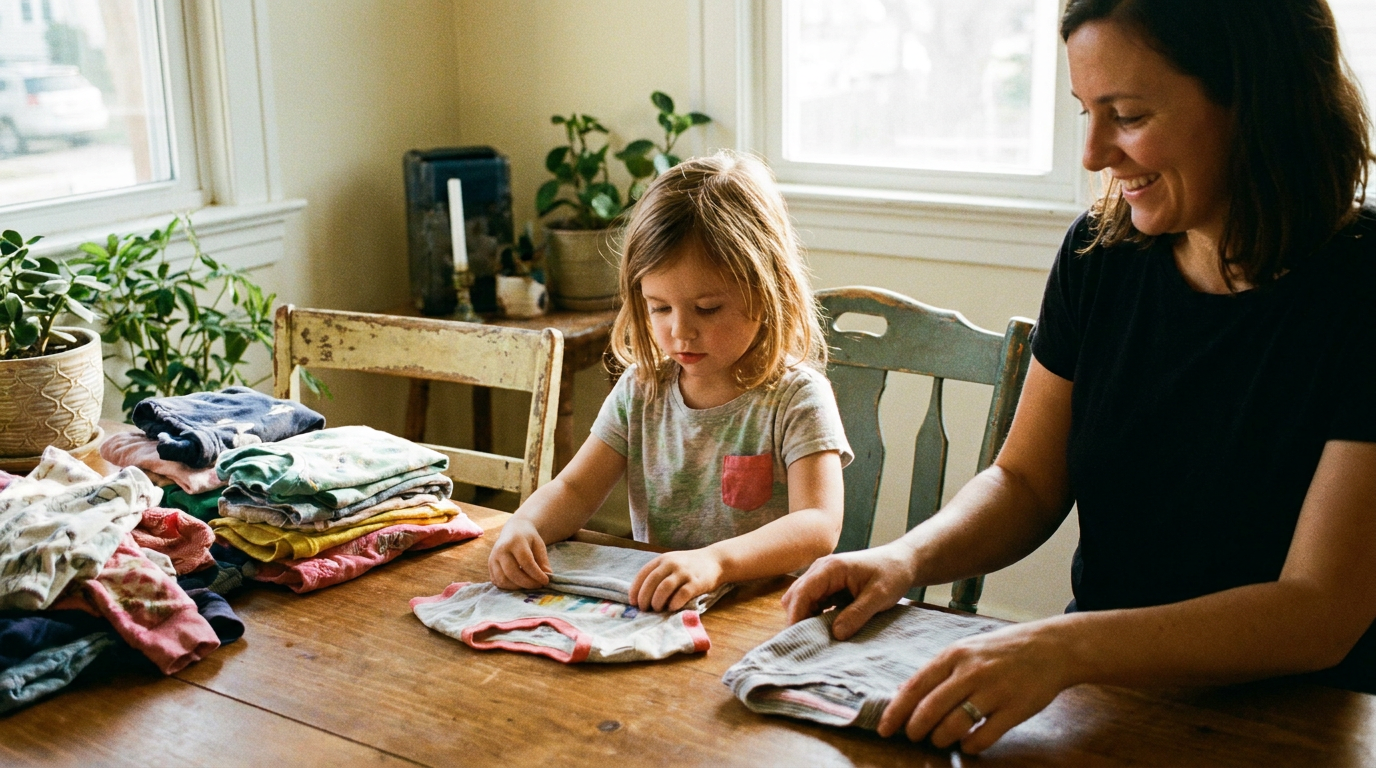
Here is what the standard clothing cycle looks like in most households: a parent buys clothes, a parent sorts through them when they’re outgrown, a parent bags them for donation or a consignment drop, and the child watches — or doesn’t even notice — as it all happens around them.
There’s nothing wrong with any individual part of this. Parents aren’t failing when they handle the logistics. But taken together, this pattern communicates something to children that most parents would never consciously choose to teach: your things are managed for you. The clothes arrive. The clothes leave. You are not part of either decision.
The invisible cost of this approach is not immediately obvious. Children who grow up as passive recipients in the clothing cycle develop no real relationship with the value of what they wear. They don’t understand where things come from — not just the store or the website, but the effort, the cost, the choice behind a purchase. They don’t understand where things go when they leave. And they develop no framework for thinking about their belongings as things that carry ongoing value, not just a price tag that becomes irrelevant the moment the item is in their hands.
There’s also an emotional dimension that often goes unacknowledged. As explored in why kids won’t wear what parents pick out, children’s relationships with their clothing are far more emotionally complex than most parents realize. A piece of clothing can be tied to a memory, a feeling of confidence, a version of themselves they loved. When that piece disappears without discussion — donated quietly while they were at school — children feel a kind of low-grade loss they don’t always have the words for. Not a crisis, but a confusion: something mine was taken from me and I had no say.
The resistance that shows up when children are handed down clothes without consultation, documented so well in Help! My Kids Fight Me Over Hand-Me-Downs, is partly about taste and partly about something deeper: the desire to have agency over something as personal as what goes on their body. The friction isn’t irrational. It’s a signal.
For parents, the other side of this picture is familiar too. The donation bag that sits in the trunk of the car for six months. The guilt about the pile growing on the floor of a closet. The vague awareness that there’s a better system somewhere, but the energy required to find it always seems to exceed what’s available on a Tuesday evening. None of this is laziness. None of this is bad parenting.
“The bag in the trunk isn’t laziness. It’s a system gap. And most parents are stuck in it.”
The system gap is real. What’s missing isn’t motivation — it’s a structure that makes involving children feel natural rather than effortful. A structure where the child has a role, the clothing cycle has a logic, and the learning happens as a side effect of participation rather than as a lecture delivered on top of an already-overwhelming to-do list.
That structure is exactly what the credit system is designed to be. But before we get into how it works, it’s worth understanding why bringing children into this cycle matters so much — not just practically, but developmentally.
Children are not simply small adults who haven’t yet learned to care about money. They are people in the process of forming an identity, and clothing is one of the first and most visible arenas in which that formation happens. Think about the child who insists on wearing the same dinosaur shirt three days in a row, or who bursts into tears when their favorite dress is in the wash. These aren’t tantrums about laundry. They are expressions of something genuinely important: this is who I am today, and this is what helps me feel like myself.
From an early age, children use clothing as a form of self-expression and autonomy — often before they have the verbal fluency to articulate preferences in other domains. The choice of a striped shirt over a plain one, the decision to wear the sparkly shoes to school, the refusal to give up the beloved hoodie even as it becomes visibly too small — all of these are children practicing the fundamental skill of knowing what they like, and why, and standing by it.
Research consistently shows that children who are given meaningful choices — even small, bounded ones — develop stronger decision-making skills, greater confidence in their preferences, and a more secure sense of self. When those choices are connected to something as personal and physical as clothing, the impact is amplified. According to FamilyEducation, involving children in clothing decisions from an early age builds lifelong financial habits — teaching them to budget, to evaluate value, and to resist impulse in favor of considered choice.
What’s particularly powerful about clothing as a teaching medium is its physicality. Unlike a bank account balance or an abstract concept of savings, clothing is something children can hold, wear, feel, and see. The jacket worn every day for a season is not just a jacket — it is a record of who they were during that season. The dress that felt like armor for the first day of school carries the memory of courage in its seams. When we ask children to engage with that object consciously — to decide whether it still fits who they are, whether it’s ready to go forward to someone else — we are asking them to do something genuinely sophisticated: to hold something with both attachment and openness.
This is where the question of involving children in wardrobe decluttering becomes something more than a household management tip. When a child participates in deciding what to let go of, they are practicing what developmental psychologists call intentional release — the ability to make a conscious choice to move something out of your life, not because it was taken from you, but because you decided it was time. That distinction — between loss and choice — is enormous. And it is not something most children get to practice in the clothing cycle, because most of the time, the decision has already been made for them.
There’s something else at stake, too. The confidence that comes from choosing your own clothes — really choosing them, not just accepting what arrived — is a different quality of confidence than any other. As we explore in The Confidence Cart: How to Shop With Your Kid, the act of selecting a piece of clothing and knowing it reflects you is one of the most accessible forms of self-knowledge available to a child.
“When your kid picks something out and knows they earned it — their confidence in wearing it is different. That’s not just shopping. That’s self-knowledge being built, one season at a time.”
The case for children’s agency in the clothing cycle is not sentimental. It is grounded in what we know about how children develop. The question, then, is not whether we should involve them. It’s how. And specifically — why a credit system is a more powerful vehicle for teaching value than any explanation, lecture, or simple shopping trip could ever be.
Most parents understand that teaching children about money is important. But most of the tools available for doing that — allowances, chore charts, savings jars — teach a particular version of the lesson: money is earned through time or compliance, and then spent on things you want. It’s not a wrong lesson. But it is an incomplete one.
The Prelove You kids clothing credit system teaches something fundamentally different. And the difference is not cosmetic.
When a child earns credits through a clothing platform, the process looks like this: they give something real — a piece of their wardrobe, something they actually owned, something that meant something to them — and in exchange, they receive something tangible in return. The loop is not abstract. It is completely, viscerally concrete. This jacket, which I wore to my first sleepover, has become credits. Those credits will become something I choose next. That thing I choose will matter to me, because I know what it cost.
Money doesn’t work this way. An allowance arrives on a schedule, detached from any particular act of giving or contributing. A cash payment for chores creates a transactional relationship with household participation that many families find uncomfortable. Neither mechanism teaches the specific lesson that the credit system is designed to deliver: that value is circular. That the things we have can generate something new. That contributing to a system — not just consuming from it — is where genuine participation begins.
Research into children’s financial literacy consistently shows that the most effective financial lessons for children are those grounded in tangible, repeatable experience — not explanation. Children learn about value not by being told that things cost money, but by navigating actual decisions with real stakes attached. The credit system creates exactly those stakes, but through a medium children already care deeply about.
“The item they loved has become the credits they earned. That’s not a transaction. That’s a lifecycle lesson.”
There is also an emotional dimension to earning credits from clothing that simply doesn’t exist with cash. To earn the credit, something had to be released. A real piece of a child’s life — the dress from the birthday party, the shoes worn to every soccer game — had to be consciously given forward. That moment of release is where the deepest learning lives. The child who hands over their favorite outgrown raincoat and then watches their credit balance grow is learning something no financial literacy curriculum has ever quite managed to teach: that generosity and value are not opposites. That giving something forward is not a loss. It is the beginning of something new.
This is also where the children and value of money conversation gets genuinely interesting. Children who understand that their belongings have ongoing value — not just value at the moment of purchase, but value that persists, that can be converted, that can be passed forward — develop a more sophisticated relationship with consumption. They begin to understand that what they own is not disposable. That things have a life beyond their time in their closet. As KidsMoney notes, developing a healthy approach to clothing budgets and spending is one of the most practical financial skills teenagers can acquire — and that skill is built on foundations laid years earlier, in moments like these.
The credit system is not a trick to get children to cooperate with the decluttering process. It is a structural invitation to participate in something real — and to walk away with a lesson that compounds over seasons. Now that the conceptual case is made, it’s time to look at exactly how the Prelove You credit system works — and why children find it genuinely exciting to be part of.
The mechanics of the Prelove You credit system are simple enough to explain in a single sitting with a child — and layered enough to be genuinely interesting when you dig in together. The basic loop goes like this: you send in outgrown clothing, Prelove You grades each piece and assigns credits to your account, and then you use those credits to shop for new-to-them items from the platform’s curated selection of quality children’s clothing. You can learn exactly how it works here.
But the detail that transforms this from a nice concept into a real learning tool is in the grading. Because every item isn’t simply accepted and assigned an arbitrary value. Each piece is evaluated across five specific criteria — and each criterion becomes a conversation starter when you involve your children in preparing their items.
Type — Is it a dress? A pair of jeans? A cozy onesie? A structured jacket? The credit value depends on the category of the garment and how much demand exists for it. Children quickly learn that different items carry different weight in the system — not unlike how different assets carry different value in any economy.
Designer — Designer pieces score more highly on Prelove You’s credit scale. This isn’t about snobbery — it’s about quality and demand. Children who notice this learn something genuinely useful: craftsmanship and provenance matter, and the pieces that were made with care retain more value over time.
Condition — The better the condition, the higher the score. Simple as that. But this single criterion quietly teaches children that how you treat your things matters. A piece that was hung up after wearing, kept clean, and stored carefully is worth more than one that was crumpled on the floor. The credit system creates an incentive for care that no parental lecture ever quite achieves.
Sustainability — Prelove You awards additional credits to garments made from sustainable materials, in their effort to show love to eco-friendly fashion. This gives environmentally conscious families a tangible reward mechanism for the choices they’ve already been making — and introduces children to the concept that how something was made is part of its value.
Cleanliness — Items sent in a squeaky clean, ready-to-wear condition earn extra credits. So washing and folding before sending isn’t just tidiness — it’s a strategy. Children who understand this become invested in the preparation process in a way that transforms what could feel like a chore into something purposeful.
What makes the entire system feel genuinely inclusive — and what matters most when you involve young children — is the guarantee underneath all of this: even if an item doesn’t meet the grading criteria in any meaningful way, it still earns one credit. No child’s contribution is dismissed. Nothing is worthless. That message, stated quietly through the mechanics of the system, is one of the most important ones the credit system delivers. Every item they care enough to send forward has value. Every act of participation counts.
The maximum of 50 credits per item creates natural excitement and curiosity — there are pieces worth hunting for, preparing carefully, sending in with real anticipation. And because Prelove You also accepts end-of-life items — the stained, the worn-through, the past-their-prime — parents don’t have to make one more exhausting judgment call about whether something is “good enough” to send. If a child wants to include it, it can go.
One detail worth highlighting for families: Prelove You’s vision for tracking pieces through the system — the idea that a garment can be followed through its chapters — is particularly meaningful for children. The knowledge that the raincoat they loved might now be keeping another child warm somewhere transforms the moment of sending it out from a goodbye into something more like a beginning.
“Prelove You brings the fun back into shopping. My daughter loves receiving her new clothes every month — and I love helping keep the planet safer!”
— Kristen, mom of Mikayla
Existing members can start earning credits here, and any questions about the process are answered in detail in the Prelove You FAQs. Now that the system is clear, the next question is the practical one parents always ask: how do I actually bring my children into this? What does that conversation look like? And what do I do when they don’t want to let something go?
The most common reason parents don’t involve their children in the clothing cycle is not reluctance — it’s uncertainty. What do I actually say? How do I make this feel natural rather than forced? What do I do when they cry about the shoes? These are real questions, and they deserve specific answers.
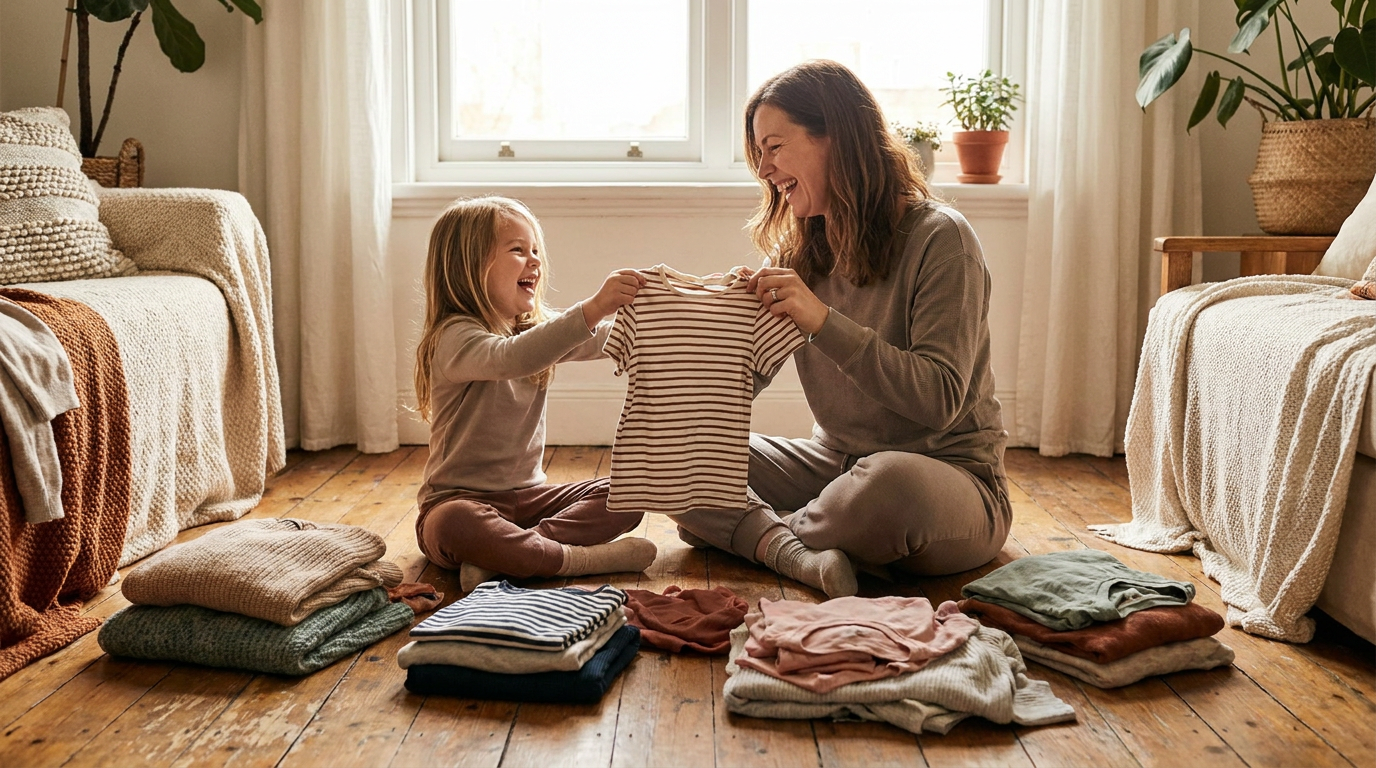
The good news is that children across a wide age range are genuinely capable of participating in the credit cycle — they just need entry points that match where they are developmentally. Here’s what that looks like in practice.
At this age, the conversation about clothing is best rooted entirely in the body. Abstract concepts like “earning” and “value” are beyond reach, but does this still fit? is a question a three-year-old can answer with authority.
Let them be the ones who check. Can they still zip the zipper all the way? Do their shoes feel tight when they stand up straight? Is the waistband pulling? This gives them a genuine role — expert witness to their own body — and makes the decision feel collaborative rather than imposed. They are not being told something is too small. They are discovering it.
When something goes into the Prelove You bag, make it ceremonial. Let them name what the piece meant: “This one helped me learn to ride my bike.” “This was my favourite summer dress.” That naming transforms the moment from a loss into a recognition. You are not taking their sweater. You are acknowledging what it was, together.
Conversation starter: “Do you remember when you wore this? Let’s check if it still fits you. It doesn’t? That means you’ve grown so much. Should we let it go find a new adventure?”
This is the age where the credit system begins to reveal its full educational power. Children at this stage are ready to understand cause and effect in a more sophisticated way — and when you explain that the condition and cleanliness of a piece affects how many credits it earns, you’ve created an incentive structure that actually works.
Bring them into the preparation. Show them the grading criteria. Let them decide: Is this clean enough? Should we wash it before we send it? The question “if we wash this really well, it earns more credits” is one of the most naturally motivating things you can say to a child who has just seen what those credits can become in the shop.
This is also the age to introduce the idea that different pieces are worth different amounts — and to let that conversation go wherever it leads. Why does a designer jacket earn more than a basic tee? Why do sustainable materials score higher? These questions lead naturally into conversations about quality, care, and why things are valued the way they are.
Conversation starter: “You’ve got a credit account now. Everything we send in earns you credits, and the better condition it’s in, the more you get. Want to pick out which things are ready to go and help get them ready to send?”
By ten, most children are ready to engage with the credit system as genuine financial practice. They can browse the Prelove You shop, understand their credit balance, make selections, and feel the real satisfaction — and real constraint — of working within a budget.
Bring them fully into the shopping side. Don’t just tell them what you’ve chosen. Sit with them while they browse. Let them make the case for a piece they want. Ask them to think about whether it’s a good use of their credits. This is where children’s clothing credits become something genuinely indistinguishable from financial literacy — the skills being practiced are budgeting, evaluation, and self-restraint dressed in the clothes of a shopping experience they actually enjoy.
Conversation starter: “You’ve got [X] credits. Here’s the shop — take a look at what’s there and see what you’d want to spend them on. What catches your eye? Do you need it, or do you just want it? Is there something that’s a better value?”
Across all age groups, the families who get the most out of the Prelove You credit system are the ones who turn it into a seasonal event rather than a reactive task. Not a chore on a list, but a household ritual with its own energy.
Think: the change of seasons as a natural cue. Put on some music. Make a snack. Get a box for things going out and create a little ceremony around filling it. Celebrate when the credit balance goes up. Let the shopping moment — when your child chooses what comes next — be genuinely exciting.
As documented in A Year in Clothes: What Our Kids’ Closets Taught Us, the families who treat the clothing cycle as a reflective, intentional practice rather than an administrative burden find it becomes something children actually look forward to — and something that builds a family vocabulary around value, care, and sustainability.
This moment will come. The beloved item that is genuinely too small but that they cannot imagine parting with. The right approach is not to override, and not to give in entirely. It’s to honor the resistance first.
“It makes sense that you don’t want to let it go. It’s a really special one. Can we think about who might love it next?” That reframe — from goodbye to gifting forward — changes the emotional texture of the moment. And if the answer is still no, not yet — that’s allowed. The system works best when it’s built on trust, not compliance.
As you’ll find in 5 Ways To Shrink Your Kids’ Clothing Footprint (Without The Guilt), sustainable habits in families are built on consistency and gentleness, not force. One piece staying behind won’t break the system. The conversation you had about it might be the most valuable thing that happened all day.
“Remember that one thing you wore again and again this year? That’s because it made you feel amazing. Clothes that feel good help us feel brave, comfy, and confident — aka the best style recipe ever.”
According to the Washington Post, one of the most effective strategies for managing the constant churn of children’s clothing is building consistent, season-by-season habits rather than attempting a once-a-year overhaul. The credit system is perfectly designed for exactly that cadence. With the practical playbook in hand, the real question is the longest-horizon one: what are children actually building when they participate in this system over time?
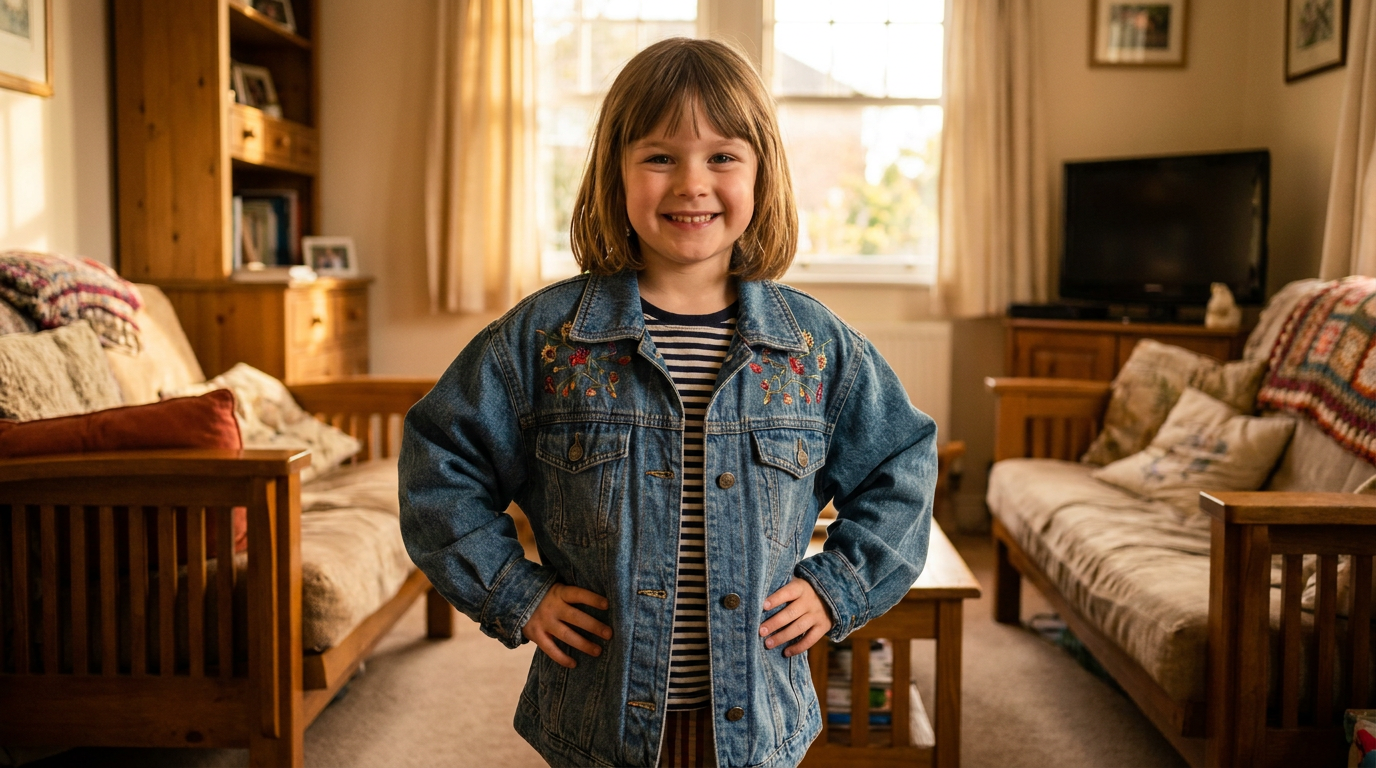
The credit system, practiced across seasons and years, does something that is hard to see in any individual moment but becomes undeniable over time. It builds a child who thinks differently about what they own.
Not in a heavy, lecture-y way. Not because they have been told the right things. But because they have done something — over and over, in a structure that makes the lesson impossible to miss — that teaches the right things experientially. That is a fundamentally different kind of knowing.
Confidence in taste and self. Children who choose their own clothing — and who know they earned the right to choose it through their own contribution — wear it differently. There is a quality of ownership in the selection that is visible to anyone who looks. The piece was not handed to them. It was not chosen for them. It was the result of their own decision, made with credits they generated themselves. That is a small but real experience of autonomy, and autonomy, practiced repeatedly, builds confidence that transfers far beyond the wardrobe.
Understanding sustainability through lived experience. There is a version of environmental education that happens through information — graphs, statistics, explanations of why fast fashion is harmful. That version has its place. But there is another version that happens through doing, and it is more durable. A child who understands that the jacket they outgrew is now keeping another child warm — not as an abstract idea but as the direct result of a choice they made — is experiencing the circular economy as a human reality, not a policy concept.
As TeachSustainability.org notes in their work on teaching circular economy principles to primary-age children, the most effective way to introduce life cycle thinking to young learners is through tangible, repeatable experience — mapping the journey of real objects through real systems, and understanding that those journeys don’t end when an item leaves their hands. The credit system is that experience, built into a household rhythm. It is circular economy education that doesn’t require a classroom.
The lifecycle of belongings. This is perhaps the most foundational shift that the credit system makes in a child’s relationship with their things. Children who move through this system long enough begin to understand — intuitively, not intellectually — that things have chapters, not endings. A piece leaves their closet. It earns them something. It finds a new story. The item doesn’t disappear; it continues. That understanding, once it settles in, changes the way a child relates to consumption entirely. They stop seeing their things as disposable. They start seeing them as participants in a longer story.
As the broader Prelove You philosophy captures — clothing is the literal common thread. It holds memory. It holds identity. It holds the story of a child’s growth, season by season, in its seams and its sizes and its worn-through knees. The credit system honors that story rather than simply clearing it away.
The family system. It would be incomplete to talk only about what children gain from this process without acknowledging what parents gain too. When children participate, the mental load decreases. The bag in the trunk gets dealt with — not by one exhausted parent making all the decisions alone, but by a family engaging with the process together. The closet gets cleared on a rhythm. The guilt about waste dissolves because the system handles it. The moment when your child holds up their new-to-them piece with the particular pride of I chose this, I earned this — that is the moment the household infrastructure clicks into place, and it is a very good feeling.
Rethinking the new outfit mentality. As explored in 5 Reasons to Rethink the ‘New Outfit’ Mentality for Kids, the cultural assumption that children’s wardrobes should be refreshed with new purchases at every season is both financially and environmentally costly — and it teaches children that novelty is the point, rather than quality and meaning. The credit system is a structural counter to that assumption. It says: what you have matters. Where it goes matters. What comes next is something you helped create.
That message, received season after season, builds the kind of child who grows into the kind of adult who makes considered choices, values what they own, and understands that their participation in a system — however small — makes a difference.
Start by giving children an active role rather than asking them to observe or comply. Let them be the ones to check whether clothing still fits — can they zip the zipper, do the shoes pinch, is the waistband pulling? Make the process physical and collaborative rather than something that happens to them. Frame it as something they are contributing to, not something being decided for them. With Prelove You, children can take this involvement a step further: they help sort and prepare the items that go into the bag, earn credits for their contribution once the pieces are graded, and then use those credits to choose what comes next. That complete loop — give, earn, choose — transforms decluttering from a household chore into something children are genuinely invested in.
The most effective method is giving children a tangible, repeatable experience of the full cycle — not an explanation of it, but a lived version of it. When a child contributes something, watches it generate value in the form of credits, and then chooses what that value becomes, they are experiencing the lifecycle of a belonging in the most concrete way possible. A kids clothing credit system like Prelove You makes this cycle visible and rewarding: the piece they outgrow earns credits, those credits fund their next favourite item, and the piece they sent in finds a new home with another child. Over time, and across seasons, children build an intuitive understanding that things have chapters, not endings — and that their choices are part of something larger than their own wardrobe.
Here is the child from the beginning of this piece, a season later. They know why their pieces are leaving. They prepared them — washed and folded and considered. They know what those pieces earned, because they watched the balance go up. And now they are standing in front of the Prelove You shop, choosing what comes next, with the particular confidence of someone who understands what they contributed to get here.
That is not a transaction. That is a child who has learned, through doing, that their choices have consequence. That value is circular. That giving forward is not a loss. That what they wear can carry meaning — because they chose it, with something real.
For parents, this is not about adding another thing to a plate that’s already full. It’s about replacing a system that was never quite working — the bag in the trunk, the quiet donation, the closet cleared while everyone was at school — with one that actually involves the whole family. A system that gets lighter over time because everyone is in it. A habit that, practiced across enough seasons, builds something lasting in the children who live it.
Clothing is the common thread. It runs through memory and identity and growth. When your child holds that thread — when they understand where it came from, where it’s going, and what it means — they carry something with them that has nothing to do with what’s in their closet.
Become a Member and start earning credits together — send in what they’ve outgrown, let them choose what comes next, and build the household rhythm that actually sticks.
Not sure where to start? See how PLY works →

