



 Sustainability Scoop
The Milestone in the Drawer: On Holding On and Letting Go
Your child’s clothes hold more than fabric. Here’s how to honor that — and finally let it move.
There is a drawer in your house that doesn’t close all the way.
You know the one. It sticks at a certain angle — not because it’s broken, but because something inside it has been there so long it has quietly become part of the architecture. You’ve nudged it shut a hundred times. You’ve opened it for something else entirely and then closed it again quickly, the way you do when you’re not ready for what’s inside.
At the bottom of that drawer, folded with a care that suggests it was placed there intentionally, is something small. A onesie, maybe — the one with the snaps that never quite lined up but somehow worked anyway. Or the pajamas worn so many hundreds of nights that the fabric went soft, then thin, then almost translucent with love. Or the first-birthday outfit, still slightly creased from the way it was packed away at the end of a day that felt enormous.
This is not clutter. You already know that. Clutter is easy to throw away. Clutter doesn’t make you pause in the middle of a Tuesday morning and feel the weight of time in your hands. What’s in that drawer is something else entirely — a record of a child’s growth written not in words or photographs but in fabric and weight and size.
This is not a decluttering guide. It is not a list of tips for letting go. It is an essay about why children’s clothing milestones carry so much of what we mean when we talk about time, identity, and memory — and about what it means to honor that weight without keeping it indefinitely in a drawer that won’t close properly.
Because there is a way. Not to forget. Not to discard. But to let what these pieces hold continue forward — to follow the thread, rather than hold it still.
Children grow faster than anything else in the human experience. In the first year of life alone, a child typically moves through five or six clothing sizes. What fits in January is laughably small by June. The 0–3 month onesie that swam on them at birth is outgrown before you’ve finished washing it a dozen times. Sizes that represent entire chapters of early childhood — newborn, 6–12 months, 2T — pass in weeks, sometimes days.
This speed is part of why sentimental children’s clothing accumulates the way it does. There is no gradual transition, no warning. One day the striped sweater fits. Three weeks later it doesn’t. The speed of physical change makes each size feel like a contained era — a version of your child that was fully real and is now, in the most physical sense possible, gone.
Psychologists have a name for the mechanism that makes this feel so significant. Research from Bruce Hood at the University of Bristol and Paul Bloom at Yale University describes how humans instinctively invest certain objects with what they call an “essence” — a unique, irreplaceable quality that exists beyond the object’s physical form. In their landmark study, children refused to swap their cherished comfort objects for perfect duplicates — not because they could identify any physical difference, but because they believed, intuitively, that something irreplaceable resided in the original. Not just fabric. Not just construction. Something more.
This is not a childish belief that parents outgrow. It is a deeply human one. The same mechanism that makes a child cling to a particular stuffed bear makes a parent unable to place a hospital onesie in a donation bag. The object is not just the object. It is the experience it held. It is the morning it was worn, the smell of that particular season, the weight of a baby in your arms when the world was still very new.
Children’s clothing milestones are real milestones — not soft, sentimental approximations of them, but the actual markers of development. The first time they chose their own outfit. The piece they wore on the first day of school, standing at the door with a backpack that was almost as big as they were. The item they demanded to wear every single day for three weeks because it made them feel like themselves, somehow — like the self they were still in the process of becoming.
What the research illuminates, and what every parent already feels, is that these pieces are body-scaled to a version of your child that no longer exists. The 3–6 month onesie is not simply a garment from the past. It is the physical shape of who your baby was at that precise moment in time — a moment that, in the way of all moments, cannot be returned to. Letting go of the clothing can feel, in the deepest sense, like letting go of the stage itself. Like acknowledging that this particular version of your child has already passed.
That is not irrational. It is emotionally coherent. It is, in fact, one of the most human responses to the experience of watching your child grow. The grief that lives inside a drawer of outgrown clothes is a small grief, yes — but it is a real one. The unnamed mourning of childhood passing, one size at a time.
Understanding this is not an invitation to wallow. It is the beginning of knowing what these pieces actually need — which is not indefinite storage, but genuine honoring. And honoring them well requires first knowing exactly what’s in the drawer.
Every family’s sentimental drawer looks slightly different on the surface. But the taxonomy of what accumulates inside it — the categories of pieces that refuse to be released — is remarkably consistent. If you have been a parent for any length of time, what follows will feel like someone opening your drawer alongside you.
The firsts. The going-home outfit, chosen before the baby arrived, washed and folded and waiting. The first pair of shoes — those impossibly small leather things, stiff because they were barely worn. The first-birthday dress or romper, perhaps slightly stained from the smash cake, which makes it more rather than less precious. These pieces are the easiest to name and the hardest to touch, because they represent the absolute beginning of everything.
The most worn. This is often the piece that surprises parents the most — the one they didn’t expect to feel so attached to. The dinosaur shirt. The soft striped sweater that went through the wash so many times it developed a particular drape, a specific weight. The leggings worn so constantly that they pilled and faded and became, in their worn-ness, irreplaceable. These pieces hold the memory not of the extraordinary days but of the ordinary ones. Tuesday mornings. Saturday afternoons at the park. Ordinary days, which are so often the ones we miss most.
The milestone dressed. The holiday pajamas, worn for the Christmas morning photos year after year until they couldn’t possibly fit any longer. The Easter outfit that was briefly, earnestly perfect. The Halloween costume they chose themselves — the one that required negotiation, compromise, and ultimately a child’s unbridled confidence in a vision nobody else quite understood but that turned out to be completely right. The piece worn to a grandparent’s house for the last time. The outfit from the day a sibling arrived. These carry the weight of days that were marked as significant at the time, and have only grown more so.
The sentimental hand-me-down. The piece that came from somewhere else — a grandmother’s careful keeping, a cousin who outgrew it years earlier, something that belonged, improbably, to you or your partner at this same age. These carry a different quality of weight: not just the memory of your child, but the layered memory of everyone who wore it before. They are already, in some sense, the beginning of a thread.
The end-of-life piece. The item so loved it is genuinely, thoroughly worn through. Stained in a way that has long since passed washable. Pilled at the elbows. Soft in a way that only comes from years of use. Past wearable by any conventional definition — and yet, somehow, entirely impossible to discard. Because the wear is the story. The wear is evidence of a child who lived fully in what they wore.
The almost-donated-three-times piece. You know this one. It goes into the bag. You pull it back out. It goes in again. You find it on the floor of the trunk two weeks later and bring it back inside. You are never quite sure why it keeps returning — only that something about it keeps pulling.
The Prelove You Way
“The most worn piece is often the most loved. The stain on the knee isn’t a flaw — it’s proof that it was exactly right.”
What all of these pieces share is not just sentiment — it is meaning. They are physical evidence of a child’s growth, and of the time you spent together inside each stage. The problem is not that you have them. The problem is what happens when they accumulate without any structure to hold them.
The drawer becomes a bin. The bin becomes a shelf. The shelf becomes a storage unit, or a basement corner, or the back of a closet that nobody opens anymore. Season by season, size by size, the clothing accumulates — not honored, not released, simply held. And holding without intention has costs that are both emotional and practical, and that compound over time.
There is a guilt that comes with the unprocessed bag. It is low-grade and persistent — not dramatic, but present. I should deal with this. I’ve been meaning to sort through it. I’ll get to it this weekend. The bag sits in the trunk of the car for three weeks. The bin in the mudroom becomes part of the landscape, something you step around without seeing anymore. The guilt is not about the clothing itself. It is about the gap between the care these pieces deserve and the suspension they’ve been kept in.
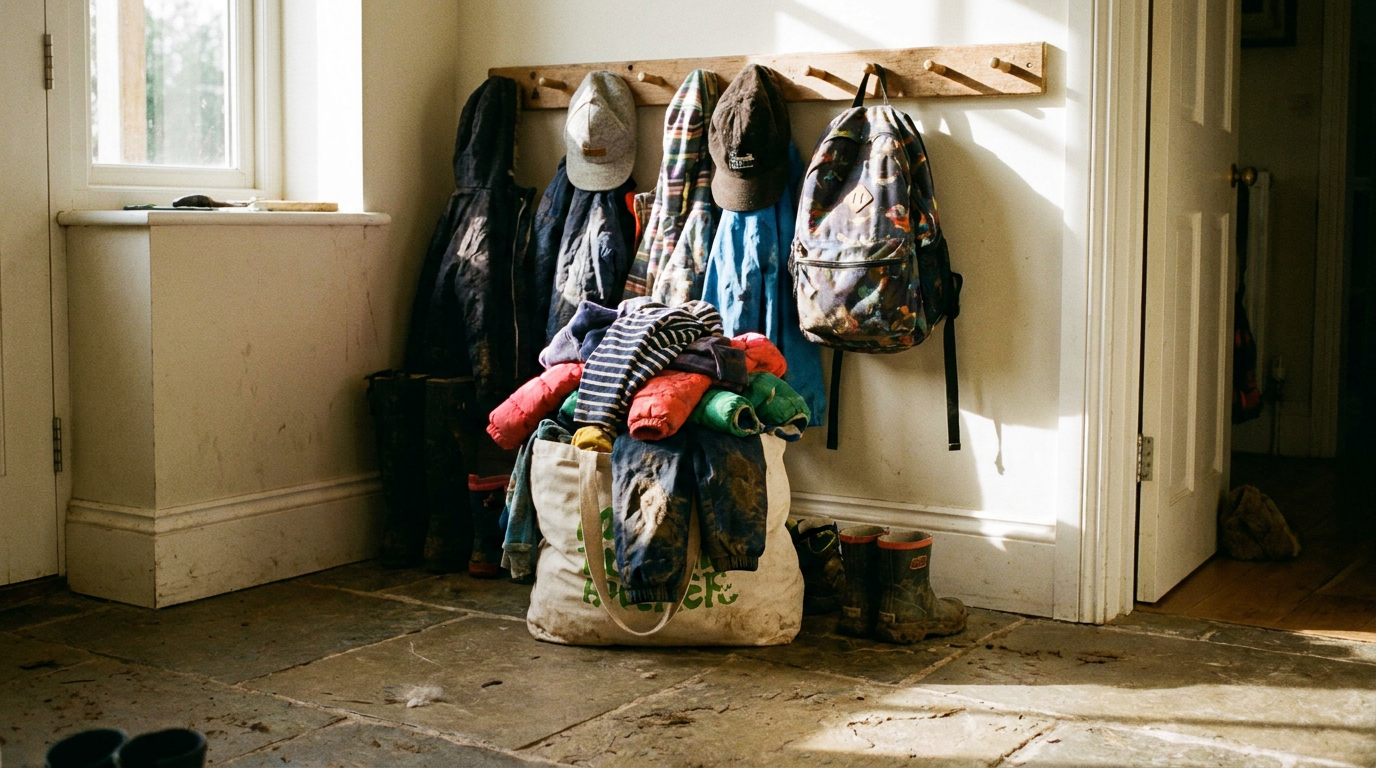
There is also a practical reality that matters: when everything is kept, nothing is truly honored. The first-birthday dress buried under seventeen other pieces is not being treasured — it is being stored. The most-worn sweater, compressed at the bottom of a bin that is growing heavier each season, is not being remembered. Accumulation without structure flattens the hierarchy of meaning. Everything becomes equally held, which means nothing is held particularly well.
The cognitive labor of the unprocessed pile is real and documented. Each time the bag surfaces — in the car, in the mudroom, in the corner of the basement — it represents an unresolved decision tree. What goes? What stays? Is this good enough to donate? Is it too stained to give away? Should I sell it? Will anyone want it? These are not small questions, and they draw on mental bandwidth every time they resurface. As explored in depth in the companion post on the invisible labor of managing your kids’ wardrobe, the cognitive weight of these unresolved loops is one of the most underestimated burdens of family life.
The seasonal cycle makes everything worse. Children keep growing. New items keep entering. Outgrown items keep accumulating. Without a system, each new season adds a fresh layer to an existing backlog — and the backlog grows not just in volume, but in emotional complexity. Each new bag contains a new set of pieces with their own significance, their own milestones, their own claims on your attention and care.
The traditional options don’t help much, either. Donation requires evaluation: Is this good enough? Too worn? Will they take it? Resale requires even more: photography, pricing, listing, shipping, waiting. Consignment adds appointments, drop-offs, waiting, rejection. Every option carries a gate — a moment of judgment — that adds friction to an already difficult process. And so the bag stays in the trunk for another week. And then another.
The problem was never that you cared too much about these pieces. The problem was that no system existed that was worthy of the weight they carry. That changes when the frame changes — when letting go stops being the goal, and something truer takes its place.
The language we use for releasing children’s clothing is almost entirely wrong. “Letting go” implies loss. It implies that when the piece leaves, what it held leaves with it — that the memory is somehow tied to the physical retention of the object. But this is not actually how meaning works.
Think about a well-loved book. Not a pristine, unread copy — a book that has been underlined, dog-eared, passed between hands, returned with a different reader’s annotations in the margins. A book that has been read by hundreds of people carries more meaning than one that has never been opened. Each reader adds something. The story is not diminished by its circulation — it is deepened by it.
The same is true of a loved piece of children’s clothing that finds its way to a new child who will wear it just as fully, just as constantly, just as completely. The most-worn sweater does not stop being the most-worn sweater when another child makes it their most-worn sweater. The birthday dress does not lose the memory of the morning it was worn. It gains the afternoon it will be worn next.
This is the reframe. Not letting go — letting forward. The piece doesn’t disappear. It continues. The thread doesn’t end; it extends.
This philosophy sits at the heart of how Prelove You works — and it is not simply a tagline. It is a genuine worldview about what clothing holds and what happens to that meaning when clothing moves. The “Follow the Thread” philosophy begins from the premise that a garment’s story is not a single chapter. It is an ongoing narrative, enriched by each child who wears it with full commitment, with daily life, with the ordinary and extraordinary days that make up a childhood.
There is a distinction worth drawing carefully here. Some pieces are worth keeping — truly singular, genuinely unreplaceable. The going-home outfit. The handmade piece from a grandparent who is no longer here. The item with a story so specific to your family that it belongs in your family’s archive and nowhere else. These are not the pieces the drawer is asking you to release.
The pieces the drawer is asking you to release are the others. The most-worn sweater that deserves a new child to love it just as completely. The holiday pajamas that should be someone else’s Christmas morning. The pieces that are past their time with your family but still full of life for the next one. When you can see the difference — when you can distinguish between the pieces that are yours to keep and the pieces that belong to a larger story — the release becomes possible. It becomes, even, a generous act.
And the end-of-life pieces — the genuinely worn-through, stained beyond wearable, truly-past-it items — deserve not a landfill but a responsible path forward. According to research published in Nature Reviews Earth & Environment, the textile industry is one of the most significant contributors to global environmental burden, with vast quantities of clothing ending its life in landfill rather than re-entering any kind of circular system. Even the pieces that can no longer be worn can be upcycled, recycled, or transformed — their thread continuing differently, but continuing nonetheless.
The emotional shift that happens when a parent knows where a piece goes — when they can, in some sense, follow it — is the difference between a loss and a continuity. The release becomes an act of generosity rather than an act of erasure.
The Prelove You Way
“The birthday dress doesn’t stop being the birthday dress when another child wears it. It becomes the birthday dress that found its way to two children who both deserved it. That’s not loss. That’s the thread continuing.”
From philosophy, now, to practice. Because a beautiful idea without a workable system is just another thing to feel guilty about not acting on.
The reason the drawer has stayed closed is not a lack of intention. It is a lack of infrastructure — a system genuinely designed to receive what these pieces carry and route it with care. Prelove You was built to be that system, and the way it works is worth understanding in some detail, because the details are what remove the barriers that made the whole thing feel impossible.
The first and most important feature: you send everything. Outgrown, stained, pilled, worn-through, past wearable, end-of-life. No sorting required at home. No evaluation gate asking you to judge whether your child’s most-loved piece is “good enough” to deserve a second life. The system handles the grading and routing on your behalf, and it does so with a credit structure that honors every piece regardless of condition.
Items that can continue as wearable inventory are graded by type, designer, condition, sustainability credentials, and cleanliness — and credits are awarded accordingly, up to a maximum of fifty per piece. But here is the part that matters most for the drawer: even items that cannot continue as wearable — the end-of-life pieces, the genuinely worn-through — earn a sustainability credit. The act of sending is always honored. Nothing is penalized for having been loved.
End-of-life pieces are routed responsibly through upcycling and recycling partnerships — they do not disappear into an anonymous bin. Their thread continues differently. This matters both environmentally and emotionally: the piece you loved enough to keep for three years past its last wearing is not simply discarded. It is transformed.
The credits come back as access to the shop — to high-quality, preloved pieces that are new-to-your-child but already worn-in to exactly the right softness. The system closes the loop in both directions: sending earns, receiving delights. And the membership model means this loop repeats, season after season, size after size, without requiring a one-time heroic effort of sorting and purging that nobody actually has the energy for. It is household infrastructure, not a periodic overhaul.
Three membership tiers — Lite at $35/month, Luxe at $65/month, and Limitless at $95/month, with enhanced credits for higher tiers — mean there is a genuine entry point regardless of where you are in your family’s clothing cycle. The system is designed to grow with your family, not to require a perfect moment of readiness to begin.
If you’ve wondered about the logistics before committing, the frequently asked questions cover the mechanics in detail. And if you’re ready to understand how the membership works in full, becoming a member is the place to start. The barrier has been lowered as far as it can be. The bag in the trunk can finally move.
But before we talk about closing the drawer for good, there is one dimension of this system that is too often underestimated: what it does for the children themselves.
Parents often approach the clothing cycle as a solo act — something done after bedtime, in the mudroom, alone. But children are not just the reason the clothing cycles. They can be participants in it. And when they are, something changes — both in the process and in them.
The credit system gives children a framework they can genuinely understand: the things you outgrow have value. Not just emotional value, not just sentimental weight, but actual, tangible credit that can become something new. When a child understands that the sweater they’ve grown out of will earn credits that can bring a new piece into their wardrobe, the release is no longer a simple loss. It is a transaction they can see the shape of. It is something they chose.
This matters more than it might seem. Children develop their relationship with material things early and durably. When they participate in circular systems — when the process is visible and meaningful rather than things quietly disappearing while they’re at school — they build something real: a healthier, more intentional relationship with the things they own. Not everything needs to be permanent. Not everything that leaves is gone.
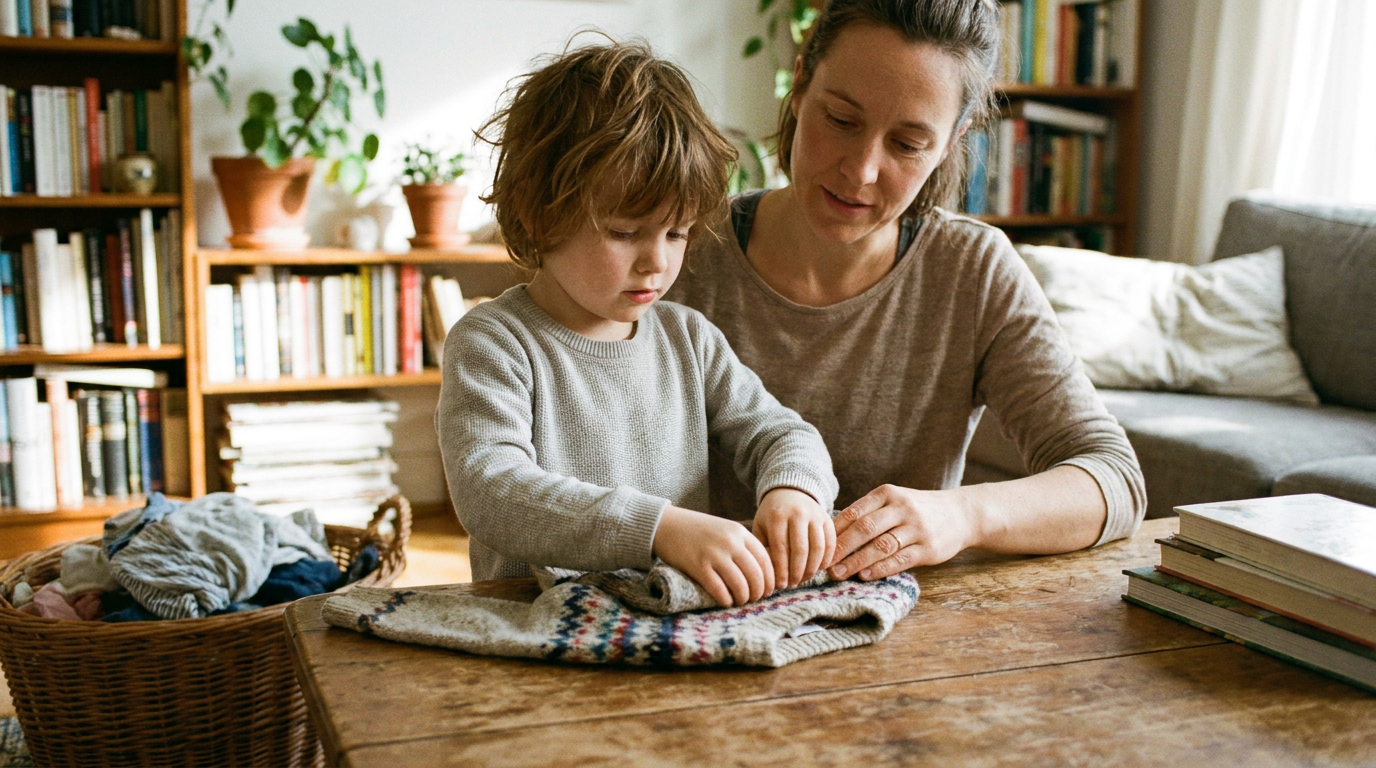
The letting-forward conversation is one of the most underrated opportunities in family life. Not we’re getting rid of this — but we’re passing it to another kid who’s going to love it the same way you did. Not a lesson about loss, but a story about generosity. About things continuing beyond our own chapter in them.
The “most-worn” conversation — sitting together and naming the pieces that mattered the most, and why — is a small act of family storytelling that costs nothing and holds everything. This was your every-Tuesday sweater. This was the one you wore on your first day. This is the one you chose yourself. Naming it together is its own kind of honoring. It doesn’t require physical retention. It requires presence and attention and a few minutes of shared memory.
Children who participate in the circular process learn things that are difficult to teach through abstraction: that value is not the same as permanence, that generosity is not the same as loss, that the things we care for can go on to matter to someone else without diminishing what they meant to us. As explored in the invisible labor post on managing your kids’ wardrobe, when this becomes a family act rather than a solo parental burden, the entire weight of the clothing cycle shifts. It becomes lighter. It becomes, even, joyful.
The Prelove You Way
“When your child can say ‘I want another kid to love this the way I did’ — that’s not just letting go. That’s the whole point.”
Return, for a moment, to the drawer.
It is still there. The onesie is still folded at the bottom. But something about seeing it is different now — not because you care less about what’s inside, but because you understand more fully what it needs. And what it needs is not indefinite storage. What it needs is a system worthy of its weight.
The drawer was never the problem. It was never about being unable to let go, or about sentimentality being a weakness, or about not knowing the right decluttering rules. The drawer stayed half-open because no system existed that felt genuinely equal to what was inside it. A system that understood that the first-birthday dress is not just clothing. That the most-worn sweater carries something irreplaceable. That the end-of-life piece, threadbare and stained, still deserves a path forward rather than a landfill.
Three things had to exist for this to become possible. An emotionally intelligent framework — the recognition that the thread continues when a piece moves to a new child, that the story is enriched rather than erased. A practical system that removes the friction — one that asks you to send everything, sorts and grades on your behalf, and honors even the pieces that can no longer be worn. And a way to follow what you loved into its next life — because continuity, when it is visible, transforms release into something that feels like an act of generosity rather than an act of loss.
Those three things exist. They exist in the same place, as part of the same household system.
The drawer can close. Not because you stopped caring about what was inside it. But because you found a way to care that doesn’t require permanent physical holding. The story doesn’t end in the drawer. It continues — into new mornings, new children, new ordinary days that will one day be the ones someone misses most.
That is the thread. And it is long enough to keep going.
Prelove You is the household system for families who want ease, intention, and beauty in how they manage what their children wear. Send everything — outgrown, worn, loved-to-threads. Receive credits. Shop for what comes next. Follow the pieces you loved into their next chapter.
A system that repeats, season after season, without guilt, without sorting, without the bag sitting in the trunk for another three weeks.
Not sure yet? See how it works or read our FAQs.
Already know the invisible labor this describes? Read the companion post →

